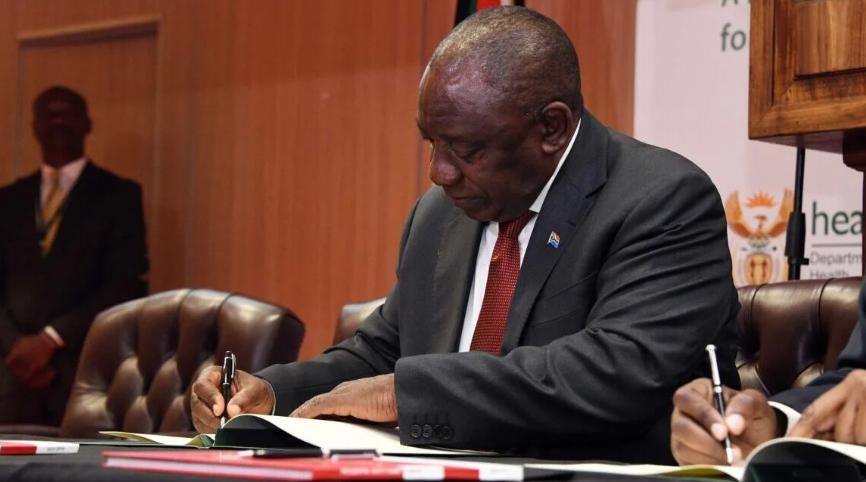
Africa-Press – South-Africa. President Cyril Ramaphosa has seven bills on his desk awaiting his signature, including critical legislation needed for the budget and changes to South Africa’s immigration laws.
While the president has put his name on many key laws in 2025, none are quite as controversial as the Expropriation Act, which he signed at the start of the year.
The Act has sparked significant upheaval among critics and opponents—both local and international—and has been the target of incessant attacks on South Africa from the Trump Administration throughout the year.
However, despite the Expropriation Act’s headline-grabbing contents, the president signed many other critical pieces of law.
These include the General Intelligence Laws Amendment Act, the Water Resources Infrastructure Agency Act, the Eskom Debt Relief Act, the Public Sector Pension & Related Payments Act and many others.
Now, as the end of the year approaches, there are at least seven more bills sitting on Ramaphosa’s desk waiting for his signature. These are:
Revenue Laws Amendment Bill
Division of Revenue Amendment Bill
Economic Regulation of Transport Amendment Bill
Immigration Amendment Bill
Public Administration Management Amendment Bill
Public Service Amendment Bill
Marine Oil Pollution (Preparedness, Response and Cooperation) Bill
Before a bill can become a law, it must be passed by both Houses of Parliament, namely the National Assembly and the National Council of Provinces, if it impacts the provinces.
Once introduced, a bill is referred to the relevant committee where it is debated in detail and, if necessary, amended. If there is much public interest in a bill, the committee may organise public hearings.
After it has been processed and passed by both houses, it is sent to the President to sign. Then it becomes an Act of Parliament – a law of the land.
Two of the seven bills awaiting this final step are primarily procedural, including the Division of Revenue Amendment Bill and the Revenue Laws Amendment Bill (RLAB), which are often tabled alongside the budget.
Specifically, the RLAB is used to clarify terms and address ambiguity in South Africa’s financial laws. The 2025 RLAB is doing so with a focus on the two-pot retirement system.
It was introduced with the second budget in March 2025, underwent parliamentary processes, and was approved by the National Council of Provinces in October.
While the bill does not make any significant or fundamental changes to the two-pot system, it includes important clarifications and alignments that enable the system to work efficiently and effectively.
The Division of Revenue Amendment Bill, meanwhile, is the crucial law that adjusts the national budget’s revenue sharing among national, provincial, and local governments.
It is triggered by changes in the Medium-Term Budget Policy Statement (MTBPS) and is tabled at the same time. The bill was introduced in November and approved by the NCOP at the end of the month.
The other five bills have specific aims and changes in mind:
Immigration Amendment Bill
Home Affairs Minister Leon Schreiber
The bill aims to amend South Africa’s Immigration Act to bring it in line with the Constitution by closing various loopholes and protecting the rights of immigrants not to be held unfairly.
The changes follow a Constitutional Court order in 2017, which found that certain sections of the Act were inconsistent with the Constitution.
Up until now, decisions about whether to detain or release undocumented immigrants were inconsistent, open to abuse, and often tied up in lengthy court battles.
The new law will establish clear rules, ensuring that immigration officers and magistrates make decisions based on the same standards, rather than on discretion.
The amendments also bring protections for children, who may no longer simply be processed as “illegal immigrants”.
Under the changes, child immigrants must be referred to child protection services, and detention will only ever be allowed as a very last resort under court supervision.
Public Service Amendment Bill and Public Administration Management Amendment Bill
DPSA minister, Mzamo Buthelezi
While two separate bills, the PSA and PAMA Bills were processed together and work towards similar aims. Specifically, they seek the professionalisation of the public service and to reduce political interference.
The bills seek to professionalise and modernise the public service in line with the National Development Plan (NDP), the Professionalisation Framework, and the Single Public Administration Initiative.
The core objective is to delineate powers between executive authorities and heads of Department (HODs), ensuring that strategic and political oversight remains with the former and operational and administrative accountability, including financial management responsibilities, rests with the latter.
One of the key amendments prohibits HODs and their direct subordinates from holding political office within political parties, thereby strengthening the principle of political neutrality within the public service.
The bills place a strong emphasis on ethical conduct and conflict-of-interest management.
To this end, they make significant changes to prohibit any employee who is a director of a company, whether public, private, or non-profit, from conducting business with the state.
They also broaden the definition of “public administration” to include public entities, among many other changes.
Economic Regulation of Transport Amendment Bill and Marine Oil Pollution (Preparedness, Response and Cooperation) Bill
The remaining two bills waiting for Ramaphosa’s signature are minor laws,
The Economic Regulation of Transport Amendment Bill primarily fixes a clerical error in the main Economic Regulation of Transport Act.
It simply corrects a typo where Schedule 1 of the Act incorrectly refers to itself as a 2020 Act instead of a 2024 Act.
The Marine Oil Pollution (Preparedness, Response, and Cooperation) Bill is an important law, but one that primarily deals with contingency.
The bill outlines the processes for regulating and managing preparedness and response to major marine oil pollution incidents at the national level.
It also ensures cooperation with other countries as necessary and appropriate, including the development of contingency plans, research, training and exercise programmes.
According to the government, South Africa is situated on a key sea-shipping route, and as such, is exposed to various risks associated with maritime traffic, including oil spills and other types of pollution.
The bill was tabled in 2022, lapsed, and was revived in 2024, ultimately reaching the president’s desk in early December.
For More News And Analysis About South-Africa Follow Africa-Press