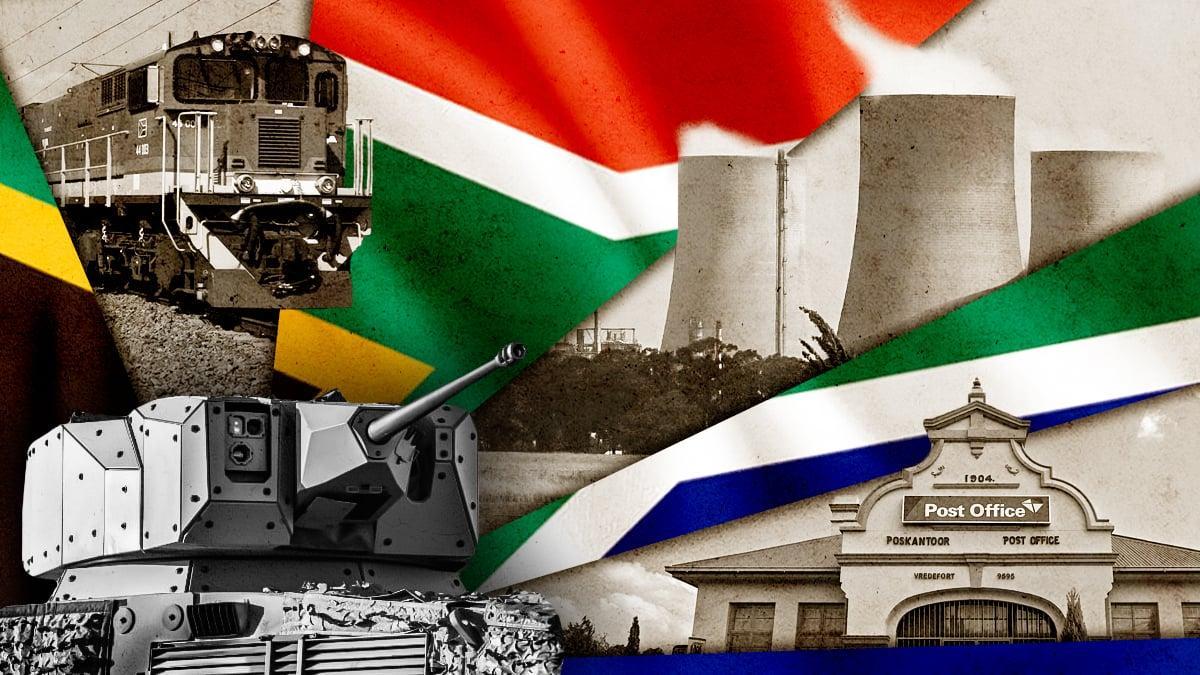
Africa-Press – South-Africa. The debt the South African government took on in order to bail out struggling state-owned enterprises (SOEs) is one of the main reasons for the country’s ailing financial health and, by extension, its poor credit rating.
These bailouts cost the country more than R330 billion between 2013 and 2023, with the government’s exposure to SOE guarantees now standing at around R500 billion.
Despite this government support, eight of South Africa’s SOEs remain uncertain about their ability to continue operating as going concerns.
Business Leadership South Africa (BLSA) recently released its Position Paper on South Africa’s Sovereign Credit Rating.
This paper analysed how the country’s credit rating fell to so-called “junk status” and what it is doing to rebuild credibility with rating agencies.
The Position Paper explained that, between 2012 and 2017, the government’s debt-to-GDP ratio saw a substantial increase, rising from 35% to 46%.
This coincided with the lead-up to South Africa’s downgrade to sub-investment grade, or “junk status”.
Since 2017, South Africa’s debt-to-GDP ratio has continued to climb, with it now expected to peak at 78.9% in the 2025/26 financial year.
BLSA explained that the key driver of South Africa’s escalating debt burden is persistent budget deficits.
The country has averaged a budget deficit of approximately 5% over the past decade, with every fiscal year ending in deficit.
“Additionally, the financial difficulties stemming from SOEs have exacerbated public finance deterioration, particularly through bailouts and contingent liabilities,” BLSA said.
The paper pointed out that, from 2013 to 2023, the cumulative value of SOE bailouts amounted to around R330 billion. The majority of this support went to Eskom, which received around R182 billion.
Notably, this R330 billion figure does not include the massive R254 billion debt relief package given to Eskom in 2023.
BLSA said the government’s current exposure in guarantees is estimated to exceed R500 billion.
Of this figure, Eskom accounts for more than R300 billion, Transnet for about R78.6 billion, and SANRAL for around R30 billion.
The table below shows the guarantee balance of SOEs with going-concern uncertainties in the 2024/25 financial year, according to the Auditor-General of South Africa (AGSA).
SOEs on the brink
In the AGSA’s Consolidated General Report on National and Provincial Audit Outcomes for 2024/25, it discussed the frail state of many of the country’s SOEs.
The AGSA explained that the audit outcomes of SOEs reflect poor-quality financial and performance reporting, as well as high levels of disregard for legislation.
Concerningly, the AGSA said eight SOEs reported serious financial health concerns relating to their ability to continue operating.
“For seven of them, this has been the situation for at least six consecutive years,” the AGSA said.
It explained that these uncertainties arise from persistent operating losses, liquidity constraints driven by delayed revenue recovery, and high fixed costs.
Another driver of this uncertainty is a reliance on government support that is not always formally committed at the time of financial statement approval.
Based on the audited 2024/25 financial statements of the National Revenue Fund, SOEs have been provided with financial guarantees of R453.48 billion over several years.
The AGSA pointed out that the SOEs with going-concern uncertainties received 84% of these guarantees, and their loans accounted for 96% of the exposure.
The eight SOEs with going-concern uncertainties are Broadband Infraco, Denel, Eskom, IDT, SAA, the SABC, the Post Office, and Transnet.
The AGSA said that, while progress has been made at some SOEs, the pace is slower than what the country and its already strained fiscus require.
“Defaulting on the conditions for guarantees, bailouts and turnaround plans continues to create pressure on government finances,” it warned.
“Without urgent reforms, improved governance, sustainable revenue models and the implementation of credible turnaround strategies, SOEs will continue to pose a major risk to the country’s fiscal health and economic recovery.”
BLSA also emphasised the need for SOEs to improve and implement reforms, as their poor performances are another factor holding South Africa back from credit rating upgrades.
Rating agency S&P Global specifically highlighted ongoing risks from SOEs and network industries as one of its key concerns for South Africa.
Similarly, rating agency Moody’s flagged South Africa’s ongoing exposure to SOE-related fiscal risks as a key concern, particularly where guarantees are included in government debt metrics.
The graphic below, courtesy of the AGSA, shows the audit outcomes for South Africa’s SOEs, with only two achieving a clean audit in the 2023/24 and 2024/25 fiscal years.
For More News And Analysis About South-Africa Follow Africa-Press