Africa-Press – South-Africa. South Africa’s oil refining capacity has plunged by around 50% since 2020, with over 260,000 barrels per day of potential throughput lost in the past five years.
This has left the country with only three operational refineries, run by Sasol and Astron Energy, to protect it from global oil shocks.
These facilities are under increasing pressure amid the conflict in the Middle East and are fulfilling a vital role, Sasol CEO Simon Baloyi said.
Baloyi told 702 that the facilities, despite broader challenges in the refinery sector, remain critical for South Africa’s energy security.
This is because they give the country relative freedom to diversify its fuel supply and sources, as it can refine unprocessed crude oil rather than refining only finished petroleum products.
The current energy shock has reminded countries around the world about the value of having their own energy sources and, particularly, their own refining capacity.
This gives the autonomy and resilience amid external shocks. Crucially, South Africa is not a net energy importer, thanks to its reliance on coal for electricity, but it remains a net oil importer.
Over the past two decades, many countries, including South Africa, came to the conclusion that it is more efficient to import refined petroleum products rather than unprocessed crude.
As a result, refining capacity has shifted to a few global hubs, many in Asia, which has created highly efficient supply chains. However, these supply chains have also proven vulnerable to external shocks.
Baloyi explained that this increases the value of local refining capacity, enabling the country to source crude oil from elsewhere and not rely on a handful of global refineries.
“We have to make sure the refineries we still have are operational, as those refineries give you diversity of supply and production,” Baloyi said.
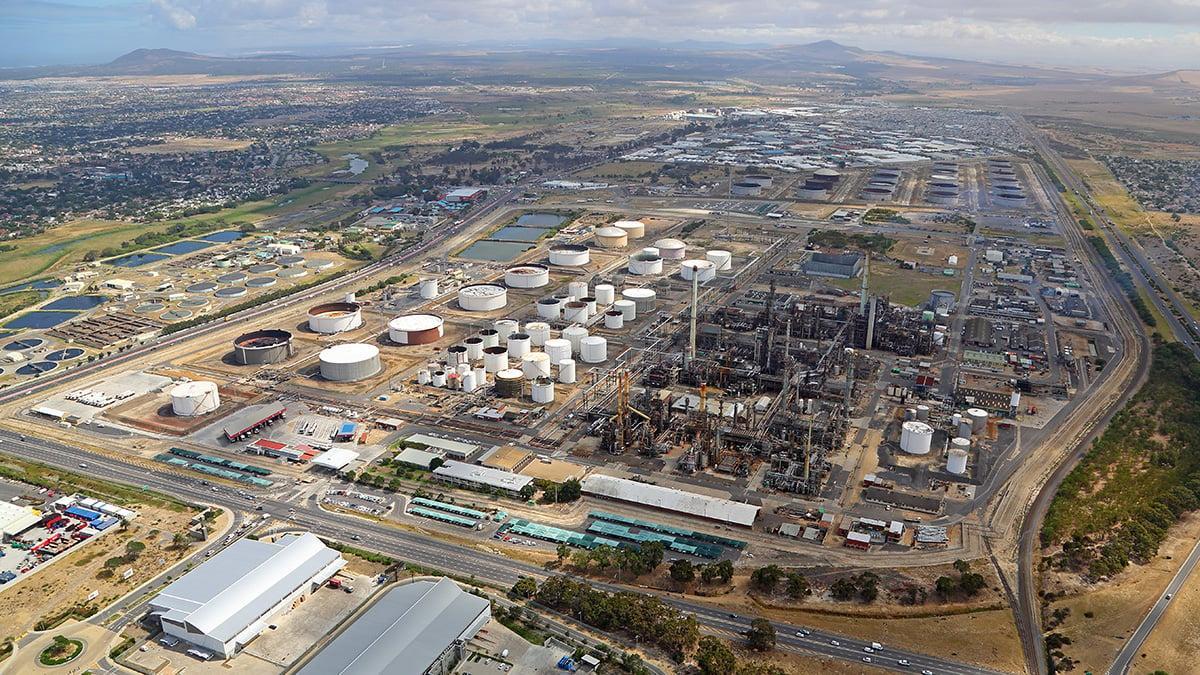
The Astron refinery in Cape Town has a capacity of 100,000 barrels of oil per day, with Sasol’s Natref having a similar capacity. Sasol’s Secunda refinery has a capacity of 150,000 barrels per day.
While these numbers sound impressive, South Africa has lost 260,000 barrels worth of capacity since 2020 as three facilities were shut down.
Sapref in Durban, the country’s largest refinery with a capacity of 180,000 barrels per day, has been shut since 2022. The Central Energy Fund bought Sapref from Shell and BP, with plans to restart operations in the near future.
The Engen refinery, also in Durban, has been permanently shut down since a fire in 2020, with 135,000 barrels of capacity offline. It is now a fuel storage and import terminal.
Apart from these two major facilities, the smaller PetroSA gas-to-liquids facility in Mossel Bay was mothballed amid a lack of feedstock.
As a result, South Africa’s refinery capacity has halved since 2020, and it now imports the majority of its finished fuel products, particularly diesel.
The collapse of a vital industry leaves South Africa vulnerable
Sasol’s Secunda CTL facility
South Africa used to produce the majority of its own refined petroleum products and a large share of its own oil.
This was done through the pioneering of synthetic fuel technology, where oil is produced from coal, of which South Africa has an abundant supply.
Sasol pioneered the commercial application of the Fischer-Tropsch process, invented in Germany, that uses chemical reactions to create synthetic oil.
The company’s facilities in Secunda and Sasolburg used to supply up to a third of South Africa’s total fuel needs and have produced well over two billion barrels worth of synthetic fuel over the past 60 years.
Sasol remains the only commercial operator of a coal-to-liquid plant in Secunda, which has two units capable of producing 150,000 barrels per day. Baloyi said this plant is special because it is South Africa’s only domestic source of fuel.
“The Secunda refinery is special in that it does not rely on crude oil. Secunda is the largest refinery remaining and essentially relies only on coal and gas, which we have ourselves,” Baloyi said.
“What is absolutely crucial is that this refinery not only produces fuel and diesel, but also produces ammonia and other chemicals that are vital for other industries in South Africa.”
Baloyi explained that for South Africa to become fully independent, you would need around two to three more ‘Sasols’ operating in the country.
“We can supply a significant chunk of liquid fuels, but we are still importing a lot to make up the balance. You would need substantial investment to hit the sweet spot between local production and imports,” Baloyi said.
South Africa would also have to explore for more of its own oil and gas reserves, for which there is evidence, but it has proven difficult to exploit these resources.
Econometrix chief economist Dr Azar Jammine explained that South Africa is highly vulnerable to external shocks because of the lack of its own production and refinery capacity.
“Unfortunately, one of the sad stories of our economic decline in the past 15 years has been the deindustrialisation of the South African economy,” Jammine said.
“One area that has played a big role has been the virtual disappearance of our synthetic fuel industry, which used to be substantial.”
For More News And Analysis About South-Africa Follow Africa-Press