Africa-Press – South-Sudan. A Chinese-funded water project in South Sudan’s Lakes State is improving rural livelihoods, public health and household incomes, according to beneficiaries and local officials, as communities gain access to reliable water supplies.
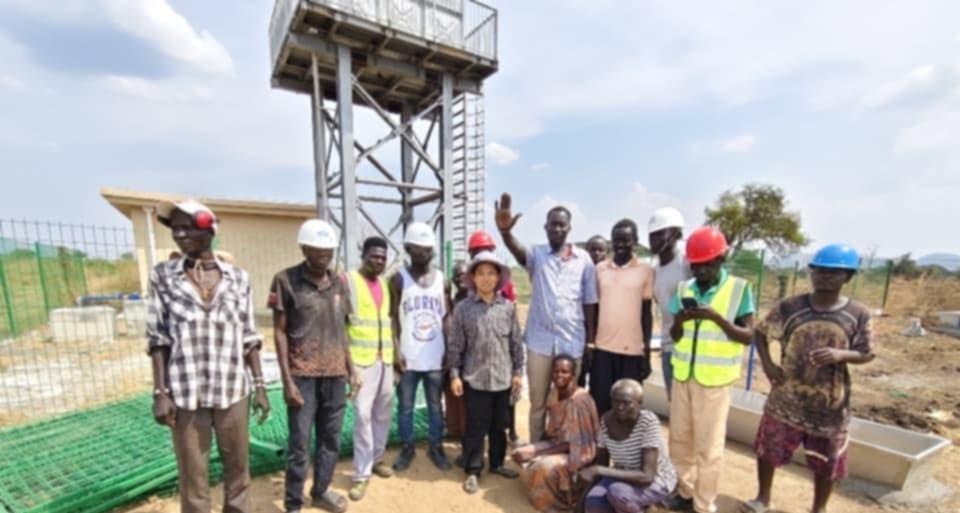
The project, allocated by the national Ministry of Water Resources and Irrigation in November 2024 under China’s aid programme, entered its main implementation phase between October 2025 and January 2026. It includes the construction of water yards, drilling of boreholes and installation of solar-powered tap systems across Yirol West, Yirol East, Awerial and Rumbek East counties.
While designed to expand access to safe drinking water, the initiative has also enabled small-scale farming, particularly among women, creating new sources of income.
Akur Luel Akucpiir, a 32-year-old mother of six in Nyangbut village in Yirol East County, told Radio Tamazuj that access to water had transformed daily life.
“A bundle of kadhora (Jute leaves) sells for 500 South Sudanese pounds (SSP) and sukuma wiki (kale) sells for 1,000 SSP,” she said. “In a day, a woman can earn between 30,000 and 50,000 SSP depending on the size of the harvest.”
She said the income allows women to buy basic goods such as food, soap and clothing, reducing dependence on other sources of support.
Before the project, women spent hours walking to rivers to fetch water and had little opportunity to grow crops, she added. Competition over scarce water sources sometimes led to disputes.
“Now there are no queues and no conflicts. Everyone can fetch water freely,” she said.
Local residents and officials said the project has also helped reduce water-borne diseases such as cholera, typhoid and diarrhoea, particularly in riverside communities like Pagarau and Adior payams in Yirol East County.
However, gaps remain. Some communities still rely on untreated river water.
“People in Pagarau Payam still drink directly from the river, and cholera is killing people,” Akucpiir said, urging expansion of the programme.
Maintenance challenges are also emerging, with communities reporting shortages of spare parts and equipment.
“The biggest problem is spare parts. Some boreholes break down repeatedly,” she said, adding that farmers also need tools such as jerrycans, watering cans and wheelbarrows.
Despite these constraints, the project has supported informal savings schemes among women. Jur Gak Deng said groups pool income from vegetable sales to invest in livestock or pay school fees.
“When it is my turn, I can buy a goat. Later we sell goats to buy bulls for ploughing or pay school fees,” she said.
Women fetch water at a communal water point in Lakes State (Photo: Radio Tamazuj)
Solar-powered systems can also be unreliable during cloudy weather, forcing residents to revert to hand pumps.
Abraham Chol, a water yard mechanic trained under the project, said households contribute monthly fees — typically 5,000 to 10,000 SSP — to fund repairs and maintenance.
“The Chinese trained us on sustainability. The fees help us buy spare parts and maintain the systems,” he said.
Local civil society representative Daniel Laat Kon said the project had improved both health and economic activity, but called for expansion to underserved areas.
“Clean water supports livelihoods and reduces disease. More investment is needed in other counties,” he said.
Project officials said dozens of facilities have been installed across the state, with a handover to government and communities expected soon.
Monica Abeny, director of water in Yirol East County, said nine water yards and three hand pumps had been installed in her area, significantly easing access.
“Women can now fill several jerrycans within minutes, and vegetable production has increased,” she said.
State officials said a total of 48 boreholes had been planned, though some failed during drilling and may need to be redone in a future phase.
“Communities are happy, but more facilities are needed, especially in areas affected by conflict where people still rely on unsafe water,” said Mager Anyuon, a senior official in the state ministry.
Paul Dut Majok, director of water and sanitation, said the project had laid a foundation for improved access but required further investment.
“Many areas still lack clean water. We hope support can be extended to reach more communities,” he said.
As the project nears completion, residents say its impact is already visible, with improved health, reduced conflict over water and new income opportunities emerging in rural areas.
For More News And Analysis About South-Sudan Follow Africa-Press