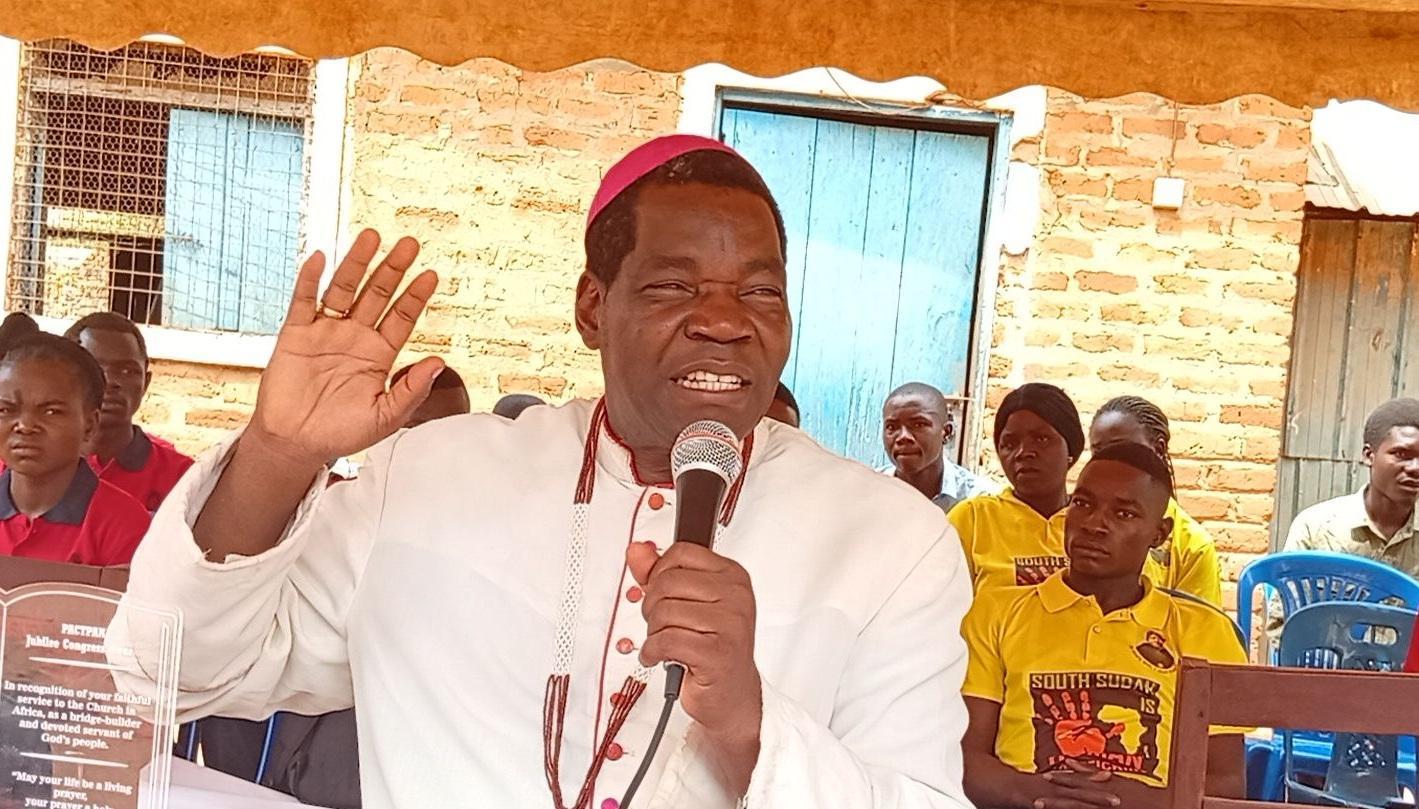
Africa-Press – South-Sudan. The Catholic Bishop of the Tombura-Yambio Diocese, Eduardo Hiiboro Kussala, has called on South Sudan’s national leaders to provide urgent support to Western Equatoria State, highlighting severe developmental shortfalls and persistent violence threatening civilian safety.
Speaking during a public rally in Yambio on Wednesday, Bishop Hiiboro stated he felt compelled to raise the alarm over continuous insecurity, armed clashes, and community-level conflicts that have plagued the state for several years.
Welcoming the state governor and his delegation, the bishop praised their local leadership but emphasized the necessity of close collaboration with national authorities to restore long-term stability.
“For too long, our people have faced insecurity, and basic services remain inaccessible. We need the light of leadership from Juba to guide our state out of darkness,” Bishop Hiiboro said.
“We call on our brothers and sisters in the national government to provide ideas, resources, and support so that our communities can live safely, and development reaches every corner of Western Equatoria,” he added.
The bishop outlined challenges that are both security-related and developmental. He noted that while direct threats to civilians disrupt daily operations, poor infrastructure and limited government support severely restrict families’ access to education, healthcare, and markets.
“In our communities, people cannot safely go to the fields to farm, children struggle to reach schools, and ordinary citizens face constant danger in carrying out basic daily activities,” he said, adding that it is heartbreaking to see lives lost unnecessarily as people simply try to secure food or water.
Recounting previous regional peacebuilding initiatives, Hiiboro noted that collaboration between local leaders and neighboring states had temporarily improved security and facilitated development.
However, he warned that without sustained national backing—including resources, guidance, and protection—those fragile gains are at risk of reversing.
Stressing the importance of partnerships among religious institutions, civil society, and the government, the bishop used a biological analogy to underscore his point. He compared community growth to photosynthesis, explaining that just as plants require sunlight, water, and fertile soil to grow, communities require security, resources, and leadership to thrive.
“This is not the work of one person alone. All of us — the church, the community, local and national leaders — must work together to make Western Equatoria flourish,” he said.
Addressing rising concerns over social tension and hate speech, Hiiboro urged political and community leaders to condemn violence, unify their constituents, and prioritize the safety of citizens. He called on the government to act decisively, pledging the church’s full support in return.
“Our prayer is that God guides our leaders to do what is right for the people of Western Equatoria,” he concluded. “We also pledge to work hand in hand with the government to ensure peace, security, and development become realities for every citizen.”
For More News And Analysis About South-Sudan Follow Africa-Press