Africa-Press – South-Sudan. After ten years since the last visit of Chinese leader Xi Jinping to Egypt, the Al Ain Al Sokhna area appears significantly different from what it was during his previous visit in 2016. At that time, the Chinese-Egyptian project in the region was still in its early expansion phase, while satellite images from 2018 to August 2026 reveal a clear expansion of industrial areas, alongside a major reshaping of the waterfront of Sokhna Port.
This transformation represents not just urban expansion or an increase in the number of factories, but reflects a gradual change in the nature of the role Egypt seeks to play in partnership with China. Al Ain Al Sokhna is transitioning from an industrial zone hosting Chinese companies to a part of a system that integrates manufacturing, logistics services, ports, and supply chains, positioning it to serve not only the Egyptian market but also markets in Africa, the Middle East, and Europe.
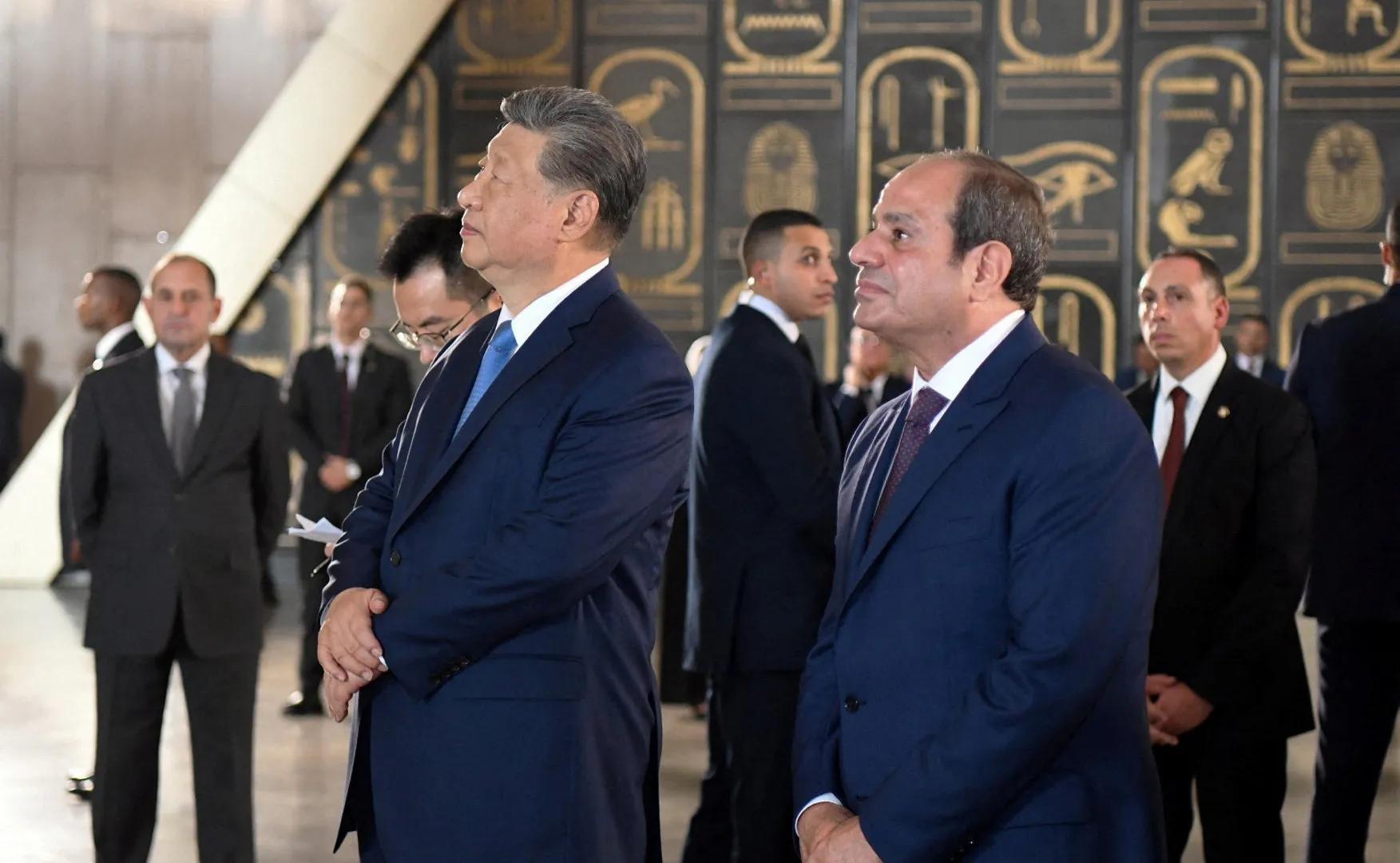
Xi arrived in Cairo on September 1, 2026, marking his first visit to Egypt in a decade, coinciding with the 70th anniversary of diplomatic relations between the two countries. Egypt was the first Arab and African country to establish diplomatic relations with the People’s Republic of China in 1956. The Egyptian presidency stated that the visit aims to enhance political, economic, and developmental relations and to follow up on the implementation of the comprehensive strategic partnership signed in 2014.
However, the significance of the visit goes beyond celebrating seven decades of relations. The choice of Al Ain Al Sokhna as one of the focal points in the accompanying political and economic discourse reflects the area’s importance in both Egyptian and Chinese calculations, especially amid the reshaping of global supply chains and increasing competition for ports, industrial zones, and trade routes.
From Industrial Zone to Production System
The organized Chinese industrial presence in Al Ain Al Sokhna began nearly two decades ago, with the establishment of “Teda Egypt for Investment” in 2008 to develop the Chinese-Egyptian economic and trade cooperation zone.
Initially, the area was limited in size, with the launch phase covering 1.34 square kilometers. In 2016, Egypt and China launched an additional expansion covering 6 square kilometers, increasing the total area to 7.34 square kilometers.
However, the expansion did not stop there. In July 2025, Egyptian and Chinese authorities signed an agreement to add 2.86 square kilometers, with Chinese investments of about $100 million allocated for developing the infrastructure of the new extension. By the end of 2025, the developed area exceeded 10 square kilometers, with nearly 200 companies operating within it, attracting actual investments exceeding $3.8 billion, according to published data from the Chinese side.
These figures reveal an important transformation: Teda is no longer just a space for individual factories but has become a platform for gathering multiple industrial activities.
The importance of industrial diversity is highlighted here. The area has attracted companies working in construction materials, oil equipment, and heavy machinery, alongside industries related to renewable energy, glass, and electrical components. This diversity allows for the formation of links between companies within the area itself, reducing the reliance of factories on importing all production components from abroad.
In other words, Al Ain Al Sokhna has begun to gradually transition from a “factory within an industrial zone” model to a more complex model that involves multiple parts of the production chain on the same site.
Solar Energy Reveals the Transformation
This change can be observed more clearly in the Chinese investments related to solar energy.
In November 2024, a subsidiary of China Glass Holding began the “CNG Egypt New Energy Glass” project in the Teda area with announced investments of $300 million. The project includes a production line for flat glass with a capacity of up to 1,000 tons per day, and another for glass used in photovoltaic cells with a capacity of 800 tons per day, covering an area of about 500,000 square meters.
In June 2025, the Chinese company “Sunrev” signed an agreement to establish a complex for producing solar energy components with investments of $200 million, on an area of 200,000 square meters. The first phase of the project aims to produce solar cells and modules, while the second phase targets localizing the production of essential materials such as silicon spikes and wafers used in cell manufacturing.
These investments hold significance beyond their financial value. Choosing Egypt for the production of solar energy components indicates an attempt to leverage its geographical location, trade agreements, and the network of ports associated with the Suez Canal to access other markets.
Here, one of the most important dimensions of the transformation in Al Ain Al Sokhna emerges: China is not only investing in producing goods for the local Egyptian market but can also use Egypt as a production and export base close to multiple markets.
The Port Completes the Picture
If the expansion of the industrial area represents the land aspect of the transformation, then the redevelopment of Sokhna Port represents its maritime aspect.
Satellite images comparing the period between 2018 and 2026 show significant changes along the coastline, with the emergence of docks, waterways, reclaimed lands, and new areas designated for logistics operations.
The Egyptian Ministry of Transport states that the port development project has increased its total area to about 29 square kilometers, including five docks and 18 kilometers of new berths with a depth of up to 18 meters, in addition to reclaiming about four million square meters and establishing trading yards, logistics areas, internal roads, and railway networks.
This infrastructure reveals an attempt to integrate the port with the industrial area, so that the process of transporting products from the factory to the ship is not separate from the production system but rather part of it.
This is a crucial element in competing for industrial investments. A factory located near a deep port connected to road and rail networks can theoretically reduce the time and cost of transporting raw materials and final products.
China is Not the Only Player
Despite the clear Chinese character of the industrial area, Sokhna Port itself does not represent a purely Chinese project.
DP World has been present at the port since 2008, managing operations related to containers, goods, and logistics services. The company had executed an expansion of the second dock with investments of about $520 million and announced in 2019 that the project would raise the capacity of its facilities in Sokhna to about 1.75 million standard containers annually.
This fact reveals a different nature of the project: Al Ain Al Sokhna is not an economic sphere of influence for a single country but rather a space where Chinese, Emirati, Egyptian, and international investments intersect.
This intersection may be one of its strengths, but at the same time, it makes the success of the area dependent on Egypt’s ability to coordinate the interests of different investors and link industrial areas with ports, transport networks, and markets.
Why Does China Care About Al Ain Al Sokhna?
For Beijing, the value of Al Ain Al Sokhna lies not only in the size of the Egyptian market. Its location at the southern entrance of the Suez Canal gives it significance in the trade system between Asia, Europe, and Africa.
The area also aligns with the logic of the “Belt and Road” initiative, which focuses on infrastructure, ports, and trade connectivity. Chinese authorities describe the Teda area as one of the most important platforms for Chinese economic and trade cooperation in Egypt and North Africa.
However, recent developments indicate that the potential function of the site is changing. The presence of factories for glass, solar cells, and other components means that Al Ain Al Sokhna could become a point in a production chain extending from raw materials and components to manufacturing and then exporting.
Here, Africa emerges as one of the potential markets. Egypt has a geographical location that connects the north of the continent with its east, while Sokhna Port and the Suez Canal provide direct maritime access to Asian and European markets. If the connection between the port, the industrial area, roads, and railways is completed, the area will be better qualified to serve as a center for re-export and distribution.
Cairo Seeks Investments Beyond Financing
From the Egyptian side, the equation appears more complex than merely attracting foreign capital.
The government seeks to increase local manufacturing, exports, technology transfer, and job creation, goals emphasized by Egyptian leader Abdel Fattah el-Sisi during discussions with Xi, where he highlighted the importance of localizing industry and technology transfer as priorities for cooperation between the two countries.
This means that the economic value of Chinese investment is not measured solely by the amount of money entering the country but by the extent to which factories are connected to local suppliers, the proportion of locally produced components, the volume of exports, technology transfer, and the ability of Egyptian companies to integrate into production chains.
This is a critical point, as the area may achieve significant investment growth without necessarily leading to a profound transformation in the local production base if the majority of inputs remain imported and the local added value remains limited.
A New Test for the Egyptian-Chinese Partnership
Xi’s visit comes at a time that differs from the previous one in 2016. Over the past decade, the Teda area has expanded, Sokhna Port has changed, and Chinese investments in manufacturing and energy have increased, while competition for global supply chains has intensified.
At the same time, Egypt seeks to diversify its economic partners and not rely on a single source of financing or investment. Meanwhile, China is looking for production and logistics sites that allow its companies to access foreign markets amid changes in global trade.
Thus, Al Ain Al Sokhna appears as a meeting point between two strategies: Egypt wants to transform its geographical location into greater economic value, while China aims to expand the presence of its companies outside its borders and connect new production sites with global trade networks.
The challenge for both parties will not only be to build more factories or berths but to transform this infrastructure into an integrated economic system capable of producing goods, exporting them, providing local added value, and linking Egypt to African markets.
While Xi Jinping had inaugurated a decade ago the expansion of an industrial area in a limited desert space, he returns today to a site where factories, ports, logistics areas, and supply chains intersect. This change may be the clearest indicator that Egyptian-Chinese relations have moved from the stage of building individual projects to an attempt to build a long-term economic platform, whose success will be linked as much to what happens inside the factories as to what occurs at the berths.