Africa-Press – South-Sudan. Information, Communication, and Technology experts in East African Counties have been urged to develop locally relevant content, applications, and services to make ICT meaningful in people’s lives.
In a statement sent to Eye Radio newsroom, the Tanzanian minister of ICT, Hon. Nape Moses Nnauye said that to make ICT relevant in socio-economic development programs in the region.
He added that the ICT experts should develop local content and applications for diverse sectors.
These sectors include education, healthcare, the environment, agriculture, and products that are useful to local communities.
“This could also mean locally relevant applications such as software or computerized systems that present end-user solutions,” said Nnauye.
In a speech read on his behalf by the Arusha Regional Commission, Mr. John Mongella singled out government information and services provided to citizens as a good example of local content that can be adapted for widespread distribution through the electronic environment as e-government services evolve.
“Locally relevant content can also be information about basic healthcare such as disease outbreaks, which can be effectively broadcast by using different technologies such as radio, television or mobile telephony, particularly in rural areas of developing countries where in most cases there are limited medical facilities,” said Hon. Nnauye.
“As individuals use ICTs for different communication purposes, ranging from communicating with family, business colleagues, or customers, this can be a significant aspect to further encourage new users of ICT,” added the Minister.
The Minister observed that irrespective of the relevance of the content, application, or service, its availability in local languages was critical if ICT is to be relevant and useful to the communities and groups targeted by ICT projects and/or policies.
Hon. Nnauye said that ICT policies highlight a nation’s ambitions in the use of ICTs as a tool for better livelihoods, peace, and security, good governance, and education as well as an economy with a competitive advantage in the global market.
“The potential of ICTs in economic development requires building an ‘enterprise ecosystem’ that offers ‘end-to-end solutions for the poor,” he added.
Speaking at the forum, the EAC Deputy Secretary General in charge of Planning and Infrastructure, Eng. Steven Mlote said that the EAC Secretariat was working with the Partner States to promote the establishment of communication infrastructure and services, as well as the standardization of technologies and services in the region.
“The EAC has worked closely with the Partner States in the development of National ICT policies, and efforts are ongoing towards the harmonization of ICT policies, laws, and regulations among the EAC Partner States. The region has also continued to promote ICT as a priority investment sector,” said Eng. Mlote.
Eng. Mlote disclosed that the EAC Vision 2050 had set a target to attain 95% penetration of Internet and mobile networks in the region, and 67% of individuals in East Africa using the Internet by the year 2050.
“To reach these targets, the EAC has set out to build and implement ICT development programs that are consistent with national, regional, and international aspirations and commitments,” said Eng. Mlote.
“The programs will seek to attain universal access to communication infrastructure and services; ensure availability of rich and diverse ICT content and applications; and build competence, confidence, and security in the information society,
“With such aspirations, we shall therefore work towards reducing the cost and increasing the robustness of cross-border communications; narrowing the divide digital; and expanding digital connectivity across our region,” added the Deputy Secretary General.
Eng. Mlote urged the participants at the forum to critically look into the Internet Governance issues relevant to the region.
He further asked the experts to put in place a coordinated approach to address issues concerning the Information Society and Knowledge Management in the region.
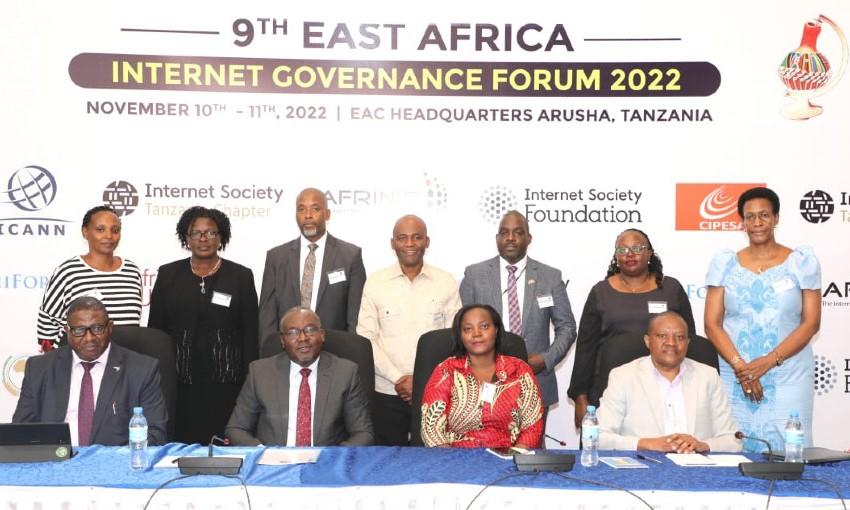
The 9th East Africa Internet Governance Forum was held between the 10th – 11th of November 2022 at the EAC Headquarters in Arusha, Tanzania.
Also present at the event were: Members of Parliament from Tanzania and Uganda; Uganda’s High Commissioner to Tanzania, Amb. Anne Katusiime; Mr. Pierre Dandjinou, the Vice President, Global Stakeholder Engagement – Africa, ICANN; Ms. Anja Gengo, NRI Initiative Coordinator, UN Internet Governance Forum; Mr. Adil Suleiman, Senior Policy Officer, Infrastructure and Energy Department, African Union, Dr. Ally Simba, Executive Secretary, East Africa Communications Organization, and heads of private sector organizations.
For More News And Analysis About South-Sudan Follow Africa-Press