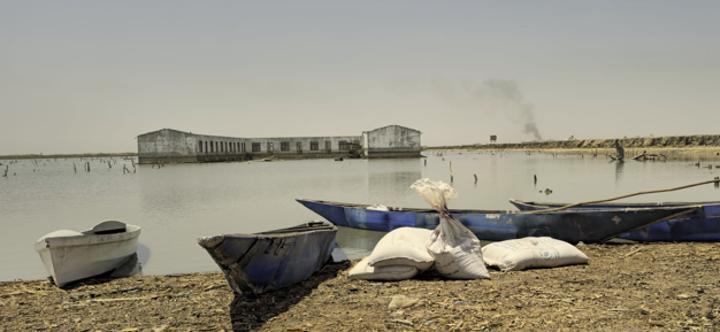
Africa-Press – South-Sudan. Standing on land that was underwater just a few years ago, humanitarian officials, diplomats, and local leaders delivered a consistent message this week: peace is holding in South Sudan’s Unity State, but sustaining it will depend on climate resilience, livelihoods, and continued international support.
The assessment came during a high-level visit by International Organization for Migration (IOM) Deputy Director General for Operations Ugochi Daniels, who toured flood-affected communities in Bentiu and met residents displaced by years of conflict and recurring floods.
“This visit is an opportunity to demonstrate that we are fully committed to peace and recovery here in Unity State,” Daniels said. “It is also a demonstration of our support to the state leadership and the investments that have been made, particularly in providing land for durable solutions.”
The delegation included ambassadors from France and the Netherlands, representatives from the Norwegian embassy, and officials from other UN agencies, underscoring growing concern over how shrinking humanitarian budgets could affect fragile gains.
From emergency response to resilience
Daniels said her return to Bentiu — her second visit since 2022 — showed tangible progress despite severe constraints.
“I am very pleased to see the difference since 2022,” she said. “But there are still acute life-saving needs, and at the same time, people are telling us clearly: they do not want to sit and wait for assistance. They want to rebuild their lives.”
IOM and its partners have increasingly shifted from emergency response towards land reclamation, flood-mitigation dikes, and livelihood support, using nature-based solutions to reduce fuel dependence and long-term costs.
“Where we are standing today was completely flooded some years ago,” Daniels said.
Funding pressure and hard trade-offs
The visit comes as humanitarian funding continues to decline globally, forcing aid agencies to scale back or adapt programmes.
“Even before the current crisis, funding for humanitarian response was going down,” Daniels said. “We have reduced staffing and adapted quickly, but reducing dependency on aid and supporting self-reliance is more important than ever.”
She confirmed that some services have already been affected, including a pause in onward transportation assistance for new arrivals in Renk, one of South Sudan’s main entry points for people fleeing the war in Sudan.
“The needs are great,” she said. “There will never be enough funding to meet them all. That’s why sustainability is not optional.”
Water as risk, and resource
French Ambassador Philippe Michel Kleibauer said Unity State’s greatest challenge — excess water — could also become its greatest long-term asset if properly managed.
“The main problem you are facing is water, too much water,” he said. “But for much of the world over the next decade, the problem will be the opposite: a lack of water. In that sense, water is the greatest wealth you can have.”
Drawing a comparison with water-scarce regions, Kleibauer said that in countries such as Botswana, rain is referred to as pula, a word that also means money and is used as a greeting to convey good wishes.
“Here, the challenge is to learn how to manage this water — to contain it, protect it and preserve it,” he said. “If you succeed in living with this water, you will be managing a resource that much of the rest of the world will be missing.”
He acknowledged the immediate hardship caused by flooding, including the loss of livestock and livelihoods, but said this was why international partners remained engaged.
“We know it is very difficult now,” Kleibauer said. “That is why we are here — to help you manage this water and protect it for future generations. Water is life. If it is clean, children are healthier, people can farm and fish, and communities can rebuild.”
‘Peace and quiet have been restored’
Unity State Governor Justice Riek Bim Top Long said maintaining stability has been his administration’s overriding priority.
“Peace and quiet have been restored,” he said. “Despite all the years of conflict and recurring flooding, Unity State is experiencing relative calm.”
He credited close coordination with humanitarian partners for helping the state transition from crisis response towards recovery and climate resilience.
“IOM has worked hard in moving from emergency response to recovery and climate resilience,” the governor said, describing the organisation’s role in aligning humanitarian, recovery, and development efforts with the state government under a unified framework.
Bim said land reclamation and flood mitigation remain central to the state’s strategy, particularly in Bentiu town and surrounding areas where displaced populations are concentrated.
“Scaling up land reclamation and flood mitigation is a strategic priority,” he said, thanking international partners for early investment and technical support.
Governance, services, and durable solutions
Beyond climate impacts, the governor pointed to long-standing governance gaps worsened by years of conflict, including the absence of a functioning judiciary for more than a decade.
“When I was appointed, I brought the judiciary with me,” he said. “Accountability matters. It helps stop cycles of revenge and builds trust.”
He said the state has expanded schools, health facilities, and key supply roads linking Bentiu to Juba, while promoting farming, livestock production, and vocational training.
“These efforts are part of advancing durable solutions,” Bim said, adding that an inter-ministerial council now provides legal and political oversight to ensure displacement solutions remain a governance priority.
Communities call for peace and opportunity
For residents, peace remains inseparable from survival.
“We have been supported, and if peace continues, we will be able to do things we could not do during the war,” said Tuach Thak Banguot, whose cattle and crops were destroyed by floods. “Our land was our livelihood, and it is gone.”
Youth leaders echoed those concerns, warning that flooding has wiped out income while exposing communities to disease and danger.
“What we need as young people is peace,” said Tater Jal Both. “This water has destroyed our livelihoods.”
They called for vocational training, sports facilities to promote social cohesion, improved health services, and practical tools to adapt if floodwaters persist.
A fragile window
Daniels said the message she heard most consistently during the visit was exhaustion with conflict.
“People are tired of war,” she said. “They told me the person next door, regardless of where they come from, is their neighbour. They do not want ethnic tension.”
But she warned that without sustained investment — particularly in climate adaptation, land reclamation and livelihoods — the progress remains fragile.
“We are with the people. We are with the government,” Daniels said. “But with reduced funding, efficiency, partnership, and long-term thinking are essential if these gains are to last.”
For donors weighing priorities amid multiple global crises, Unity State offers both a warning and an opportunity: early investment has helped stabilise a once-volatile region, but the cost of disengagement could be far higher.
For residents, the priority remains simple after years of conflict and displacement.
“We don’t need conflict anymore,” said Tuach Thak Banguot. “We want peace so we can go back to our land and live.”
Source: Radio Tamazuj
For More News And Analysis About South-Sudan Follow Africa-Press