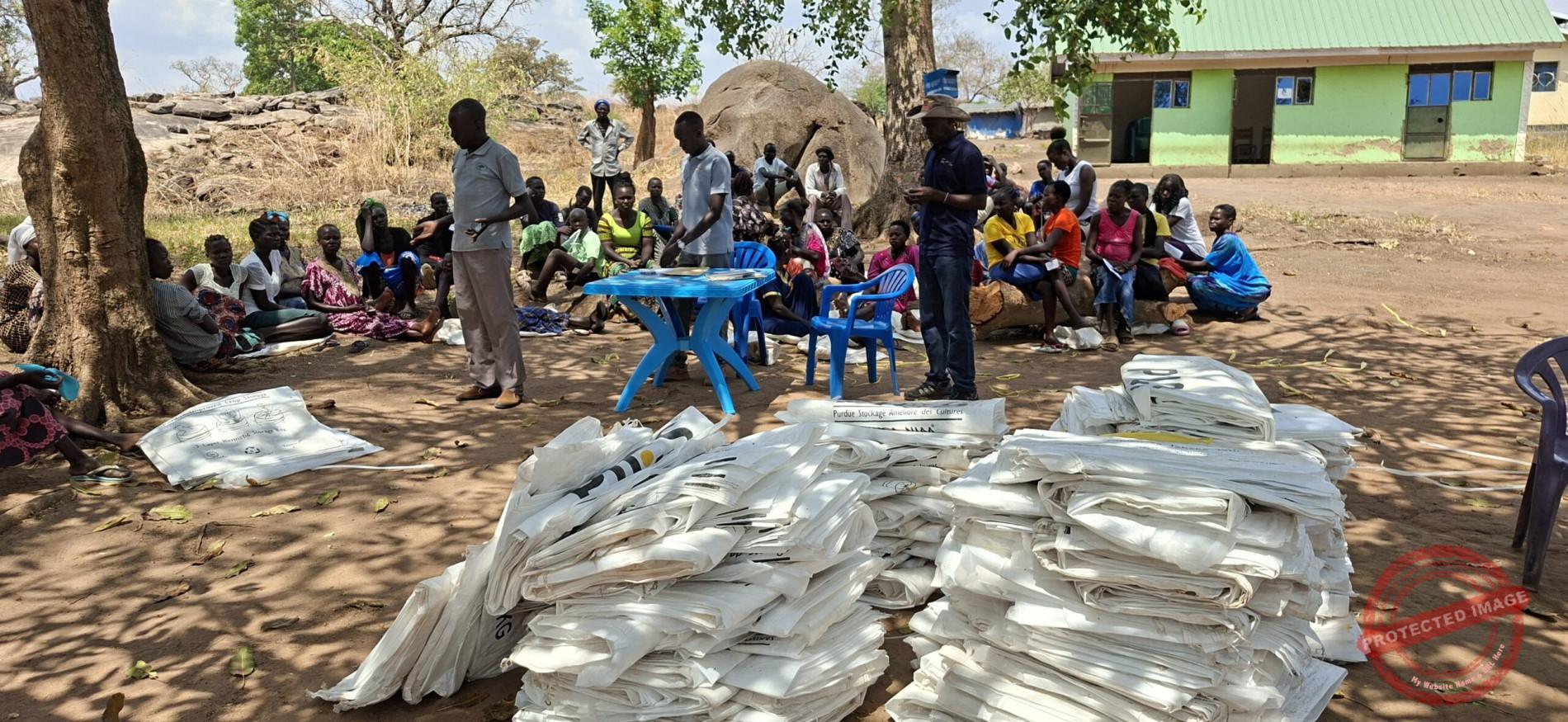
Africa-Press – South-Sudan. Farmers in Yei and Magwi counties expect a reduction in wastage following the distribution of 21,000 hermetic bags by Germany Development Agency or GIZ. The initiative, through the Community-Driven Rural Development or CDRD and Improved Living Conditions and Psychosocial Support or ILiPS projects, reached 2,500 farmers, cooperatives, and dealers.
With a storage capacity of 2,100 metric tons, the distribution aims to support food security and household incomes. Farmers in South Sudan face losses due to infrastructure, storage facilities, and pests.
Crops including maize, beans, sorghum, cowpeas, and soybeans are vulnerable to weevils. These losses lead farmers to sell produce after harvest at prices lower than those offered during periods of demand. The bags provide a solution. Each 100kg bag has a three-layer design that protects grains from pests and mold without chemicals.
Advisors for Community-Driven Rural Development or CDRD and Improved Living Conditions and Psychosocial Support, or ILiPS, noted the distribution occurred during the harvest between December 2025 and February 2026.
Farmers stated the timing allows them to store yields and wait for market valuations. Equipment distribution is paired with training to maintain quality and bridge the gap between harvest and the next season.
The Improved Living Conditions and Psychosocial Support, or ILiPS project, is implemented by GIZ for the German Federal Ministry for Economic Cooperation and Development (BMZ). It supports returnees, displaced persons, and communities with tools, seeds, and training.
The Community-Driven Rural Development or CDRD project is also implemented by GIZ for the BMZ, with funding from the European Union and the Netherlands.
This collaboration falls under the Global Gateway and Team Europe initiatives to support development in governance and systems. Germany continues to support development in South Sudan, focusing on governance, water supply, and equality.
For More News And Analysis About South-Sudan Follow Africa-Press