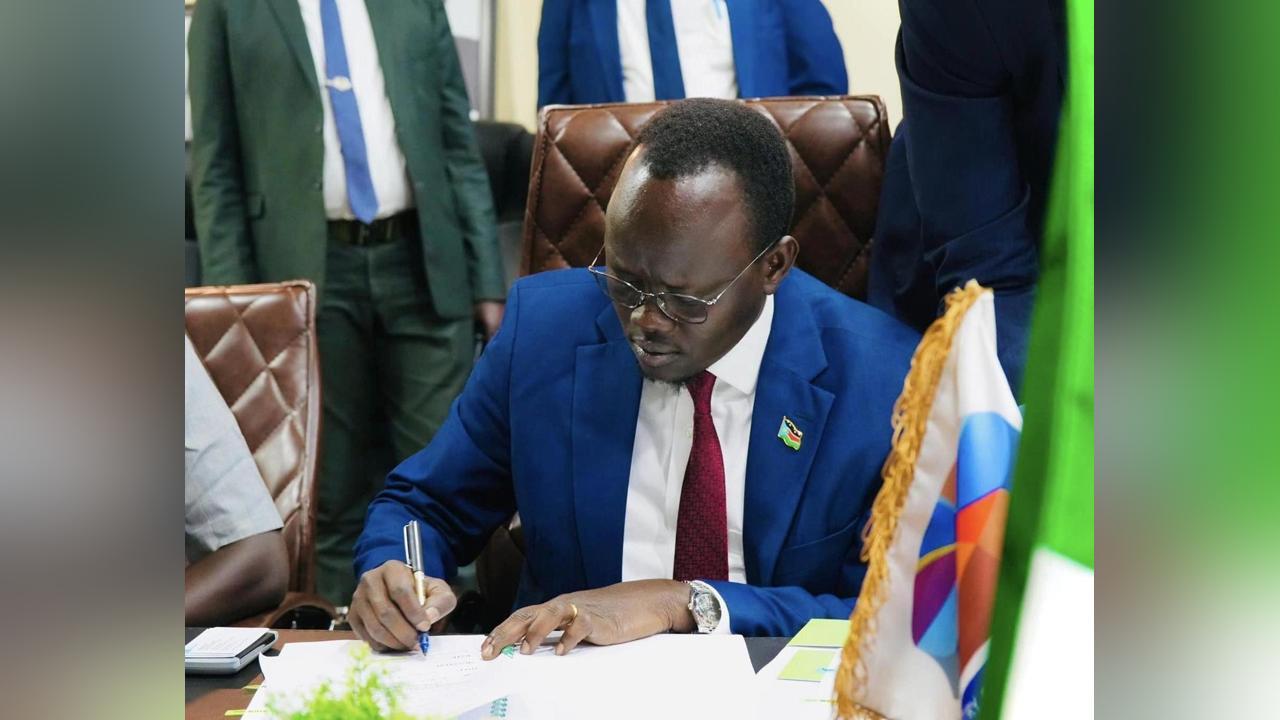
Africa-Press – South-Sudan. The Government of South Sudan has formally adopted a new economic stabilization and structural reforms policy framework aimed at addressing fiscal pressures, inflation, and currency instability, as the country grapples with deep-seated economic challenges, according to the Minister of Finance and Planning
Speaking at a press conference on Wednesday, the Minister of Finance and Planning, Dr Bak Barnaba Chol said, the policy was endorsed by the Council of Ministers and will now guide government action toward restoring economic stability and promoting sustainable growth.
“This is a Cabinet-owned policy,” the Minister said. “It reflects collective deliberations within the Economic Cluster and inputs from key institutions, including the Bank of South Sudan, the South Sudan Revenue Authority, sector ministries, and other relevant authorities.”
The Cabinet’s decision follows an assessment of the current economic situation, which found that despite signs of resilience, the economy remains under strain due to fiscal deficits, inflationary pressures, currency volatility, and heavy dependence on oil revenues.
“The economy continues to face fiscal pressures, inflationary tendencies, currency instability, and structural imbalances driven largely by over-reliance on oil revenues and limited domestic production,” the Minister said.
At the center of the reform package is a tightening of public spending, with government committing to strict fiscal discipline and improved budget credibility.
According to the Minister, Cabinet approved targeted fiscal adjustments designed to protect social and political stability while restoring confidence in public finances.
“Government will enforce absolute prioritization of salaries payment and essential government operations, including security, peace implementation, and elections,” he said.
Non-essential spending will be curtailed, with payments for certain claims, contracts, and expenditures to be limited. The Minister also announced a temporary freeze on recruitment across government institutions, except for critical and clearly justified needs.
To boost revenues, the government plans a series of reforms targeting both oil and non-oil income streams. These include oil sector reforms, the introduction of Value Added Tax (VAT), expansion of non-oil revenue sources, and the cancellation of non-statutory tax exemptions.
The government will also review existing Economic Partnership Support Agreements (EPSA) and Status of Forces Agreements (SOFA) arrangements, which have affected revenue collection.
On monetary policy, the Minister said the government will work closely with the Bank of South Sudan to improve coordination between fiscal and monetary policy.
“Together with the Bank of South Sudan, we shall work on alignment between fiscal and monetary policy,” he said, adding that reforms will focus on liquidity management, foreign exchange administration, implementation of the Treasury Single Account, and broader financial sector reforms.
The policy also places strong emphasis on economic diversification and boosting domestic production through public-private partnerships and support to small and medium-sized enterprises.
Priority sectors include agriculture, livestock, fisheries, wildlife, tourism, agro-processing, mining, and extractive industries. Trade facilitation and export promotion will focus on high-potential commodities such as sesame and gum arabic.
The Minister said implementation of the reforms will be overseen through inter-ministerial coordination under the Economic Cluster, with regular reporting to the Council of Ministers.
“The Economic Stabilization and Structural Reforms Policy represents a deliberate programme of adjustment, enhancement, and rationalization,” he said. “It is designed to stabilize the economy, protect livelihoods, and lay the foundation for sustainable and inclusive growth.”
He added that the government is committed not only to policy formulation, but also to disciplined implementation, transparency, and accountability.
For More News And Analysis About South-Sudan Follow Africa-Press