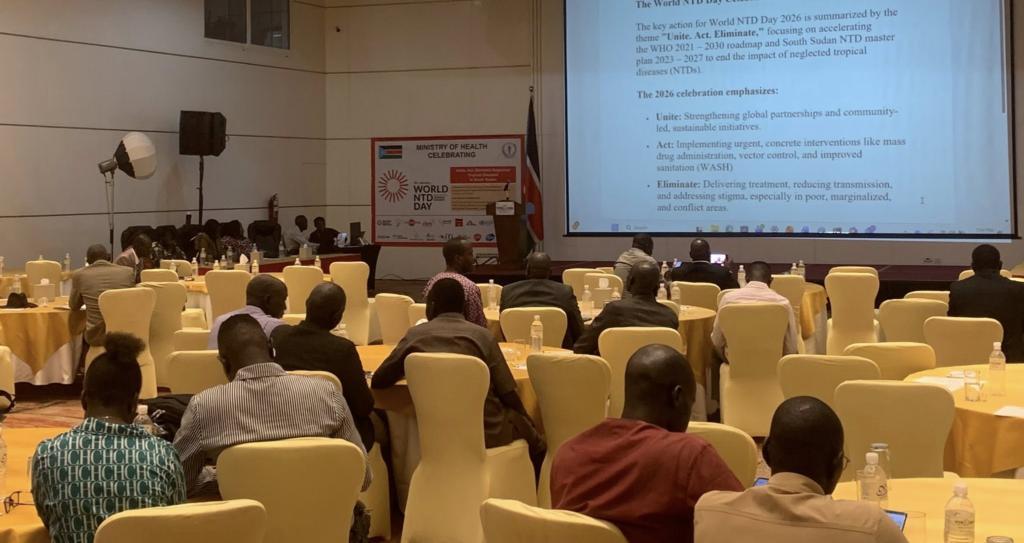
Africa-Press – South-Sudan. South Sudan marked World Neglected Tropical Diseases (NTD) Day on Friday with a bold call to end foreign dependency by integrating NTD programs directly into the national primary healthcare system.
Under the global theme “Unite, Act, and Eliminate,” health officials revealed a sobering reality: South Sudan currently hosts 19 of the 20 WHO-listed NTDs. While the Ministry of Health reaffirmed its commitment to the 2030 elimination roadmap, the day belonged to survivors who demanded “dignity over speeches,” specifically calling for a dedicated National Leprosy Day and specialized gear like protective shoes to manage their conditions.
The Burden of 19
South Sudan remains a primary battleground for NTDs. According to the National Ministry of Health, the country is burdened by 19 out of the 20 NTDs recognized by the World Health Organization (WHO). From the disfiguring effects of Elephantiasis (Lymphatic Filariasis) to the “river blindness” of Onchocerciasis, these “silent killers” haunt three-quarters of the country, often flourishing in areas with limited access to clean water.
“This is a day for the world to tell stories of success and failure,” said Hon. Dr Samuel Yata, the Head of the Elimination Committee. “We are moving from just treating symptoms to assessing transmission. We are protecting millions from disfigurement, but the lack of domestic funds and the challenges of our climate remain systemic hurdles.”
Voices of Resilience: “It is Not a Curse”
The most moving moments of the celebration came not from the podium, but from the front-row seats occupied by survivors. Joseph Wani, a leprosy survivor, stood tall to dismantle the ancient stigma surrounding the disease.
“Leprosy is not a curse,” Wani told the hushed room. “It is caused by a bacilli that is curable with modern treatment. But we need detection in the villages. We need protective shoes and blankets because when you have leprosy, you lose feeling. You can be burning in a fire and not know it.”
His colleague, John Laku Casmiro, shared a double burden. Having survived leprosy through early treatment, he recently lost sight in one eye to Trachoma. “I look like any other man because I got treated early,” Casmero said. “But now I fight Trachoma. We need the government to put resources into it so the next generation doesn’t have to fight two diseases at once.”
A Mother’s Heart and a Ministry’s Promise
The atmosphere shifted from formal policy to a deeply personal exchange when Madam Yar Manyuon of the Ministry of Health addressed the survivors directly.
Speaking for affected families, leprosy survivor Mama Anthony Poni described the agonizing choice between basic survival and education. “Schools in South Sudan have become like markets where everyone sets their own prices,” she observed, noting that for the elderly and those disabled by leprosy, these fees are out of reach.
She then delivered a direct challenge to the government and international partners: “Do not just give us food; help us educate our children so they don’t end up on the streets.”
Moved by the plea of a mother who asked for nothing for herself, Madam Manyuon made an immediate, personal pledge. “I have heard the voice of a mother,” Manyuon said. “In the spirit of solidarity, I will personally sponsor one of your children. May that child be a symbol of your resilience.”
Beyond this individual gesture, Manyuon committed to elevating World Leprosy Day to a national priority, ensuring the day—celebrated on the last Sunday of January—is observed with the dignity and visibility it deserves.
The Road to 2030
The Carter Center, represented by Nicholas Presley, reaffirmed its long-standing partnership with South Sudan, citing the “massive decline” in Guinea worm cases over the last two decades as proof that victory is possible.
However, the “last mile” remains the hardest. Albert Elzayemoni, from the Ministry of Water Resources, reminded the audience that health and water are inseparable. Without a clean rural water supply and hygiene, the cycle of reinfection will continue.
As the Budwe Cultural Group took to the floor to close the ceremony with dance, the words of Achol Ayom, Deputy Director of the HIA/AID Commission, lingered: “Disease is a disease—whether it is malaria or leprosy. You are not a curse. South Sudan will be free one day, but only if we extend our hands to our neighbors today.”
For More News And Analysis About South-Sudan Follow Africa-Press