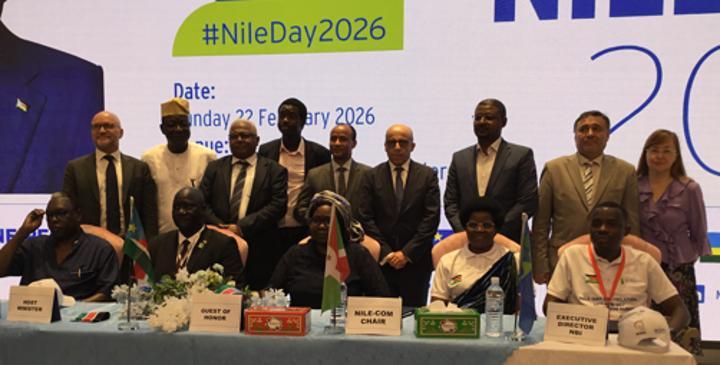
Africa-Press – South-Sudan. South Sudan Cabinet Affairs Minister Dr. Martin Elia Lomuro on Sunday called on the Nile Council of Ministers to think morally and humanely when collectively dealing with issues of the Nile waters and be mindful of the needs of communities in other countries.
Dr. Lomuro, who was addressing the ministers during the 20th Anniversary of Nile Day in Juba on Sunday, stressed that the use of the Nile waters should not be politicized.
“…You put it in writing and in a policy statement, but I would like to put it in cognizance. Just imagine the women, the youth, and the community in Egypt, and imagine the needs of the youth, the women, and the community in Burundi. Are they any different? They are not different,” he stated. “Therefore, any minister of water resources has the same responsibility across the continent. It means you have to imagine if you are sabotaging or prohibiting the development of water resources in any of the countries, you are directly impacting negatively on the youth, the women, and the communities on the line. These communities are different ethnically, but their need for water is the same.”
“Therefore, I encourage you as ministers responsible for water not to think politically, but to think morally and humanely, so that you can, in your cooperation, in your dialogue, be flexible, realizing that you are also responsible for the needs of other communities in other countries,” Dr. Lomuro added.
He stressed that the ministers must be driven by morality, rather than politics. He urged support for the development of water resources and electricity production in South Sudan.
“…if we move together as members of the Nile vision, it will help us to participate more now, since we have not been participating before independence,” he said. “With these few remarks, I want to conclude that the celebration is not just ceremonial, but should be transformational, and the voices of community, youth, and women should guide us towards a new era of further governance.”
For his part, Egypt’s Minister of Water Resources and Irrigation, Dr. Hani Sewilam, cautioned against “hasty, undisciplined institutional steps” regarding Nile water governance.
He emphasized that a comprehensive consensus is the only viable path for the region and urged an inclusive dialogue that accounts for the concerns of all Nile Basin states, particularly regarding the Cooperative Framework Agreement (CFA).
“Egypt remains committed to a collective future but rejects any framework that ignores the concerns of the basin’s majority,” Dr. Sewilam stated. “Egypt believes that the active participation of all segments of society, especially women and youth, is essential to building a society that values every drop of water and is committed to protecting it. Women play a pivotal role in managing domestic water use and supporting rural livelihoods, including agriculture. However, their representation in water-related decision-making remains below their actual contribution.”
“Empowering women in water management is not just a matter of justice; it is essential for achieving more effective and sustainable outcomes. Young people represent a large proportion of the Nile Basin population,” he added.
Meanwhile, South Sudan Foreign Minister Monday Semaya Kumba said the country respects all member states and is committed to the Nile Basin Initiative cooperation agreement.
“We are committed to the principles of equitable sharing of the Nile resources. Above all, we are dedicated to the mutual values related to Nile Basin matters and to the sustainability of its resources,” he said.
South Sudan Minister of Water Resources and Irrigation James Mawich Makuach said it was a great achievement to host the Nile Day celebrations aimed at promoting regional solidarity and peace.
“It is the fruit of our country’s commitment to regional and international engagement in water diplomacy, and this is a shared responsibility that falls on all of us,” he stated. “The aim of celebrating Nile Day is to provide a platform for South Sudan, a member of the Nile Basin Initiative, to highlight the vital role of cooperation and financing in ensuring the sustainable management and development of shared water resources.”
On his part, Elharith Mustafa Abdurrahman, chairman of the water resources technical organ in Sudan, said that the event celebrates collective commitment to dialogue, cooperation, and mutual equity in managing and utilizing the Nile’s water resources.
“This spirit of cooperation is more relevant than ever, especially given the increasing demands for water, energy, and food, alongside the growing challenges posed by climate change across the basin. This year’s theme, ‘Voices of the Nile: Community, Youth, and Women Engaging in Sustainable and Resilient Governance,’ resonates deeply with Sudan,” he said. “We firmly believe that sustainable and resilient governance is built on a foundation of inclusivity. By empowering our communities, youth, and women, we ensure that the benefits of our cooperation are tangible, equitable, and owned by those who depend on the Nile. Their voices are essential for building trust and shaping a future that works for everyone.”
Habtamu Itefa Geleta, the Ethiopian Water Resources and Irrigation, said that gathering celebrated gains for a sustainable future and memorialized over two decades of structured regional cooperation under the Nile Basin Initiative.
“This year’s theme, ‘Voices of the Nile: Community, Youth, and Women Engaging in Water Governance,’ is both timely and transformative,” he said. “It reflects a growing recognition that the governance of shared water resources cannot rely solely on government and technical excellence; it must be inclusive and participatory, amplifying the voices of those who depend on water every single day.”
He added that the Nile is a lifeline for over 250 million people across the basin, sustaining agriculture, generating energy, supporting ecosystems, and anchoring the livelihoods of rural communities.
For More News And Analysis About South-Sudan Follow Africa-Press