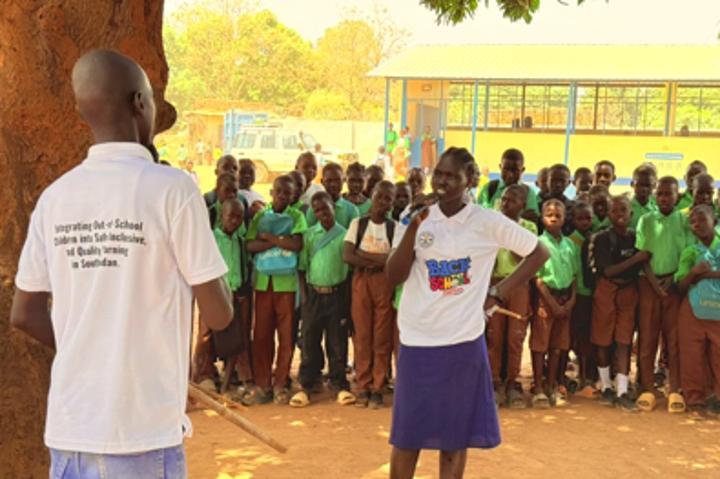
Africa-Press – South-Sudan. Under the shade of trees at Loko Loko Primary School in the Western Bahr el Ghazal State capital, Wau, children gathered to watch a short drama carrying a vital message: violence has no place in the classroom.
In the skit, a troubled teacher arrives at school burdened by frustrations from home and lashes out at pupils. The lesson for the audience is clear — children should be guided, not beaten. The performance was not staged by professional actors, but by UNICEF-trained student reporters campaigning for education and child rights in South Sudan, where millions of children remain out of school because of poverty, conflict, displacement, and weak infrastructure.
According to UNICEF, around 2.8 million children in South Sudan are out of school, one of the highest rates in the world. Years of conflict, economic hardship, climate shocks, and shortages of trained teachers have all disrupted learning across the country.
“We were giving information to the teachers that whenever there are problems in their houses, they should keep it there,” said Dual Madut Madut, a young UNICEF reporter based in Wau. “They should know their homes are different from their schools and treat pupils the way they are supposed to be treated.”
The campaign forms part of a wider Back to Learning initiative aimed at helping children return to classrooms and addressing the reasons many leave.
At Loko Loko Primary School, the hunger for education was unmistakable. Children in mixed uniforms, some barefoot, crowded into the compound at the start of the new academic year.
Yet visiting officials and aid partners said the greater challenge was no longer persuading children to come to school, but ensuring schools had the capacity to receive them.
Strained classrooms, unpaid teachers
David Ashley, the British Ambassador to South Sudan, said schools faced mounting pressures, including overcrowded classrooms, delayed salaries, and shortages of resources.
“We’ve seen very enthusiastic children,” he said. “The problem here is less about encouraging kids to come and more about ensuring there are facilities available to accommodate them.”
Another obstacle is language. Many teachers are more comfortable teaching in Arabic, while the national curriculum is delivered in English, affecting the quality of learning.
Teacher pay is also a major concern
Ashley said some teachers had gone many months without salaries, leaving them dependent on parental contributions even though primary education is meant to be free. Without reliable funding, schools struggle to maintain buildings, expand classrooms, or buy books and other materials.
Dr. Mandy Daniel, Western Bahr el Ghazal State Minister of General Education and Instruction, said authorities were committed to improving standards but needed stronger support from national institutions and development partners.
Why rights matter
For campaigners, education is about more than reading and writing. It is also about helping children understand their rights, including the right to safety, healthcare, protection from abuse, and the right to learn.
In communities where early marriage, child labour, violence, and discrimination can block a child’s future, knowing those rights can help children seek support and remain in school.
14-year-old Bita Arkanjilo, another young reporter, said many of the barriers facing children begin at home.
“No child should drop out of school because of poverty,” she stated. “They should not give up their hopes.”
She said some children leave school because their parents cannot afford the costs or fail to support them. Others are drawn into gangs or negative peer groups.
“Many girls are getting out of school because of early pregnancies,” she said. “Some are forced into marriage before their age.”
Across South Sudan, girls are more likely than boys to leave school early because of domestic responsibilities, pregnancy, insecurity, or family pressure to marry.
Young voices for change
Seventeen-year-old Priscilla Amuge, also a youth reporter, said the UNICEF-backed training had helped young people speak directly to pupils, parents, and community leaders. They visit schools, organize awareness sessions, and appear on radio programmes to discuss children’s rights and the importance of staying in class.
“We are trying our best to ensure that our voices are being heard by the community,” she said.
Amuge said some progress was visible. She believes more children are returning to school and that gang activity and drug abuse among youth have declined in some areas.
Still, persuading girls who have dropped out to return remains difficult.
Some parents reject daughters after pregnancy, she said, while others fear stigma from classmates if they come back.
“They give them trauma, they will even lose focus,” she revealed.
Aid officials said support at Loko Loko, including renovated classrooms, toilets, and access for children with disabilities, showed what investment could achieve. However, donors also stressed that outside funding cannot replace the state’s responsibility to provide education.
That belief was echoed in the schoolyard, where laughter mixed with the voices of campaigners determined to keep children in class. For these young reporters, the fight for education is being led not from government offices or donor compounds, but from classrooms, community meetings, and radio microphones — one conversation at a time.
Top of Form
Bottom of Form
For More News And Analysis About South-Sudan Follow Africa-Press