
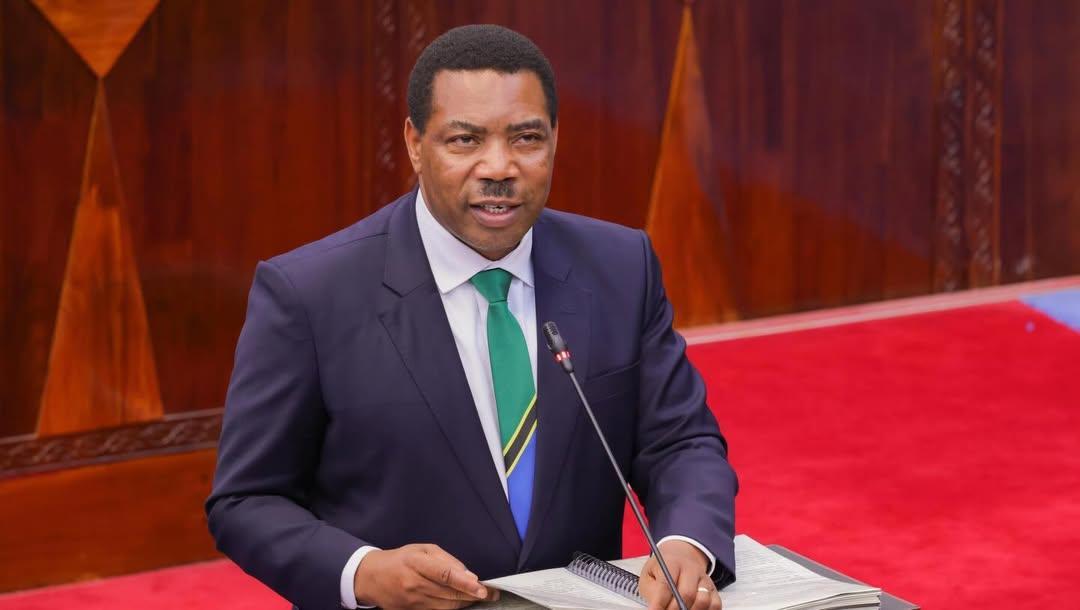
Africa-Press – Tanzania. PRIME Minister Dr Mwigulu Nchemba has said the government has completed an initial assessment of the economic impact of the ongoing Middle East conflict, warning that Tanzania like the rest of the world, cannot escape global shocks, but is taking firm measures to safeguard its development agenda.
Dr Nchemba made the remarks yesterday during an impromptu question and answer session to the Prime Minister in the National Assembly, responding to Mr Ado Shaibu Ado (ACT-Wazalendo–Tunduru), who raised concerns that the escalating conflict has caused widespread global disruptions beyond the recent rise in fuel prices.
Mr Shaibu warned that the war has triggered broad negative effects on international trade, global insurance markets, import and supply chains, mining, and the aviation sector, developments which, he said, place Tanzania at risk.
Before responding in detail, Dr Nchemba acknowledged the gravity of the situation, noting that both the Middle East conflict and earlier tensions in Eastern Europe have created worldwide instability.
“It is true, the ongoing war in the Middle East, and previous conflicts in Eastern Europe, carry global consequences. Tanzania is not an island.
We trade, we communicate and we cooperate with nations across the world,” he told the House.
He said the government has already conducted preliminary assessments through various ministries and institutions, indicating that Tanzania should expect economic shifts across several sectors.
“We have already projected changes in certain areas, including an immediate rise in fuel prices and insurance costs. There will also be disruptions in global financial markets, which both the private sector and the government rely on to secure financing for development projects,” he said.
Dr Mwigulu said the government’s core strategy to cushion the economy will be to strengthen the use of domestic resources, in line with President Samia Suluhu Hassan’s directive to reduce dependence on volatile global markets.
“One of the key approaches is to rely more on internal resources to ensure ongoing development projects continue uninterrupted. This will help the country remain on course despite external shocks,” he said.
The Premier cited the mining sector as a key area where the government intends to intensify investment, research and production to boost revenue and economic resilience.
He noted that in the last financial year, the mining industry recorded strong revenue performance, not only from large-scale operations, but also from increased productivity among small-scale miners.
“In the last financial year, the sector was expected to collect about 1.2tri/-. By this point in the current year, it has already collected nearly 1tri/-. This shows mining is one of the strongest domestic revenue sources, and expanding this sector will strengthen our self-reliance,” he said.
He added that only 16 per cent of the country has been geologically surveyed, underscoring Tanzania’s vast untapped mineral potential.
“Every district in Tanzania has mineral deposits. This is a key sector where increased research and exploration will significantly expand our revenue base,” he said.
Dr Nchemba said the government will continue conducting deeper assessments, as the duration and full economic impact of the conflict remain uncertain.
“We cannot yet determine exactly when the conflict will end or the full extent of its effects. Because the National Assembly is in session, we will continue updating the House on additional measures the government is taking to safeguard the economy,” he said.