

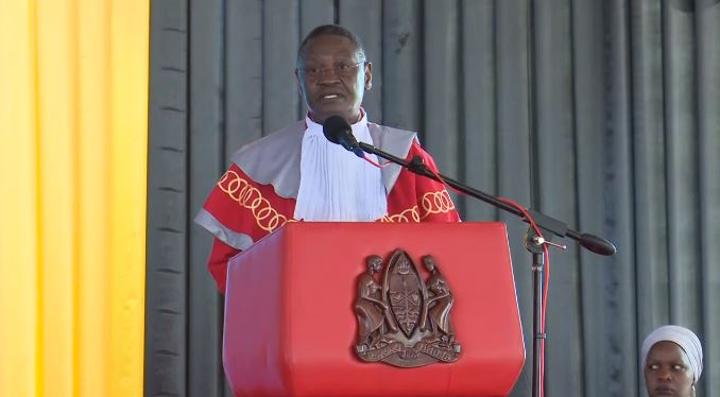
Africa-Press – Tanzania. THE Chief Justice, Prof. Ibrahim Juma, on Monday revealed new procedures used by the Judicial Service Commission to get names of competent persons, who were proposed to the President to be appointed as judges of the High Court of Tanzania.
The disclosure was made during the swearing in of seven Justices of the Court of Appeal and 21 judges of the High Court, being the country’s first judicial system since independence and defeats rumour that there were some people, who had lobbed within the Judiciary to get acquire such posts.
Prof. Juma told President Samia Suluhu Hassan after the oath taking ceremony that every country in the world has its own system of procuring judges in accordance with their independent Constitution, Law and history.
He said that according to Article 113 (1) of the Constitution, read together with section 29 of the Judicial Administration Act, the Judicial Service Commission is tasked with advising the president on the appointment of judges to the High Court.
Prof Juma said that in order to get the judges of the High Court, in September 2020, the Commission instructed its chairman, who is also the Chief Justice, to ask various stakeholders in the legal sector to submit names of Tanzanians with constitutional qualifications for appointment as judges.
“Stakeholders submitted to the commission 232 names including 141 men and 91 women. There were 87 names from the Judiciary, 30 State Attorneys, 36 from Ministries and other public institutions, 22 from universities, 53 advocates from the Tanganyika Law Society and four from Land Tribunals,” he said.
According to him, another way used was to look into the judiciary’s data and review the list of senior judicial officers. He said that the subcommittee of the commission for persons thereafter, lined them up for interview after also probing and assessing their constitutional qualifications.
“The criteria used by the subcommittee to get the names are integrity, experience of legal work in the judiciary, and time remaining for retirement which is 60 years for a judge, the ability to express themselves verbally and in writing and understanding the activities of the judiciary,” said the Chief Justice.
He said that after the analysis, the committee retained 84 names, of which seven were already Presidential nominees, so they did not need to be interviewed.
Prof. Juma pointed out that three people who were asked to be interviewed said they were not ready to work as judges, thus those who were called for the interview narrowed to 74.
He further said six were called for interview, but did not appear and that dropped the number to 68, who were interviewed based on the commission’s instructions, including the committee subjecting them to written and spoken interviews.
The Chief Justice said that the process of face-to-face interviews in writing provided the Commission with an opportunity to get to know the nominees. He said that the committee submitted a total of 46 names before the commission for discussion and recommendation to the President.
“Therefore, none of you who have been sworn in today applied for this position, but you were nominated by legal entities. So it is your turn now after being sworn to show your faith and display the trust you have to the President and the Judicial Service Commission,” he told the new judges.
Equally, the Chief Justice, thanked the President for the appointment, saying that before being sworn in, the Court of Appeal had 17 justices, but the number has now increased to 24, although it is only 23 who perform day to day duties of hearing appeals, as one has special assignment.
At the High Court level, he said, there were 70 judges as well as six others, including the Principal Judge, who had special assignment-a situation in which the court remained with only 64, who were performing daily judicial adjudication duties.
Therefore, he said, the number has increased to 86 following the swearing of the new 21 judges. He also revealed that the appointment of the new justices of the Court of Appeal and judges of the High Court will bring a great impact on conduct of cases.
Before the swearing of the new Justices, Prof Juma said that the Court of Appeal had five panels of three justices, where each panel was handling between 28 and 36 appeals per session. In a year, one panel, the Court of Appeal, conducts nine sessions.
Therefore, he said, the capacity of each panel to hear appeals in a year was between 252 and 324 cases, thus five panels could determine appeals ranging from 1260 to 1620 each year.
“Following the increase of the justices, the number of panels would increase from five to seven, which could determine appeals ranging from 1764 to 2268, a difference of 1260 to 1220 appeals and the workload will decrease from 959 to 685 appeals,” Prof. Juma said.
Likewise, the Chief Justice explained that there would also be a positive impact on part of the High Court following the swearing in of the new judge.
With the increase of 21 new judges, such a situation would help to determine more cases and reduce the piling up of cases and appeals and ultimately reduce the workload of each judge.
Before the swearing of the new judges, the workload at the Court of Appeal in 16 registries and four divisions was 21,861, of which each of 64 judges handling 342 cases. Therefore, the increase in the number of the judges would enable each judge to determine an average of 257 cases.