

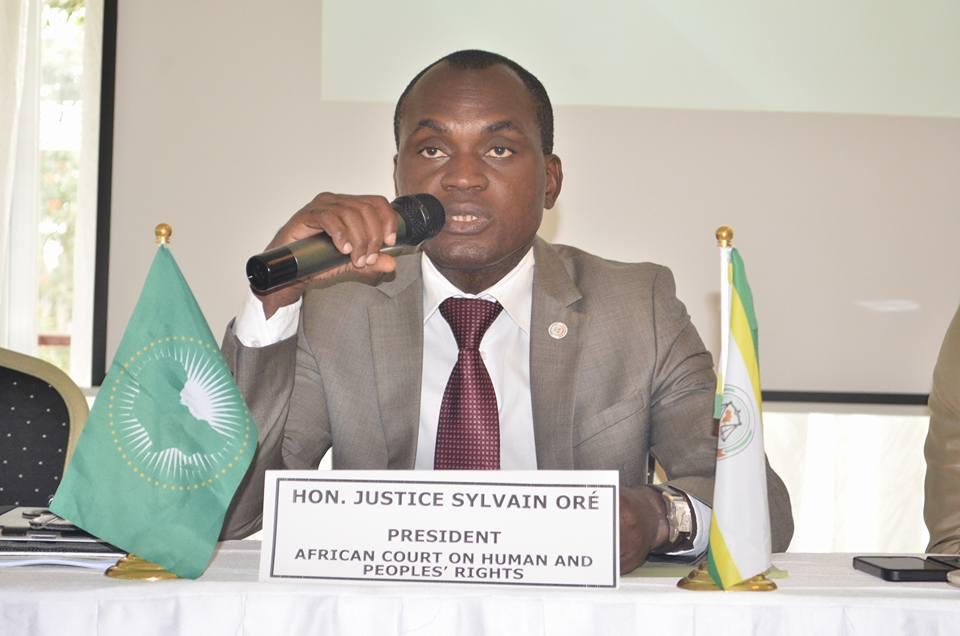
Africa-Press – Tanzania. THE Arusha based African Court on Human and Peoples’ Rights has proposed to the African Union Heads of State summit to impose sanctions on nations that have failed to implement judgements of the continental court.
This was revealed by President of the Court, Justice Sylvain Ore, at a news conference held in Dar es Salaam over the weekend.
He said that enforcement of court decisions by state parties remains a big challenge. “What we have proposed is to put in place a mechanism for sanction to those countries that have not implemented the decisions of the court.
We are waiting for the summit to adopt this proposal of the mechanism,” Justice Ore said.
The president recalled that all international courts were facing the challenge, but on part of the African court they decided to propose the mechanism to the AU Heads of State summit in order to solve them.
He was briefing reporters on the activities lined up to mark the court’s 15 years anniversary since its establishment in 2006.
Justice Ore thanked the government of Tanzania for the immense contributions in the successes of the court.
“We are located in a very nice place. Of course it is not permanent. We are still in the process of having a permanently constructed building area of the court, but at least the court is somewhere where it can plan and execute its activities peacefully.
We are very grateful to the government of Tanzania,” he said.
According to Justice Ore, they were still having meetings with relevant authorities to have such a permanent building, as already the court has secured the land, which, he said, was also a good thing.
He was of the firm view that there was no doubt sooner than later they would get the permanent seat of the court.
During the celebrations, the continental court is expected to conduct various activities, including holding a Judicial Dialogue for various justices from different African nations, training seminars for journalists and sports competitions for students. T
he president also explained that the court is set to rename the Hall used for conducting of cases, which will be called Nelson Mandela, the founding father of South Africa and the Court’s Library to be renamed Julius Nyerere, the founding Father of Tanzania.
He pointed out that the proposal to the two great leaders was a grand honour for their immense contributions in the protection of human rights of the people.
The African Court on Human and People’s Rights is the judicial arm of the African Union and one of the three regional human rights courts together with the European Court of Human Rights and the Inter- American Court of Human rights.
It was established by virtue of Article 1 of the Protocol to the African Charter on Human and Peoples’ Rights on the Establishment of an African Court on Human and Peoples’ Rights (the Protocol).
The Protocol establishing the African Court on Human and Peoples’ Rights was adopted on June 9, 1998 in Burkina Faso and came into force on January 25, 2004 after it was ratified by more than 15 countries.
The mandate of the court is to complement and reinforce the functions of the African Commission on Human and Peoples’ Rights, which is a quasi-judicial body charged with monitoring the implementation of the African Charter on Human and People’s Rights.
Out 55 Member States of the African Union (AU), 54 have ratified or acceded to the with the exception of Morocco and have therefore committed themselves to respecting the principles set out therein and only 31 Member States have currently ratified the Protocol establishing the African Court.
Out of these, only six States have accepted the competence of the court according to its Article 34 (6), according to which individuals and NGOs can directly file cases to the African Court.