

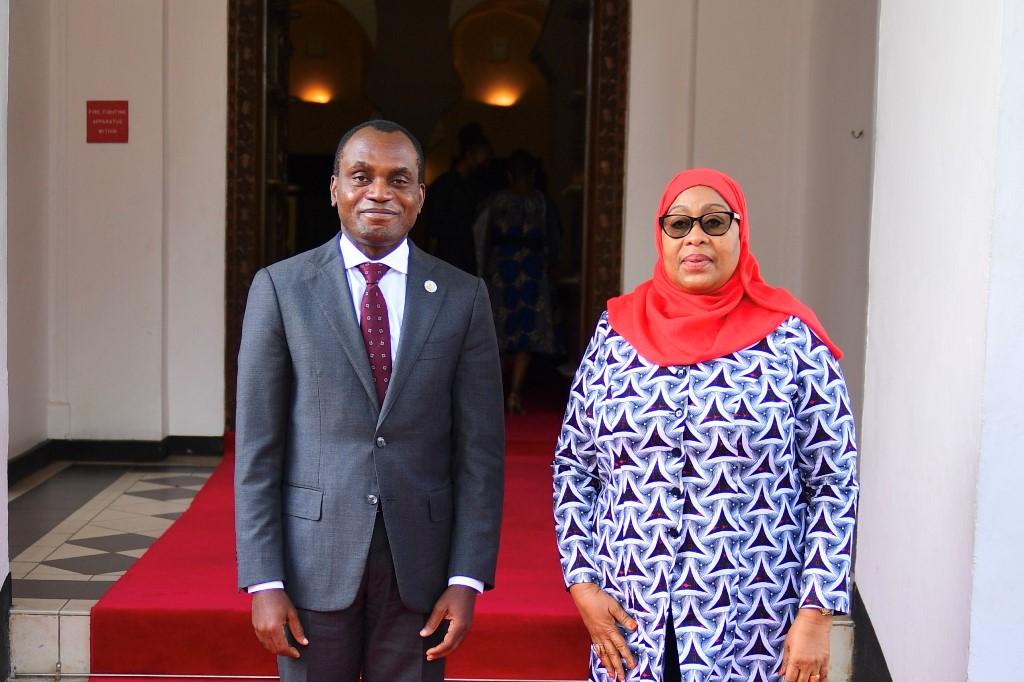
Africa-Press – Tanzania. TANZANIA sticks to her decision to withdraw the right of individuals and NGOs to directly file cases against the government at the African Court on Human and People’s Rights, President Samia Suluhu Hassan said on Thursday.
President Hassan said the government may revisit the decision, but currently, the government has not changed its position after withdrawing from the Arusha-based continental court almost eighteen months ago. President Samia revealed this when bidding farewell to the outgoing President of the African Court, Justice Sylvain Ore, who paid a courtesy call on the Tanzanian leader at the Dar es Salaam State yesterday.
Tanzania, which hosts the African Court whose seat is in Arusha, became the second country after Rwanda to withdraw the right of individuals and NGOs to directly access the African Court in 2019.
Tanzania’s notice of withdrawal of the declaration made under Article 34(6) of the African Court Protocol was sent to the African Union on November 21, 2021 Justice Oré will step down on May 31, this year after concluding his term in office.
President Samia assured Justice Ore that the sixth phase regime will continue working closely with the African Court, especially addressing existing challenges since the government recognizes the significant role the court plays.
She congratulated Mr Ore for his commendable services during his two terms in office as president of the vital continental judicial body and asked him to be a good ambassador of Tanzania.
For his side, Justice Ore thanked President Samia for the good cooperation throughout his leadership and assured her that Tanzania remains the right place for the African Court due the country’s prevailing peace, harmony and appealing environment. Justice Ore told the Tanzanian President that during his tenure, the African Court executed its responsibilities to great successes and met the expectations of the African continent.
In attendance was the Minister for Foreign Affairs and East African Cooperation, Ambassador Liberata Mulamula. In December, 2019, Amnesty International appealed to Tanzania to reconsider the decision to withdraw its declaration. The African Court on Human and Peoples’ Rights is a continental court was established by African countries to ensure the protection of human and peoples’ rights in Africa. It complements and reinforces the functions of the African Commission on Human and Peoples’ Rights.
The Court was established by pursuant to Article 1 of the Protocol to the African Charter on Human and Peoples’ Rights on the Establishment of an African Court on Human and Peoples’ Rights, (the Protocol) which was adopted by Member States of the then Organization of African Unity (OAU) in Ouagadougou, Burkina Faso, in June 1998.
The Protocol came into force on 25 January 2004. The 31 States which have ratified the Protocol are: Algeria, Benin, Burkina Faso, Burundi, Cameroon, Chad, Côte d’Ivoire, Comoros, Congo, Democratic Republic of Congo, Gabon, The Gambia, Ghana, Kenya, Libya, Lesotho, Mali, Malawi, Mozambique, Mauritania, Mauritius, Nigeria, Niger, Rwanda, Sahrawi Arab Democratic Republic, South Africa, Senegal, Tanzania, Togo, Tunisia and Uganda. To date, only 6 of the 31 State Parties to the Protocol have deposited the declaration recognizing the competence of the Court to receive cases directly from NGOs and individuals.
The six States are: Burkina Faso, The Gambia, Ghana, Mali, Malawi and Tunisia. The Court’s Contentious Jurisdiction applies to all cases and disputes submitted to it in respect of the interpretation and application of the African Charter on Human and Peoples’ Rights, (the Charter), the Protocol and any other relevant human rights instrument ratified by the States concerned.
For its Advisory Jurisdiction, the Court may, at the request of a Member State of the African Union (AU), the AU, any of its organs or any African organisation recognised by the AU, give an opinion on any other legal matter relating to the Charter or any other relevant human rights instruments, provided that the subject matter of the opinion is not related to a matter being examined by the Commission.
The Court is composed of eleven judges who are nationals of Member States of the African Union. Upon nomination by their respective States, the Judges of the Court are elected, in their individual capacities, from among African jurists of proven integrity and of recognized practical, judicial or academic competence and experience in the field of human rights. The Judges are elected for a six-year term, renewable once.
The Judges of the Court elect from among themselves, a President and Vice-President of the Court who serve a two year term. They can be reelected only once. The President of the Court resides and works full time at the seat of the Court, while the other ten (10) Judges work on part-time basis.
In the discharge of his/her duties, the President is assisted by a Registrar who performs registry, managerial and administrative functions of the Court.