

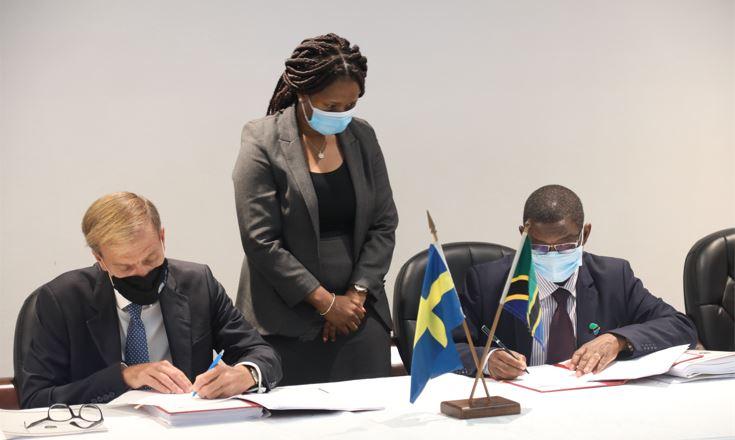
Africa-Press – Tanzania. THE Tanzania Social Action Fund (TASAF) has secured a grant amounting to 450 million Swedish Kronor (equivalent to 118bn/-) as part of the financing to support over seven million extreme poor households in Phase II of Productive Social Safety Net (PSSN II).
The development follows a financing agreement reached by the governments of Tanzania and Sweden to help extend the programme to 1,450,000 households in all villages in Mainland and Zanzibar shehias.
Speaking after signing the agreement in Dar es Salam, yesterday, the Permanent Secretary in the Ministry of Finance and Planning, Mr Emmanuel Tutuba, said the programme aimed at improving access to income-earning opportunities and socio-economic services for targeted poor households while enhancing and protecting the human capital of their children.
According to Mr Tutuba, the PSSN II will be implemented for four years from 2020 to September 2023, with a budget of 883.31 million US dollars, equivalent to 2.02tri/-.
“I am pleased to note that Sweden’s contribution to the PSSN II budget has helped to reduce the financing gap of the programme which now stands at 542.2bn/-,” said Mr Tutuba.
He observed that, due to its importance, in June 2021 Sweden dished out another 26.2bn/- to the PSSN II, noting that the financing is in addition to 196.4bn/- released during PSSN I.
The PS said evaluation of the impact of PSSN in the mainland and Zanzibar show that absolute poverty was reduced by 8 per cent where the ability to afford basic needs has improved among poor households in the country.
Other achievements include, increase in the number of beneficiaries engaging in modern farming, the same applies to school enrolment by six per cent, family savings and access to health services and clinic attendance for children between the ages of 0-24 years.
“This is a great achievement as our people are gradually moving out of abject poverty to the level where they can contribute to economic growth.
“The government will take all necessary measures to ensure successful implementation of this programme in order to achieve the intended objectives,” noted the PS.
For his part, the Ambassador of Sweden to Tanzania, Mr Anders Sjöberg, revealed that the evaluation of PSSN phase one demonstrates significant results for close to 1.1 million extreme poor households of the programme.
“There is strong evidence of enhanced opportunities to get an income, to send children to school as well as to access better health care. The programme also provides families basic protection from economic shocks, which has been key during the Covid-19 pandemic,” said Ambassador Sjöberg.
He underlined the need to address the funding gap and make the PSSN an integral part of social and economic development of Tanzania.
TASAF Executive Director, Mr Ladislaus Mwamanga said TASAF recorded notable achievements throughout the implementation of the PSSN I including a total of 1,992 households willing to quit from the programme and another 211,800 have graduated.
Based on PSSN II verification, Mr Mwamanga said the targeted poor households have remained 450,000 in seven regions who will be covered soon.
“Besides empowerment and building human capital, the programme has helped in the important aspect of education. TASAF in collaboration with Higher Education Student Loans Board (HESLB) has financed 700,000 college and university students from poor households who qualified for the support,” noted Mr Mwamanga.