
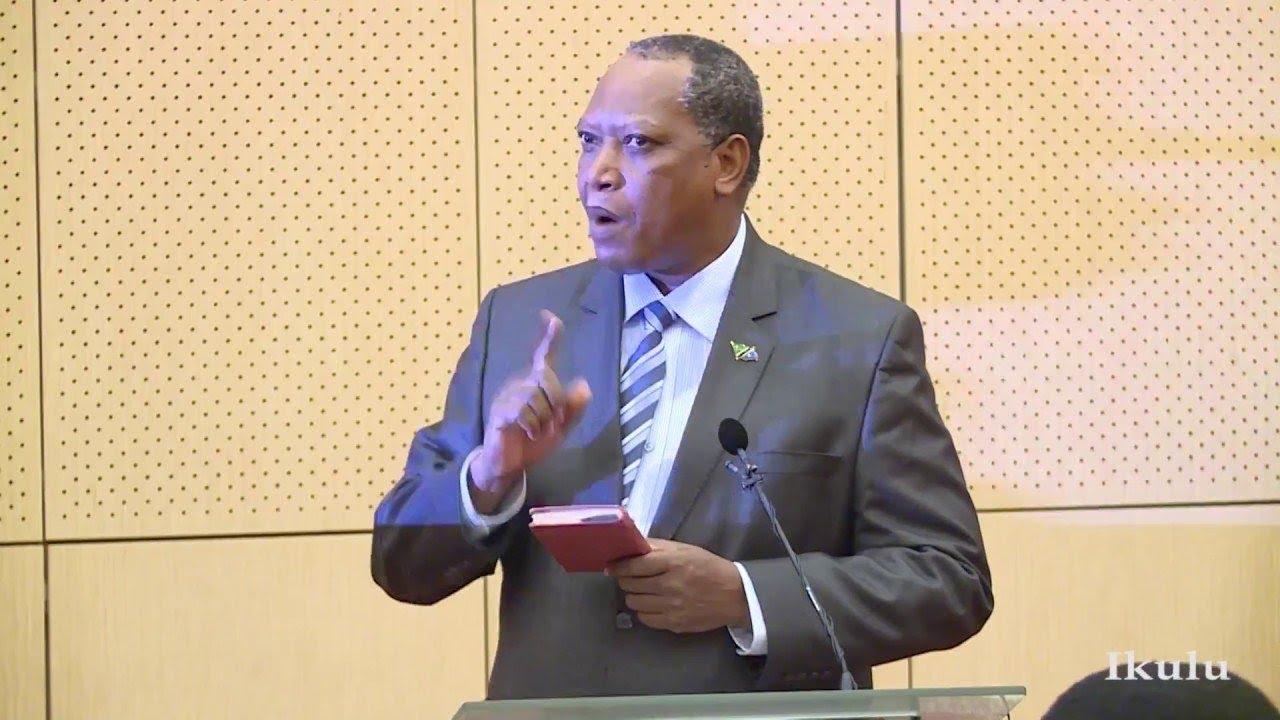
Africa-Press – Tanzania. THE Minister for Constitution and Legal Affairs, Prof Palamagamba Kabudi, has said the judiciary has made tremendous strides in justice dispensation during the country’s 60 years of independence.
Pro Kabudi said this when presenting his report on the achievements that the ministry has recorded in the past six decades, insisting that with the best judicial system, Tanzania has remained united.
“We can now stand tall that we are a nation and not a collection of tribes or a conglomeration of ethnicities,” he said, adding that this was a dream by the father of the nation, Mwalimu Julius Nyerere, who always insisted that he wanted to create a nation out of 120 ethnicities.
Among the achievements that have so far been on record within the ministry of Constitution and Legal Affairs, he said, include improved judicial services compared to when the country attained her independence when all judges, magistrates and officials in the judiciary administrations were non Tanzanians.
He also said Tanzania’s judiciary had also strengthened its Information, Communication Technology (ICT) department countrywide, whereas anybody can be able to get any information on what is happening in the corridors of justice.
The recently launched integrated justice centres is yet another success in the country’s 60 years of independence, according to Prof Kabudi.
The government has constructed six High Court buildings to be known as Integrated Justice Centres (IJC), a major project implemented in five regions of Dar es Salaam (which has two buildings), Mwanza, Dodoma, Arusha and Morogoro.
These court buildings are like one-stop centres, meaning that one building accommodates all judicial services from Primary Court level to the Court of Appeal. Thus, IJC comprises the Primary Court, the District Court, the Resident Magistrates’ Court, the High Court and the Court of Appeal.
On August 5, 2021, President Samia Suluhu Hassan launched six justice integrated centres in the country’s capital, Dodoma, which aim at helping Tanzanians to ease access to justice as well as easing the burden of travelling longer distances to access judicial services.
The centres were constructed at the cost of 51.5bn/-, courtesy of a loan from World Bank support. Yesterday, Prof Kabudi said Tanzania was the first country to have integrated justice centres in East and Central Africa, adding that some countries had started to come to Tanzania to learn from the country.
In his remarks Prof Kabudi said that Tanzania had demonstrated to the world that it can depend on herself in collaboration with other partners, who do not have ill motives with the nation that is why it managed to be categorised among the lower middle-income countries even before 2025.
“We are a confident nation which continues enjoying peace, unity, oneness, justice, respect, freedom and democracy,” he said.
The minister further said that Tanzania was proud that Kiswahili language was now identified as an international language that is why recently the United Nations Educational, Scientific and Cultural Organisation (UNESCO) declared July 7 each year as the World Kiswahili Language Day.
For More News And Analysis About Tanzania Follow Africa-Press