

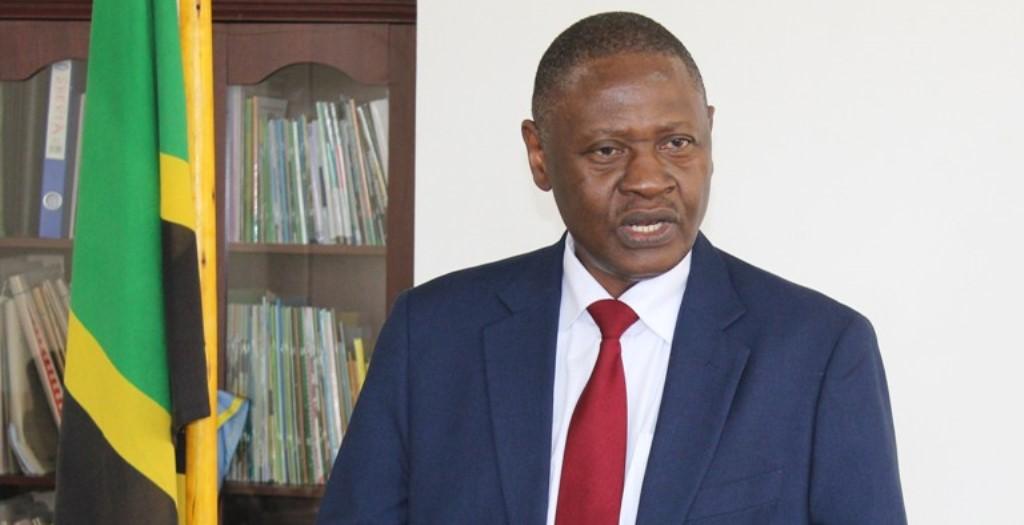
Africa-Press – Tanzania. THE Chief Justice (CJ), Prof Ibrahim Juma, has directed all judicial officers to continue providing justice to the people and keep on acquiring Information and Communications Technology (ICT) skills as the world was moves towards such direction.
Prof Juma said this while opening the meeting of members of council of the Judiciary of Tanzania at the ‘Treasury Square’ in the capital city of Dodoma over the weekend.
The CJ, who is also the Chairperson of the Council, said that it was important for the officers to continue learning as the Judiciary was committed to adapting to the changes in line with the fourth industrial revolution which is more focused on the use of ICT.
“I would like to congratulate the Judiciary staff for continuing to do their best, despite various challenges,” he is quoted as saying in a statement issued by the Information and Communication Unit of the Tanzania Judiciary recently.
Prof Juma used the opportunity to appeal to the officers to adapt to the science and technology changes as the world was currently in the 4th Industrial Revolution.
“So let us strive to work within this revolution to deliver justice in a timely manner,” said the Chief Justice.
He added that the Judiciary was currently ready and has started using ICT in its various activities, including having a Case Management System, (Tanzania Advocate Management System (TAMS), among others.
According to him, it was important for the judicial officers to be ready to support the commitment to have an online connected Judiciary for the benefit of the people.
“The road to the online Judiciary (mahakama mtandao) has already been laid and some Courts including the Kigamboni District Court have started working electronically.
Therefore, it is important that judicial officers continue to receive ICT training to keep up with the times,” stressed Prof Juma.
According to the chief justice, if workers would do so they would be able to protect their jobs due to the fact that through globalization many things would be done electronically.
Commenting on the state of affairs of conduct of cases, Prof Juma said that the Judiciary has done a great job on the hearing and deciding of cases, including the old ones which have been a source of complaints and loss of public confidence to such third arm of state.
“As of December 2019, a total of 66,873 cases remained at all levels of courts. In the year 2020, a total of 238,766 cases were opened and 243,464 cases were heard, equivalent to 102 percent of all cases filed during that period,” explained Prof Juma.
However, the CJ acknowledged that such percentage increase in hearing of cases compared to 2019 where 270,359 cases were filed and 269,513 disposed of, was equivalent to 100 percent of the cases filed in courts during the period in question.
The Chief Justice also spoke about the interests of officers and promised the Judiciary would continue to improve them as much as possible.
Regarding salary arrears, Prof Juma said that so far the Judiciary has received a total of 1,965 complaints from officers, where 1,756 claims have been submitted to the Principal Secretary (Public Service), of which 399 claims have been paid and 209 claims are still being processed.
He also identified areas of the Judiciary’s priorities, including accelerating the resolution of normal cases and having a strategy to eliminate backlog at all levels of courts and improving ICT systems as a key tool to improve service delivery.
He mentioned other priorities as strengthening the audit and monitoring of judicial activities at all levels, continuing to implement the plan for construction and renovating of infrastructure, addressing the issue of staff benefits, especially salary arrears and having a Judiciary Scale to all servants.
During the two day session, members of staff council and representatives of judicial officers countrywide will discuss various issues for the future of staff in general where they will come up with suggestions on how best to implement various productivity matters and ultimately improve services.