
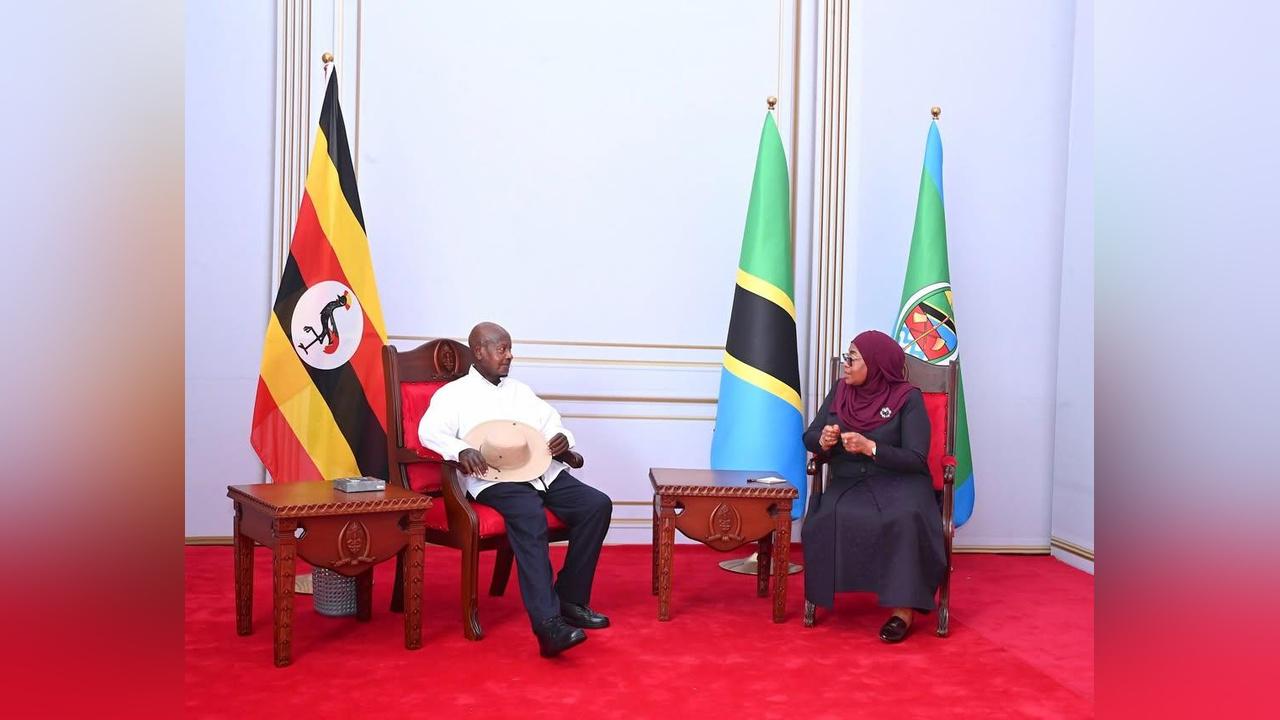
Africa-Press – Tanzania. PRESIDENT Samia Suluhu Hassan and President Yoweri Museveni of Uganda yesterday agreed to deepen trade and economic cooperation, confirming that the East African Crude Oil Pipeline (EACOP) will commence operations in July this year.
The EACOP, a long-awaited strategic regional energy infrastructure project, also known as the Uganda–Tanzania Crude Oil Pipeline, is a 1,443-kilometre pipeline designed to transport crude oil from Kabaale–Hoima in Uganda to the Chongoleani Peninsula near Tanga Port in Tanzania.
Energy cooperation topped the agenda during the discussions held at State House in Dar es Salaam, with infrastructure development, trade expansion and regional security also featuring prominently. President Museveni was in Tanzania for a one-day working visit.
President Samia said the EACOP project remains a practical demonstration of how joint investment in energy can accelerate economic growth and deepen regional integration.
“This is a clear example of what African countries can achieve when they work together with focus and commitment,” she said. She added that Tanzania remains fully prepared to work closely with Uganda to ensure that agreed projects are implemented effectively and deliver tangible development benefits to the people of both nations.
Beyond crude oil transportation, the two leaders agreed to advance plans for a cross-border clean gas pipeline linking Uganda and Tanzania, aimed at strengthening energy security and supporting industrialisation.
They also committed to developing joint energy generation projects under cooperative frameworks.
The talks further resolved to expand Uganda’s access to Tanzania’s major seaports of Dar es Salaam, Tanga and Mtwara, a move expected to ease logistics, reduce trade costs and boost cross-border commerce.
On regional connectivity, President Samia called on Uganda to support the extension of Tanzania’s Standard Gauge Railway (SGR) to facilitate faster and cheaper movement of goods within the region.
“Efficient transport infrastructure is key to unlocking trade and industrial growth across East Africa,” she said.
The two leaders also discussed the strengthening of maritime transport on Lake Victoria, including the Mwanza route, as part of broader efforts to enhance regional trade links.
Addressing trade relations, both governments agreed to remove existing non-tariff barriers, promote smooth business operations and fully exploit opportunities available within the East African Community (EAC) market.
President Samia reaffirmed Tanzania’s commitment to regional peace and stability, noting that the country will continue to play an active role in continental security matters.
She pointed out that Tanzania is expected to assume responsibilities in the African Union Peace and Security Council next year and underscored the need for collaborative solutions to challenges affecting the Great Lakes region. On his part, President Museveni outlined three guiding objectives shaping Uganda’s cooperation with Tanzania and the wider region.
“The first objective was independence, to remove colonial control,” President Museveni said, adding that the next phase must now focus on economic transformation and prosperity for the nations and the citizens.
“The second objective is prosperity for our people, in Uganda and Tanzania, through producing wealth, goods and services and ensuring we have integrated markets for what we produce,” he said.
He identified strategic security for Africa as the third pillar, urging African nations to safeguard their sovereignty while advancing development. “After independence, we must move forward and not remain as we were before. At the same time, we should not move with arrogance,” he added.
President Museveni expressed strong support for Tanzania’s ambition to become a regional hub for locally manufactured railway locomotives, saying self-reliance is critical in a competitive global environment.
“Big countries can put pressure on us, but what matters is how we resist and build our own capacity,” he said. Both leaders agreed that progress must be driven by practical implementation of economic policies rather than declarations alone.
The two countries reaffirmed their commitment to deepening cooperation in energy, transport, trade and security, positioning the Tanzania–Uganda partnership as a key pillar of sustainable development in East Africa.