
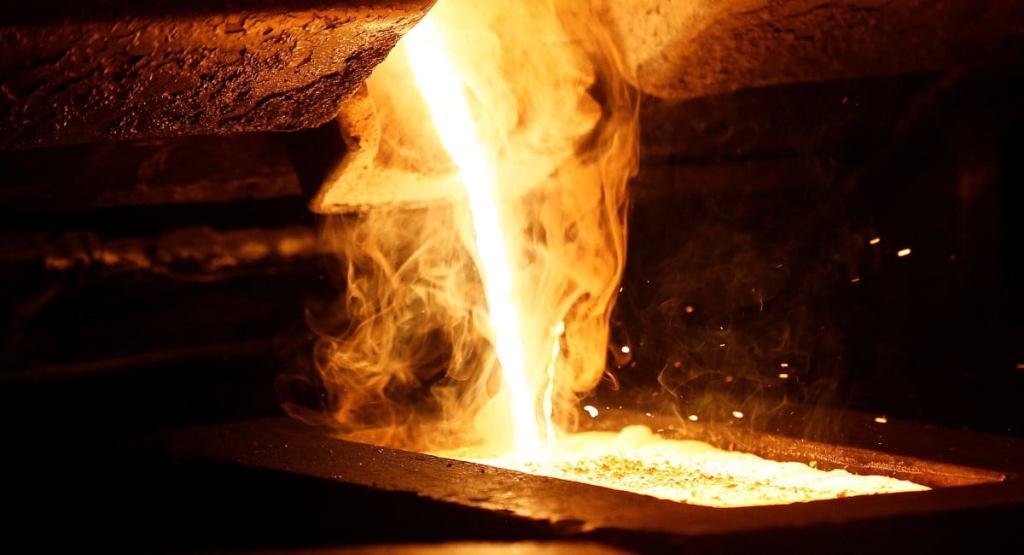
Africa-Press – Tanzania. THE construction of a gold refinery in Mwanza has been completed and the plant is expected to start production soon, the Chairman of the Parliamentary Standing Committee on Energy and Minerals, Mr Dunstan Kitandula, has said.
He told the National Assembly here over the weekend that the construction of the refinery began on March 15, 2020 and was completed in December, 2020 and now it is at the stage of testing and commissioning equipment.
“The cost of construction, machinery and other equipment stands at 4.1 million US dollars (about 9bn/-). This project, to begin with, will use 58 million US dollars (about 133.4bn/-) being investment costs (Capital expenditures –CapEx) as well as operating costs and gold purchase for the first ten days,” the Committee Chairman said.
Mr Kitandula was presenting his Committee’s report on the implementation of the responsibilities of the Ministry of Minerals for the 2020/2021 financial year as well as the Committee’s views on revenue and expenditure estimates for the 2021/2022 financial year. He explained that the gold refining plant is the first in the country to be built on joint ownership between the government and private investors.
The committee leader said the refinery will have several benefits, including increasing the country’s revenue through royalties and inspection fees and revenue for State Mining Corporation (STAMICO), through management services and quarterly profits.
“It will increase the revenue of the respective Councils through the Service Levy and also increase employment for the nation where 120 employees, most of them Tanzanians and a few from abroad are expected to be employed,” said the Committee Chairman.
According to Mr Kitandula, the employment would include contractors, gold producers, bidders, service providers and distributors. Another benefit is to increase the quality of gold from Tanzania in the international market and this will enable gold from Tanzania to be purchased by the World Bank and stored.
“This is due to the use of modern gold refining technology with international standards by 99.9 of purity. It uses a gold refining process which is technically called Aqua Regia Gold Refining Processes and Electrolysis Technology,” he said.
Mr Kitandula named other benefits as reduction of gold smuggling problems as there would be a reliable market for unprocessed and refined gold and would make Tanzanianproduced gold recognizable and have its own unique brand (Originality Mark). He pointed out that the plant would also be able to have a gold vault storage facility from various gold producers locally and abroad and would be able to provide services to customers at low cost.
“This plant will be a Bullion Vault of International standards managed by International Companies like Brinks Global. The plant will influence neighboring gold-producing countries to refine and sell their gold in our country and thus increase government revenue,” Mr Kitandula said. Through the plant, he said, there would be an opportunity to connect the nation with the world’s largest gold trading institutions such as the London Bullion Market Association (LBMA) and would provide the opportunity for other minerals (By-products) to be identified and valued in the country.
The establishment of the Mwanza Gold Refinery is a result of the Mining Act 2010 (Amendment Act) which contributed to the enactment of The Natural Wealth and Resources (Permanent Sovereignty) Act of 2017. The law places emphasis on the country’s resources and the desire to benefit from minerals mined in the country by adding value before they are exported.
The project is a joint venture between STAMICO, Rozella General Trading LLC of Dubai, United Arab Emirates (UAE) and ACME Consultant Engineers PTE Ltd of Singapore (RGTACE). The project is run under the joint venture of Mwanza Precious Metals Refinery Ltd.
In this joint venture, State Mining Corporation (STAMICO) owns 25 percent and Joint Partners own 75 percent where the Corporation’s shares will increase by 5 percent per annum for a period of 15 years, thus making it having 51 percent stake with 49 percent remaining for other partners. Furthermore, STAMICO will also receive 2.5 percent of its gross sales as Management Fee services for services given by companies.
The structure of this project is overseen by the Board of Directors and the Joint Management Committee (JMC). The Board of Directors consists of two members from STAMICO and three members from the Partners. In addition the project is closely supervised by JMC which has two Members from STAMICO and two members from partners.
JMC is responsible for overseeing the day-to-day operations of the project.