
Africa-Press – Tanzania. THE government plans to collect and spend about 39.38tri/- in recurrent and development expenditure in the next 2022/2023 financial year.
The ambitious budget will be pegged on several key priority areas, among them salary increment for public servants .
The ambitious budget will be pegged on several key priority areas, among them salary increment for public servants.
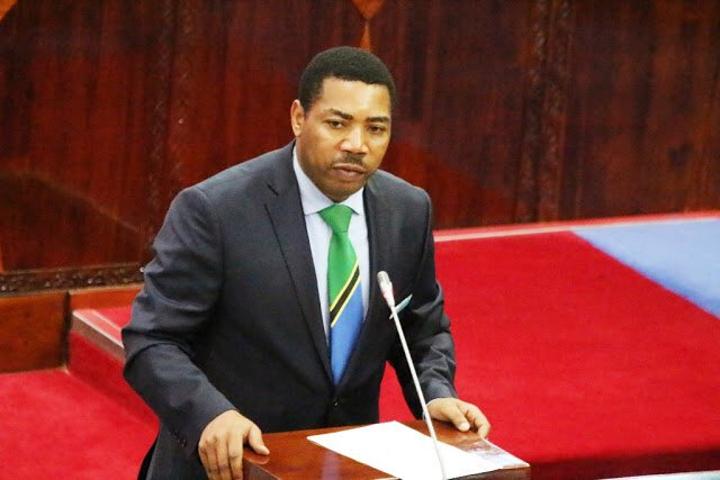
Others are implementation of flagship projects and employment creation, Finance and Planning Minister, Dr Mwigulu Nchemba said on Wednesday.
Furthermore, in the next financial year, the government plans to increase the country’s Gross Domestic Product (GDP) from 5.0 in 2021 to 5.2 per cent in 2022.
The 2022/23 budget projection has increased by 7.4 per cent compared to 36.68tril/- that was tabled in the 2021/22 budget.
The Finance and Planning Minister, Dr Nchemba said in the next budget, Development Partners are expected to contribute to the national budget through General Budget Sup-port by about 3.04tri/- (about7.7 per cent of the total budget).
Tabling the 2022/23 national development plan in the august House on Wednesday, Dr Nchemba said the plan strives tbuild a competitive and industrial economy for human development in the country. Dr Nchemba said among key priorities, is implementation of the National Population Census scheduled for 2022, repaying the public debts, pay salaries to public servants and improve social services that include health, education and water.
“Our priority is to stimulate a competitive and participatory economy… This area includes projects that will build a community that is competitive regionally and internationally,” he said.
Detailing that the goal is also to strengthen overall economic stability, business and investment environment conduct research and development as well as adopt technology from abroad.
The government said it will push for developing infrastructures and services, not to mention, roads, railway, bridges, water, ICT, energy, ports and airports.
Dr Nchemba said the new development plan will focus on strengthening “Industrial Production and Service Delivery.” He went on to note that industrial projects aimed at adding value to agricultural products, livestock, fisheries and minerals as well as producing products that will use raw materials and resources available in abundance in the country.
“That government will also implement programmes that will strengthen local markets and take advantage of regional and international marketing opportunities. Targeted markets are those that will provide opportunities for locally produced goods and services including agricultural products, industry and tourism,” he said.
Tanzania recently adopted a Business Blueprint in which the government says it would continue implementing. Dr Nchemba categorically detailed that domestic revenue is estimated at 28.56tri/- an equivalent of 72.5 per cent of the total budget.
Development partners and soft loans would add up to at least 3.04tri/- and 7.7tri/- respectively. At least 14.67tri/- will be spent for development projects, the finance minister said.
“The Annual National Development Plan 2022/23 will include ongoing illustrative projects whose implementation is expected to have a broad and immediate impact on the economy,” he said.
The minister listed some of the projects as the construction work of central Standard Gauge Railway (SGR), the 2,115 megawatts Julius Nyerere Hydropower Project (JNHPP) and improving the national flag carrier airline -ATCL.
Other projects are implementing the East African Crude Oil Pipeline from Hoima (Uganda) to Tanga (Tanzania), the Liquid Natural Gas (LNG) Processing Project in Lindi; Magadi Soda Engaruka Project; Coal Project – Iron and Steel – Liganga; Ruhudji Hydropower Washing Project (358 MW) – Njombe; Rumakali Hydropower Project (MW 222) – Njombe; and Construction of High Bridges and Highways of Kigongo Bridge – Busisi (Mwanza) and New Selander Bridge (Tanzanite – Dar es Salaam).
For More News And Analysis About Tanzania Follow Africa-Press