
Africa-Press – Tanzania. Dar es Salaam.
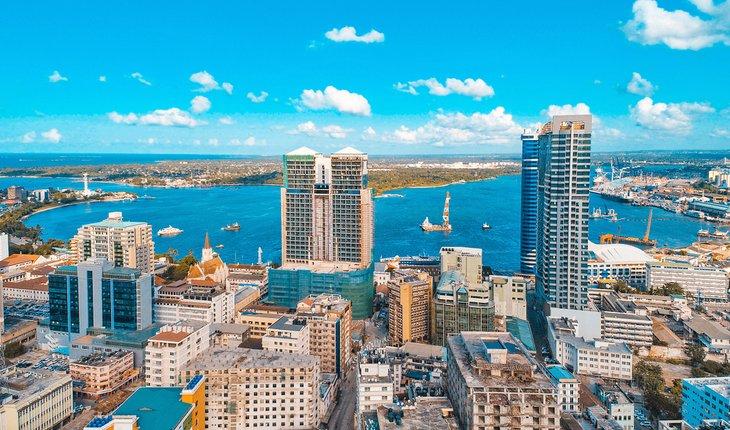
Dar es Salaam’s gross domestic product (GDP) has jumped 37 percent during the past five years as the commercial hub maintains its position of being the largest contributor to Tanzania’s economy.
The latest data by the National Bureau of Statistics (NBS) puts Dar es Salaam’s GDP at Sh25.27 trillion, up from Sh18.42 trillion that was recorded in 2016.
Mwanza comes second, with a GDP of Sh10.9 trillion: a more than 40 percent increase from Sh7.8 trillion in 2016.
Mbeya occupies third position. Its GDP reached Sh8.35 trillion last year.
Shinyanga comes fourth – with its GDP quoted at Sh7.58 trillion in 2020 – while Morogoro closes the top five list as its GDP crossed the Sh7 trillion mark, to reach Sh7.16 trillion in 2020.
Authorities and analysts say the size of the economy was directly linked to the level of economic activities and production both of which were linked to the productivity of the working-age population in the regions.
That is why Dar es Salaam – which is the country’s largest seaport and the hub of financial services, retail, real estate, construction and manufacturing and home to the largest population – leads in the GDP stakes.
Mwanza on Lake Victoria has massive fishing opportunities and is also famous for agriculture, mining and trade aroud it.
Mbeya is one of the biggest producers of high-value exports and cash crops such as coffee, tea, cocoa, pyrethrum and spices.
Its conducive weather also makes it ideal for the production of foodcrops, including maize, rice, bananas, beans, potatoes, soybeans and wheat.
Mbeya Regional Commissioner Juma Homera told The Citizen that, apart from agriculture, the region is also doing well in manufacturing.
It is home to about 20 large-scale industries, 3,000 medium-scale industries and over 10,000 small scale industries that are currently in operation.
“From the manufacturing point of view, we have pharmaceutical and crop-processing factories… But, we are also doing well in the transport, communications and hospitality sectors,” he said.
Strategic crops produced in Mbeya include cocoa, which generates almost Sh2 billion a week for farmers. “We also produce between 600,000 and 700,000 tonnes of rice a year, as well as some 2,000 tonnes of avocado which we export,” he said.
Mr Homera further said that Mbeya is home to over 3.3 million livestock head, while commercial fishing is conducted in Lake Nyasa.
As for Shinyanga, the region is a major producer of various minerals, including gold, diamonds, white wash, salt and several other minerals used in the construction industry.
Regarding Morogoro, apart from the region producing both food and cash crops such as tobacco, cotton, maize, paddy, sorghum, bulrush millets and beans, livestock keeping, it is also home to important economic activities.
For example, about 100 kilometres away from the Morogoro central business district (CBD) is the world-famous tourist attraction, the Mikumi National Park.
Analysts’ views
Speaking to The Citizen generally, an economist from the University of Dar es Salaam (UDSM), Dr Abel Kinyondo, said the presence of strategic resources in some of the administrative regions mentioned herein-above have contributed to the growth of their GDP.
Improved utilization of the resources have helped the regions to economically grow and earn more than other administrative regions.
“This creates a challenge for the government to ensure that the gaps between regional GDPs do not grow further. We must have equitable distribution of wealth across the land,” Dr Kinyondo said.
He also said that the government must make efforts to ensure that there are plans to improve the wealth of the regions which lack strategic natural resources such as water, land, skilled manpower, etc.
“It can do so by massive investments in infrastructure, creating opportunities and an enabling environment so that people can functionally produce economically. This will also reduce the rural-to-urban migration.”
Dr Kinyondo also said that inclusive socioeconomic development should be a target whereby all the sectors of the economy grow at the regionan and national levels.
From the Udsm Business School (UDBS), Prof Wineaster Anderson said when there is an increase on regional GDP it means that there is either new investment opportunities opening up, or earnings from the available investments have improved.
She said this can be influenced by advancements in technologies, modernization, increased knowledge and skills, etc. “All these changes can influence and otherwise bolster GDP. For example, if farmers in a given region were predominantly using hand-hoes before, and they now tractors, this will obviously have a positive impact on the economic status of the region,” she said.
Tanzania has in recent years become an attractive proposition for investors – and there is even a space programme in the throes of being organized to leverage all-inclusive, sustainable socioeconomic growth.
For More News And Analysis About Tanzania Follow Africa-Press