
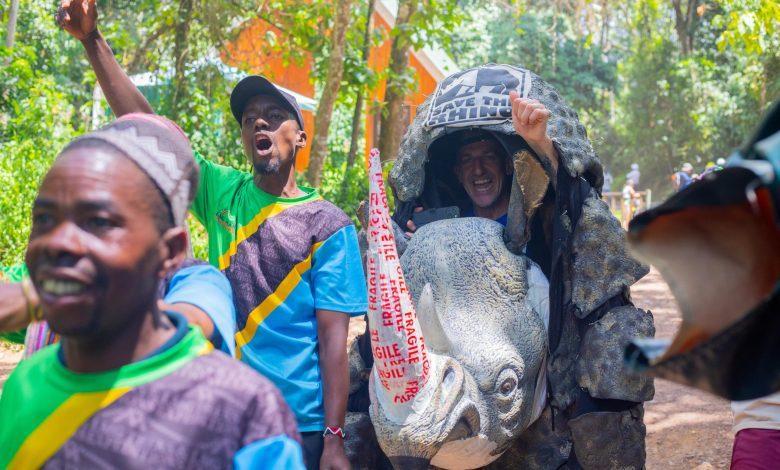
Africa-Press – Tanzania. WEARING a full rhino costume, UK conservation activist and Save the Rhino International Ambassador, Chris Green popularly known as ‘Rhino Boy’ has successfully climbed Mount Kilimanjaro to raise funds and global awareness about the threats facing one of the world’s most endangered animals.
Green completed both the ascent and descent of Mount Kilimanjaro, Africa’s highest peak and often called ‘the Roof of Africa’, earlier this week after a six-day trek that began on January 16, 2026.
Speaking at a press conference on January 21, shortly after descending the mountain, Green described the challenge as physically exhausting but emotionally uplifting.
“I have just walked all the way to the top of Mount Kilimanjaro and back down,” he said. “Physically, I feel like the ‘tiredest’ rhino there could be. But emotionally, I feel so, so happy and full of hope,” he said.
That hope, Green explained, came from the overwhelming support he received throughout the journey, including from Tanzania National Parks officials, guides, porters, rangers and fellow climbers.
“My heart is full of hope because the only way I could do this was with the help of all these wonderful people here in Tanzania,” he said. “Everybody came together to help this rhino reach the summit. It shows what is possible when we work together, we can help nature, stand up for conservation, and save a species,” he said.
Climbing Kilimanjaro is a formidable undertaking even under normal conditions. Attempting it in a bulky rhino costume pushed Green to his limits, both physically and mentally.
“Almost every day the mountain felt enormous and the challenge overwhelming,” he said. “At times it felt almost impossible. But nothing is impossible when you put your whole heart and soul into something especially when you’re surrounded by good people.”
Green said he drew strength from the cause behind the climb: the survival of rhinos. Three of the world’s five rhino species are classified as critically endangered, including Africa’s black rhino, which continues to face severe pressure from poaching and habitat loss.
“Rhinos have always been my favourite animal,” he said. “They symbolise everything we should strive to be as humans peaceful, gentle and magnificent. It breaks my heart that they are so endangered. I needed to do this to raise awareness of their plight so that, together, we can make a difference.”
According to the International Rhino Foundation, the global population of all five rhino species stands at approximately 27,000. While poaching levels have declined from their peak a decade ago, illegal wildlife trade remains highly lucrative. In South Africa alone, at least one rhino is still killed by poachers each day, with 420 animals lost in 2024 and a further 195 recorded in the first half of 2025.
Rhino horn sought for dagger handles in parts of the Middle East and for use in traditional medicine in Asia, despite international bans can fetch between US$60,000 and US$100,000 per kilogram, giving a single horn a potential black-market value exceeding US$250,000.
South Africa, home to nearly 80 percent of the world’s remaining rhinos, has been hardest hit by the poaching crisis, which escalated sharply after 2007. Conservation groups estimate that more than 9,400 African rhinos were killed by poachers between 2010 and 2020.
Green praised Tanzania and its conservation institutions for their support, awarding Tanzania National Parks a ‘10 out of 10’ rating.
From the moment I arrived, I was met with nothing but kindness and warmth,” he said. “They could have found a hundred reasons to say no, but instead they found every reason to say yes.”
Concluding the press conference, Green called for collective global action to protect wildlife.
“I feel like all of Tanzania is behind me and behind Save the Rhino an organisation I am incredibly proud to represent,” he said. “With friends like these, anything is possible. Let us save animals, save the rhino, save species and ultimately, save each other.”
Kilimanjaro is the highest mountain in Africa, snow caped and world’s highest freestanding volcano. It comprises of two dormant volcanoes (Kibo 5,895m a.m.s.l and Mawenzi 5,149m a.m.s.l) and one extinct volcano (Shira 3,962m a.m.s.l) respectively.
The origin of the word is not well known but it said to be a combination of the Swahili word Kilima meaning Mountain and the Chagga word Njaro, loosely translated as Whiteness giving the name White Mountain.
Its size is 1,712Km2 and was declared as a National Park in 1973, officially opened for tourism in 1977, declared a World Heritage Site by UNESCO in 1987 and Natural Wonder of Africa in 2013. Climbing to the top which is far up into the sky it’s a life time experience that no one can forget.
Climate
There are two rainy seasons in a year. The wet season is from March to May during which it rains around the mountain base and snow accumulates on its peak.
The dry season is from late June through September during which the nights are cool and the days completely clear.
The park is located at an altitude between 1,700 m to 5,895 metres with annual average rainfall ranging from 828 mm at alpine desert to 2,500 mm at Montane Forest.
Getting there
The park can be accessed by road or flight via Kilimanjaro International Airport – about 45km to the west. The Park Headquarters and one of the ascending gates are at Marangu, about 41Km from Moshi town and 86km from Kilimanjaro International Airport. The other seven gates of Rongai, Machame, Londorosi, Lemosho, Kilema, Mweka and Umbwe are located around the mountain base and can be reached by road.
Park attractions
The Park is endowed with a diverse variety of attractions ranging from terrestrial wilderness to permanent glaciers on the mountain peak.
Three peaks Kibo
It is the highest peak (5,895m) on Mount Kilimanjaro, is covered by snow throughout the year despite being close to the equator. Conquering this peak is an adventure of a lifetime.
Mawenzi Peak
Is the second highest peak which forms Mount Kilimanjaro 5,149m. It is rugged and maintain the features of glaciation.
Shira peak
With an altitude of 3,962m, is the oldest peak that collapsed and forms a Shira plateau with outstanding scenic beauty on the mountain with several kinds of migratory large mammals such as buffaloes, elephants and especially elands.
Montane Forest – A wide band of exceptionally beautiful montane forest encircles the whole of Kilimanjaro from about 1800 –2800m. The forest zone is worth a visit even if you are not climbing to the peaks. Marangu nature trails is particular taking you through this forest belt which supports several plant species, including endemic plants like Impatiens kilimanjari.
Zonation of vegetation
Five eco-climatic zones take you to the equivalent of a trip from the equator to the arctic in a brief tour. As one climb Kilimanjaro, vegetation and weather changes in response to the changing elevation from montane forest, heath and moorland, alpine desert and the summit zone (arctic). The mountain peak is covered by snow all year-round.
Lauwo Waterfall
Located along Marangu route 2.8Kms provides a spectacular experience while enjoying walking inside the thick montane forest.
Maundi Crater
Located just 15 minutes walk past Mandara huts on the Marangu route the crater provides a panoramic view of Lakes Chala, Jipe and Nyumba ya Mungu, all of which derive their waters from the Majestic Kilimanjaro.
Kifinika Cultural Site
This is a site along Marangu route that is sacred by the local Chagga people. Historically, the site was used for cultural rituals.
Birds and animals
The park harbors a total number of 140 species of mammals; 7 primates, 25 carnivores, 25 antelopes, 24 species of bat and 179 bird species.
Activities
The park is endowed with various tourism activities that visitors can do during their visit. The activities includes; Mountain Climbing to the Summit (MC), Paragliding, Nature Walking Safaris (Short Walking Safaris (SWS)), Long Walking Safaris (LWS), Mawenzi Technical Climbing (MTC), Picnicking, Filming, Non-Summit Bound Climbers, Crater Camping and Mountain Cycling (MB).
Mountain climbing
Climbing to Kibo peak takes 5 to 8 days depending on the route. The more days, the higher the possibility to conquer the summit. Six mountain trails can take a climber to the highest point in Africa, each route offering different attractions and challenges.