
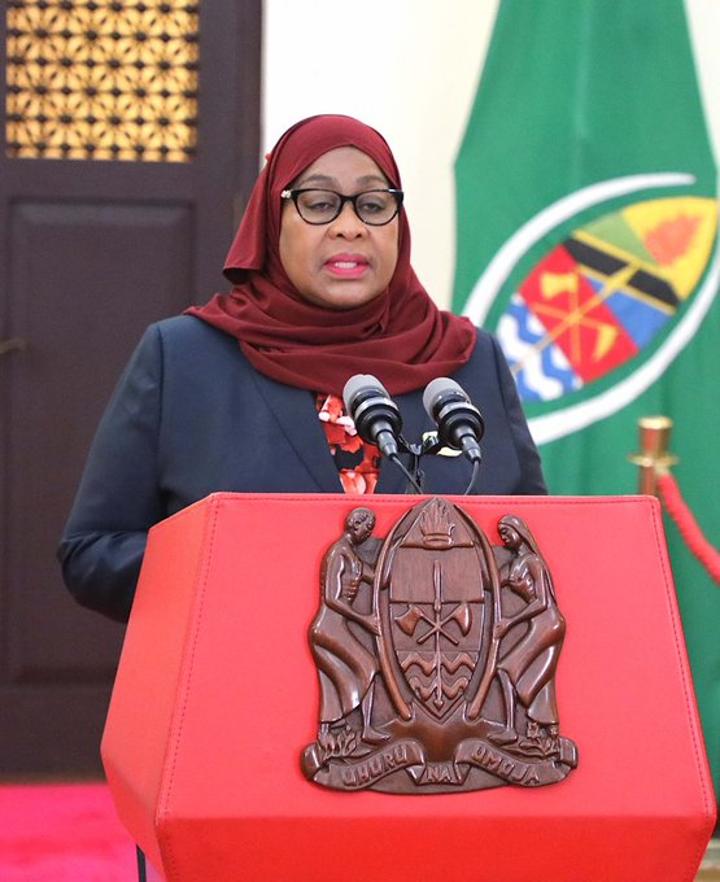
Africa-Press – Tanzania. PRESIDENT Samia Suluhu Hassan said Tanzania has made great achievements, envisaging the country’s brighter future.
Tanzanians are today celebrating 60 years of independence, almost a year after the East African nation graduated from a low-income country to lower middle-income country, a feat attained five years ahead of projection.
In July, last year, the World Bank announced the change in Tanzania’s economic status, after the country’s GNI per capita increased from 1,020 US dollars in 2018 to 1,080 US dollars in 2019, which exceeded the 2019 threshold of 1,036 US dollars for lower-middle income status.
Addressing the nation on the eve of the 60th Independence Anniversary, President Samia, while highlighting major strides in all key sectors, expressed confidence that the journey to middle and then upper middle-income economy would be shorter, given the nation’s feasible development plans.
The upgrade for Tanzania was the product of the strong economic performance of over 6 per cent real Gross Domestic Product (GDP) growth on average for the past decade.
The Head of State noted that the third Five-Year Development Plan envisages an 8 per cent economic growth rate.
She was optimistic that the government strategies and the pace of implementing development strategies will smooth the road to middle and upper-middle income status in the near future.
“We have come a long way in attaining the lower -middle income status but the future is brighter in our endeavor to attain middle and upper-income status,” President Samia said.
She noted that in 1961 the income per capita for Tanzanians stood at 776/-, but the per capita increased to 2.6m/- in the year 2020.
Ms Samia called upon Tanzanians to continue upholding national peace, unity and tranquility for the interest of the current and future generations.
With the country in the final phase of the five-year development plan, which comes to an end in 2025, President Samia said the government will come up with a 25-year development vision aimed at further improving the per capita income.
“The new plan that will run between 2015 to 2050 will aim to increase the income of individuals by focusing on agriculture, fishing, livestock keeping and industrial development,” she explained.
Reflecting on Tanzania’s 60 years of independence, President Samia said one of the key achievements that the government is proud of is the improvement of people’s welfare through provision of important social services.
“Improving living standards among Tanzanians and increased access to social services and the quality of those services, such as clean water, education, health, and access to electricity, are areas where we have succeeded and we are proud of,” she stated.
The president said that water availability has improved from 25 per cent in 1961 to 72.3 per cent in rural areas and 86 per cent in urban areas.
“As stated in our CCM electoral manifesto, we are continuing to take steps to ensure that access to clean and safe water reaches 85 per cent in rural areas and 95 per cent in urban areas by 2025.”
When the country acquired independence, she said there were few professionals in terms of education and professionalism, with only 30 people holding a degree, 16 of whom were doctors, 12 accountants, one agricultural engineer, and a surveyor.
President Samia said there were 158 nurses, but now there are 72,961 health workers and that there were no professionals in the water industry, but currently, there are 20,636 primary school teachers and 281,729 primary, secondary, and teacher training institutions.
The President also accredited Kiswahili as among the nation’s values that it has been an essential tool in uniting all Tanzanians and building a strong identity.
“It is rewarding to see that we celebrate 60 years of independence as one, with the strong identity of our language (Kiswahili), which continues to gain international popularity.
“In the last 60 years, we have made Kiswahili an official language in the Southern African Development Community and African Union. Recently UNESCO declared July 7th every year as the Kiswahili day.
The resolution made Kiswahili the first language in Africa to be recognized as an official language and celebrated every year.
The president counted many other successes in infrastructure development, water and air transport, health services provision and education, stressing that the government would further improve all sectors of the economy and enhance social service delivery.
For More News And Analysis About Tanzania Follow Africa-Press