
Africa-Press – Tanzania. SIXTY years after independence, Tanzania has continued to enjoy steady economic growth from the previous 3.1 per cent during the 1967-1985 period to an average 6.5 per cent in 2016/2020.
Favourable macro-economic indicators are among factors which led the country to attain its ambitious goal of becoming a middle-income economy before the anticipated due time.
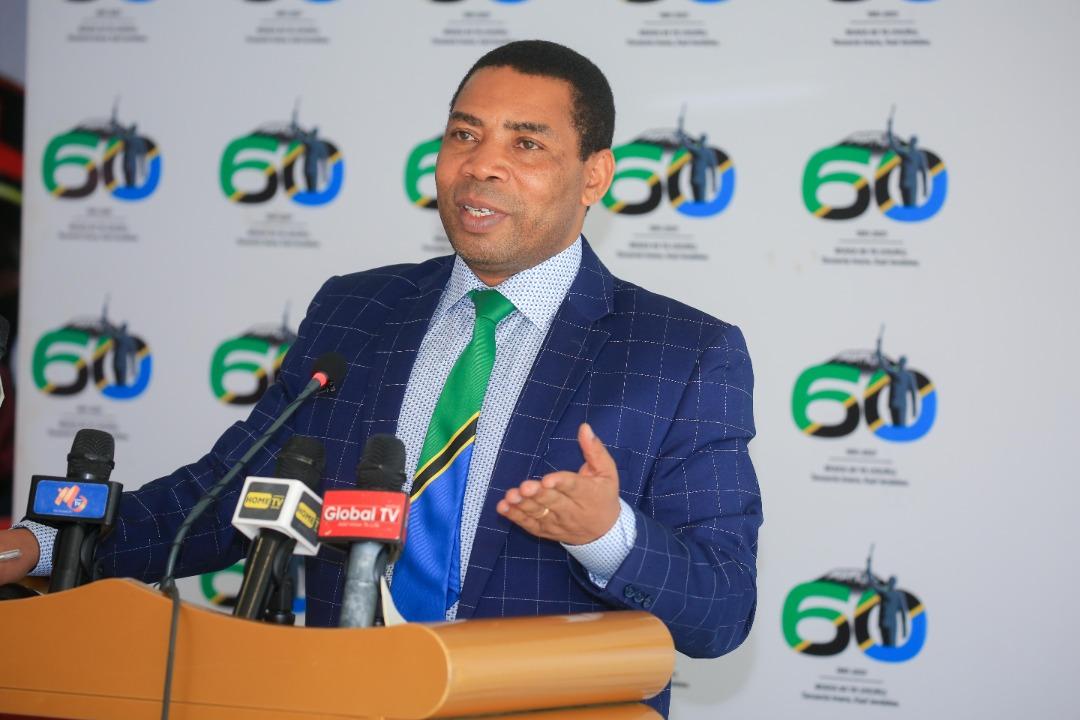
Finance and Planning Minister, Dr Mwigulu Nchemba, revealed this yesterday when detailing the achievements, challenges and direction of the ministry, ahead of the 60th Independence Anniversary on December 9th.
Dr Nchemba said the positive results in economic parameters including rapid economic growth, stabilisation of the shilling and inflation that remained in the single-digit spectrum for a long time.
He pointed out that the average per capita income has been increasing year by year rom an average of US $ 178.3 (1990/1995) to an average of US $ 1,010 during the fifthphase government.
“The level of poverty has continued to decline with the level of basic necessities falling to 25.7 per cent in 2020 from 38.6 per cent in 1992,” said Dr Nchemba.
“The decline in poverty is due to government efforts in improving basic social services including access to water, electricity, health care, free basic education as well as the empowerment of poor households through the Tanzania Social Action Fund (TASAF) programmes,” he added.
According to the Finance and Planning Minister, the inflation also went through various periods of ups and downs with the highest inflation rate being posted in 1984 at (36.1 per cent), in 1990 (35.9 per cent) and in 1994 (35.3 per cent).
Such was due to long droughts and rising oil prices in the world market, with Minister Mwigulu noting that the last time the country experienced a double-digit inflation was in 2012, when it reached 16.1 per cent.
“Since then, inflation has continued to decline steadily to a single digit and remain within the targets set by the convergence criteria set by the East Africa Community (EAC) member states of 8 per cent and the Southern African Development Community (3 – 7 per cent). “In 2020, inflation was 3.3 per cent compared to 3.4 per cent in 2019, the decline in inflation was due to a number of factors including the effective implementation of monetary policy and budget, stabilisation of oil prices in the world market, and strengthening of the shilling against other currencies in the world, and improved access to food products in local markets and neighbouring countries,” he said.
Dr Nchemba further revealed that revenue collection has also improved from total revenue of 5.55bn/- (1966/1985) to 5.5tri/- in the first quarter of 2021/22 equivalent to 89.9 per cent of the collection target.
Similarly, he said a growing demand for financial services contributed to growth in the financial sector, whereas in 2020, there were a total of 55 banks and financial institutions, 32 insurance companies, 28 market and capital companies and two social security funds.
Also, there are 549 non-deposit taking financial institutions, third-tier providers SACCOSS (460) and four-tier providers (11,149). Such efforts, he said, resulted in increased levels of access to integrated services from 56 per cent in 2013 to 65 per cent in 2017 expected to increase to 75 per cent in 2022.
He said the achievement is in line with technological reforms that have enabled mobile networks to swiftly operate in the country since the early 2000s, which has brought financial services much closer to the people.
Likewise, the government has continued to make various efforts to strengthen revenue management including the establishment of the Tanzania Revenue Authority (TRA) in 1997 and to strengthen the use of electronic systems in local revenue collections.
Although there is a growing increase in revenue, the country has still not met the target, thereby affecting its ability to achieve the set goals of providing basic services to the people as well as the implementation of development projects.
He cited an example of the financial year 2020/21, when domestic revenue accounted for 85.6 per cent of the target. Domestic revenue collected in the first quarter of 2021/22 amounted to 5.5tri/-, equivalent to 89 per cent of the target of 6.2tri/-.
Among factors which are hindering the government from arriving at the target includes some unscrupulous traders evading taxes, through smuggling, transfer of profits to companies with global network and non-issuance of electronic receipts. Dr Nchemba noted that before the year 2015, the budget allocated to development projects accounted for less than 25 per cent before agreeing to increase the budget to between 30-40 per cent.
The move enabled the government to execute its key strategic projects including the Standard Gauge Railway (SGR), whereby the Dar es Salaam-Morogoro stretch stands at 93 per cent and the 2,115 megawatts Julius Nyerere Hydro Power Project (JNHPP), whose implementation is at 55.6 per cent among others.
In addition, dependence on grants and soft loans has continued to decline from an average of 20.7 per cent of the total budget for the years 2010/11 – 2014/15 up to an average of 9.2 per cent in 2015/16 – 2019/20.
He noted that the decrease in dependence on grants and soft loans was due to government efforts in strengthening domestic revenue collection. Dr Nchemba also revealed that the country’s reserves have increased from 183.74 million US dollars in 1995 to 6,406 million US dollars in the first six months of President Samia Suluhu Hassan’s administration.
The minister maintained that Tanzania is bound to benefit more from the financial sector if more people are engaged in the productive sectors.
For More News And Analysis About Tanzania Follow Africa-Press