
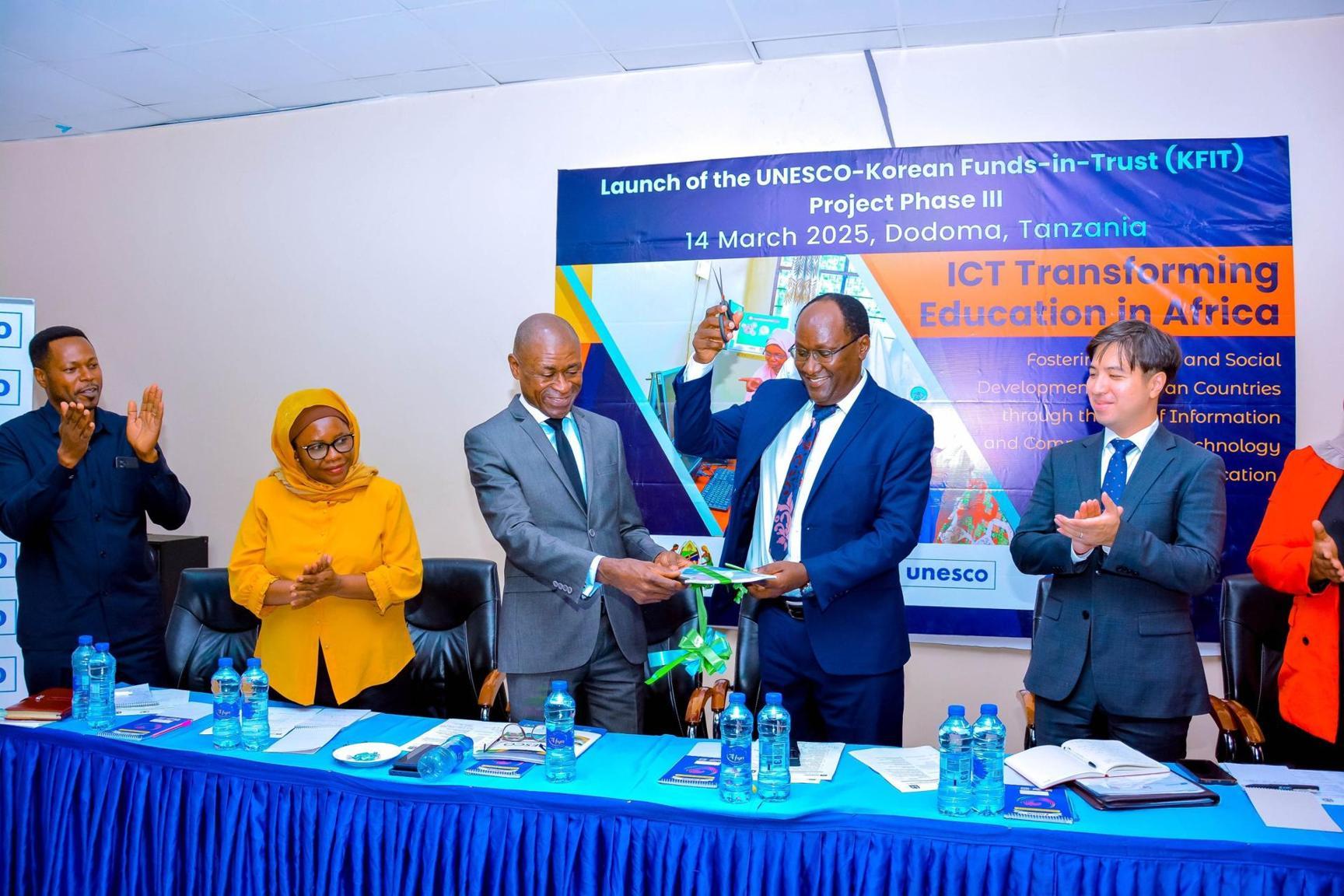
Africa-Press – Tanzania. TANZANIA, in partnership with South Korea and the United Nations Educational, Scientific and Cultural Organisation (UNESCO), has launched a national e-learning platform to strengthen ICT competence among teachers and students.
The initiative is part of the UNESCO-Korea Fundsin-Trust (KFIT) Phase III Project, ICT Transforming Education in Africa, which integrates innovative ICTbased approaches to enhance school resilience in selected African countries.
Speaking at the launch in Dodoma, Deputy Permanent Secretary in the Ministry of Education, Science and Technology, Professor Daniel Mushi, said the project will support digital content development, assessment and capacity building from 2024 to 2027.
“The government has made significant progress in integrating ICT into education through ongoing reforms. The curricula for basic and teacher education incorporate ICT in all subjects, aligning with the 2014 Education and Training Policy Version 2023. With UNESCO’s leadership and strong collaboration, teachers and learners will be equipped to thrive in this digital era,” he said.
Tanzania is one of three African nations selected for KFIT III, alongside Uganda and Namibia.
The initiative, valued at 379,745 US dollars (approximately 10bn/-), supports both school-based and home-based learning, aligning with Tanzania’s education transformation goals.
Prof Mushi encouraged teachers, administrators and students to embrace technology, describing it as a tool for transformation.
“Technology is a gateway to endless possibilities. Use it not only to enhance classroom learning but also to positively impact your communities and the nation,” he said.
UNESCO’s Chief of Section for ICT and AI in Education, Ms Shafika Isaacs, emphasised the project’s role in ensuring inclusive and highquality education.
“Technology in education must be seen as a means to an end, with the ultimate goal of ensuring access to quality education for all students in Tanzania,” she said, commending the project’s alignment with Tanzania’s national priorities.
Since 2016, the KFIT project has been implemented in nine countries, including Mozambique, Zimbabwe, Rwanda, Senegal, Ghana, Côte d’Ivoire, Namibia, Uganda and Tanzania.
UNESCO Head of Office and Country Representative, Mr Michael Toto, reaffirmed the project’s alignment with Tanzania’s education reforms, which emphasize ICT integration in teaching and learning.
“Access to technology remains uneven, with urban areas benefiting more than rural and remote regions. Addressing these challenges requires a collective effort, and the KFIT III project presents a valuable opportunity to support Tanzania’s efforts in closing the digital gap,” he said.
The Deputy Chief of Mission from the South Korean Embassy ,Mr Lee Seungyun highlighted that the project will enhance ICT-based education through the development of a digital learning platform, strengthening educators’ digital competencies, and improving education policies related to ICT learning.
“Through these ongoing ICT projects and the Korea-UNESCO partnership, we hope to see further advancements in ICT infrastructure and software, ultimately preparing Tanzania’s youth for the nation’s Development Vision 2050,” he said.
For More News And Analysis About Tanzania Follow Africa-Press