
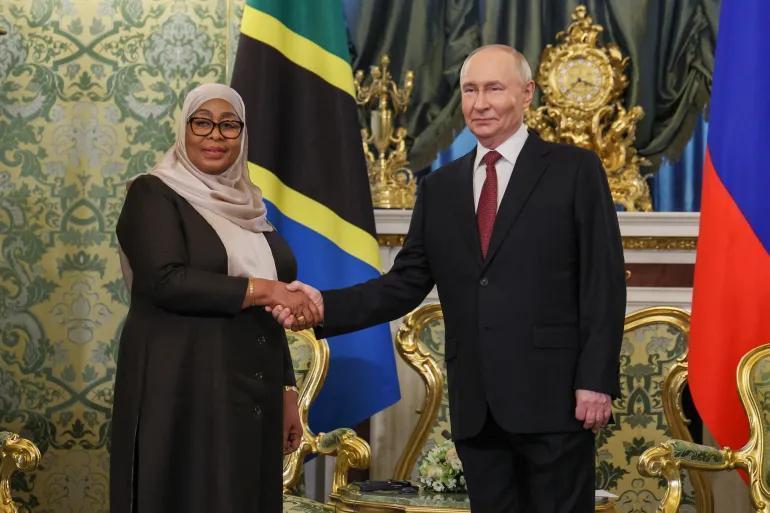
Africa-Press – Tanzania. Tanzanian President Samia Suluhu Hassan began an official visit to Russia from June 3 to 5, 2026, marking the first visit of a Tanzanian leader to Russia in over five decades. This visit aimed to strengthen bilateral relations and expand economic cooperation between the two countries.
The visit recalled the last trip made by a Tanzanian leader to Russia in 1969, when the late Julius Nyerere visited the Soviet Union. Discussions during the visit focused on energy, mining, agriculture, infrastructure, and transportation. The Tanzanian president also participated in the St. Petersburg International Economic Forum.
The visit came at a politically sensitive time, with rising Western criticism directed at the Tanzanian government since the elections held in October 2025 and the subsequent violence.
The United States, several European countries, and the European Union have intensified their criticism of Dar es Salaam, with U.S. officials calling for a reassessment of relations with Tanzania and increased accountability regarding reported human rights violations following the elections.
Alex Vines, Director of the Africa Program at the European Council on Foreign Relations, noted that the timing of the visit was linked to this political context, indicating that it had been planned for a long time. However, the Western pressures faced by Tanzania since late 2025 were one of the surrounding factors.
Vines stated that the visit did not represent a radical shift in the geopolitical balances in the region, explaining that the United States appeared less concerned about this move compared to European countries, given Washington’s focus on competition with China rather than Russia.
He also anticipated that Brussels would closely monitor the outcomes of the visit, especially amid ongoing discussions about major European projects in the energy sector within Tanzania.
Through this visit, Russia sought to enhance its presence in East Africa amid strong competition from various international and regional powers, including China, the European Union, Gulf states, Turkey, and Egypt, in a market described by observers as highly competitive.
Tanzanian researcher Thomas Kibuana emphasized that the visit should be understood in its historical context rather than just its political implications, noting that relations between the two countries date back to the early independence of Tanganyika in 1961, when the Soviet Union was one of the first countries to recognize the nation’s independence and establish diplomatic relations shortly after the declaration.
Kibuana explained that focusing on current tensions with the West might overlook the economic dimension of Russian-Tanzanian relations, pointing out that Russian investments in Tanzania have reached approximately $400 million across 44 different projects, contributing to the creation of nearly three thousand job opportunities.
Russia has also maintained a prominent presence in the strategic minerals sector within Tanzania by participating in several lithium mining projects.
The researcher rejected the characterization of the visit as an indication of Tanzania’s shift toward Russia, asserting that Tanzanian foreign policy is based on diversifying international partnerships rather than severing ties with Western partners. He noted that many African countries have adopted a similar policy of expanding economic and diplomatic relations with various international powers.
Estimates suggest that the actual impact of the visit will be determined by the agreements reached, particularly in the sectors of mining, agriculture, infrastructure, and transportation, while continuing interest in potential cooperation in defense and civil nuclear energy remains.
The visit also included the honorary award presented to President Samia Suluhu Hassan by a Russian university, in recognition of her diplomatic efforts and her policy aimed at diversifying international partnerships and enhancing Tanzania’s position on the international stage.