
Africa-Press – Tanzania. UNITED Nations Industrial Development Organisation (UNIDO), in collaboration with the Vice President’s Office (Environment), is implementing a project called “Promotion of Waste to Energy (WtE) Applications in Agro-Industries of Tanzania”.
The project is funded by Global Environment Facility (GEF) along with their stakeholders from government institutions and ministries. The aim is to support Mafia Island to produce electricity using alternative power sources. It will be able to produce up to 1,400KW. It is implemented in line with President Samia Suluhu Hassan’s stance on measures to mitigate environmental pollution and promote business and economic development on the island.
In an interview with ‘Daily News’, UNIDO National Project Coordinator for Energy and Environment Robert Washija said the project would enable Mafia Island, which is situated in the Indian Ocean, to use green sources of power and protect the environment for current and future generations.
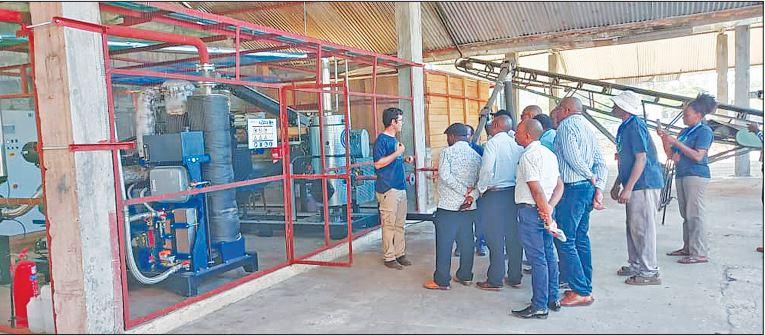
“UNIDO is supporting Kisiwani Farming Limited to intensify its use of residues from coconut oil plantations to generate electricity through modular thermal gasification and boost the island’s power supply system,” he said.
He explained that the company owned 2,700 plantation hectares and Mafia Island had already started using power from this source and all that was needed was financial and expert support so that it could produce electricity to its full capacity and get rid of diesel generators which had adverse effects on the environment.
Other stakeholders from public and private sectors joining UNIDO in this regard include the Ministry on Energy (MoE), Costech, Rural Energy Agency (REA), Tanesco and Dar es Salaam Institute of Technology (DIT) – all of which are part of the Project Steering Committee (PSC).
This project aims at promoting the use of waste to energy technologies, more specifically the application of biomass and biogas technologies in agro-industries. It was selected due to its rapid scaling up and greenhouse gas (GHG) emissions reduction potential. This is in line with a GEF-5 climate change focal area strategic programme that promotes investment in rural energy technologies. On October 21, 2021 UNIDO with PSC members visited Mafia Island.
Speaking in Glasgow, Scotland, on Tuesday during a United Nations Climate Change Conference (COP26), President Samia called on developed countries, which are major greenhouse gas emitters, to provide predictable and adequate funds to enable low income countries to achieve NDC goals sustainably.
President Samia said Tanzania’s mitigation goals had been set in all important areas, but as a developing country, it could not achieve all of its goals without adequate technical know-how support to build its capacity.
“We in Tanzania haven’t been spared by climate change effects. Sea level rise is impacting negatively our arable land and our pride – Mount Kilimanjaro – is changing due to glacier melting. We also experience unpredictable floods and droughts,” she told the summit.
She said Tanzania was experiencing all this “despite our resolve to set aside 48 million hectares for forest conservation. Our beautiful Zanzibar is struggling with temperature rise, salt water intrusion and inundation is affecting tourism and ecology.”
According to information from Tanesco website, Mafia Island, which is home to about 60,000 people, power demand is increasing. Mafia uses a generator plant with an installed capacity of 2.180KW. Its maximum demand is about 2,200KW.
According to UNIDO, pollution, climate change, habitat destruction and over-exploitation of natural resources such as fresh water and fisheries are doing great harm to human health, wellbeing and livelihoods, especially among poorer regions, and they are undermining the prospects of a long-term resilient and robust economy.
One of the prerequisites of industries to flourish in a sustainable manner is the availability of an assured supply of affordable clean energy, together with improved resource efficiency. UNIDO in Tanzania supports environmental management efforts, including the implementation of multilateral environmental agreements and the provision of sustainable clean energy.
It helps create new green industries, establishing the national road map for green supply chains, determining benchmarks and indicators, disseminating and sharing best practices, running a clean technology programme, undertaking various capacity-building initiatives and contributing to international forums with necessary research and expertise.
President Samia also said the country had put in place a national climate change response strategy, which aimed at reducing greenhouse gas emissions in a sustainable manner.
She said through hydro-geothermal and solar Tanzania had increased power generation and access rate from 43 per cent in 2017 to about 70 per cent in 2020.
She explained the country’s reforestation rate had increased from 25 to 27 per cent in 2020 and 276 million trees were being planted every year. “We know what is needed and what works. Our solidarity and commitment as leaders will be measured not by the ambitions we set today, but our actions across all pillars of Paris Agreements, mitigation and adaptation,” she emphasised, while addressing the COP26. She also said if the world won’t act accordingly, then developing countries, that had the lower adoptive capacity, remained with no option, but brace for more devastating eventualities.
Tanzania has alternative sources of power which include hydroelectric power, wind power and natural gas which boost the national grid. Apart from the melting of glaciers of Mount Kilimanjaro, Africa’s highest point, there are other indicators of climate change effects.
They include merging river banks and the water of Lake Victoria is submerging dry land in Kagera and Mwanza regions. The Indian Ocean in Dar es Salaam has seen salinity water misbehaving to dry land.
The rainy season is no longer predictable like it was in the past. All this needs urgent intervention.
For More News And Analysis About Tanzania Follow Africa-Press