

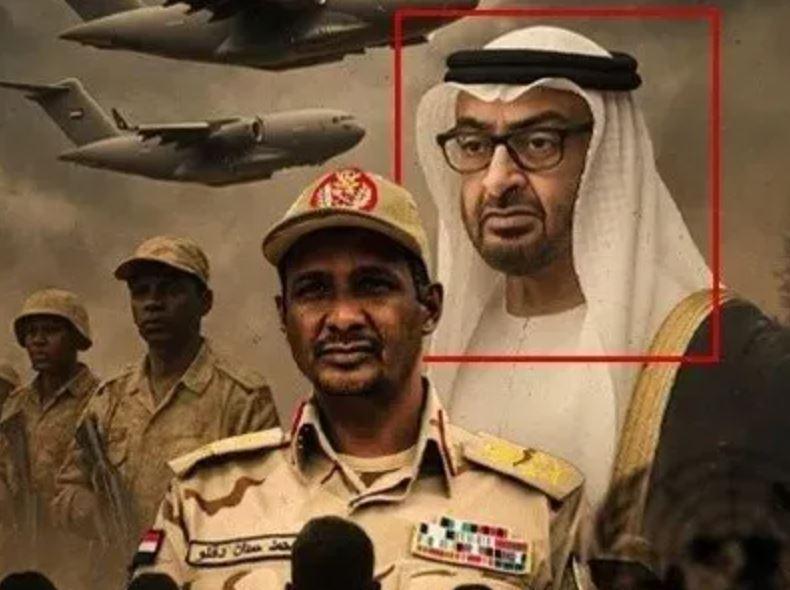
Africa-Press – Tanzania. A legal analytical study has indicated that the role of the UAE in the Sudanese war has gone beyond mere political or indirect military support, raising legal questions about Abu Dhabi’s responsibility for atrocities in Sudan through the funding of hundreds of mercenaries from Colombian military contractors and support for the Rapid Support Forces (RSF).
The study published by a local source highlighted the support network provided by the UAE to the RSF and the role played by private security companies linked to the UAE in recruiting, transporting, and financing military contractors from Colombia, some of whom participated in military operations that led to the RSF’s control over the city of El Fasher.
This study comes at a time when fears are rising about the potential repetition of the El Fasher scenario in the city of El Obeid and areas of North Kordofan, as the United Nations and other countries have warned of the possibility of new atrocities as the RSF continues its advance.
The study recalls that reports from El Fasher spoke of mass killings, targeting of non-Arab communities, and widespread sexual violence, while Amnesty International concluded, according to the study, that the RSF had committed crimes against humanity. The UN fact-finding mission found that what occurred in El Fasher and its surroundings bore “characteristics of genocide.”
The UAE as the Primary Military Supporter
The study states that the RSF received multiple external supports but describes the UAE as the most significant source of military assistance received by these forces.
According to reports cited in the study, this support included weapons used in RSF operations in El Fasher and elsewhere, including Chinese-made drones and Serbian thermal ammunition.
However, the most sensitive point in the study concerns the network of mercenaries or foreign military contractors. It refers to reports from organizations including Human Rights Watch and the Conflict Insights Group, which discussed the participation of hundreds of former Colombian soldiers in military operations of the RSF.
According to these reports, Colombian contractors worked in various roles, including piloting drones, operating artillery, and training, while one contractor spoke to Human Rights Watch about conducting “joint operations” with the RSF.
The study also indicates that witness testimonies have mentioned the presence of foreign fighters in areas that witnessed mass killings and rape.
It raises the possibility that some of these contractors themselves may be involved in violations of international law, whether through operating armed drones in operations targeting civilians or training children forced to participate in combat.
UAE-based Company Links to Senior Officials
The study highlighted the company Global Security Services Group (GSSG), based in the UAE, which reports indicate employed Colombian contractors and paid their wages.
According to the study citing Human Rights Watch, the UAE facilitated the travel of these contractors to Sudan, while some received training from Emirati nationals at a military base in Abu Dhabi.
The seriousness of these incidents increases, according to the study, due to what it describes as the close connection between the company and high-ranking Emirati officials, in addition to obtaining licenses from Emirati government entities to conduct security activities.
Here, the study shifts from the political aspect to the legal question: Can what these contractors did be considered a private act, or were they performing government tasks on behalf of the UAE?
It argues that this possibility warrants a serious legal investigation, as international law allows under certain circumstances for the actions of a private entity to be attributed to the state when that entity is legally authorized to perform governmental functions.
According to the study, delegating a private company to carry out military tasks in another country can fall within the scope of exercising governmental authority, especially since the use of military force is one of the most closely associated powers with state authority.
Attributing RSF Crimes
The study provided a more cautious legal assessment regarding the UAE’s direct responsibility for the crimes committed by the RSF.
It confirms that the publicly available evidence, while showing the extent of the military and financial support received by the forces, is currently insufficient to prove that the RSF was merely a device subordinate to the UAE or that it was operating under “effective control” directly from Abu Dhabi.
It clarifies that international law sets a very high standard for attributing the actions of an armed group to a foreign state, as it must be proven that the state was exercising control over the specific actions that constituted violations of international law, not merely providing weapons, funding, or military support.
Thus, the study concludes that the available information does not legally allow, at this time, for all RSF atrocities to be considered actions directly attributable to the UAE.
However, this conclusion does not absolve Abu Dhabi of potential legal responsibility. The study distinguishes between the UAE’s responsibility for the actions of the RSF itself and its potential responsibility for the actions of military contractors who may have operated under the authorization or legal cover of Emirati institutions.
Mercenaries May Open the Door to International Responsibility
The study sees this point as one of the most dangerous aspects of the issue. If it is proven that the UAE delegated GSSG or another company to provide fighters or military support to the RSF, then the actions committed by these contractors while carrying out those tasks may be attributable to the UAE.
In this case, any violations of international law, such as targeting civilians or operating drones in attacks against them or training children for combat, could shift from potential crimes committed by individuals to internationally unlawful acts that could impose direct responsibility on Abu Dhabi.
The study indicates that the potential legal outcomes could include the UAE’s obligation to cease harmful conduct and provide full compensation for the damages caused.
It also goes further, considering that the UAE’s support for the RSF could raise independent legal responsibilities even if all actions of the forces cannot be directly attributed to it. Among these possibilities is the breach of the duty to prevent genocide or violating international rules regarding the use of force by arming an armed group that carried out acts of violence within Sudan.
A Call Not to Ignore the Emirati Role
In a direct conclusion, the study criticizes what it describes as the hesitation of foreign countries to confront the UAE due to its role in the Sudanese war, calling for attention not only to the crimes of the RSF but also to the behavior of its external supporters.
It emphasizes that Abu Dhabi, according to its analysis, cannot be separated from the military scene that enabled the RSF to continue its operations, even if the currently available evidence is insufficient to directly attribute all the crimes of these forces to it.
As battles approach the city of El Obeid, the study warns that the world faces a new test: Will it continue to treat the UAE as merely an external party providing support, or will the evidence related to the network of arms, funding, and military contractors turn into a legal and political accountability file that places Abu Dhabi directly responsible for its role in one of the bloodiest wars in the region?
The clearest conclusion in the Just Security study is that reliance on armed groups and mercenaries does not necessarily absolve the supporting state from responsibility, and that the network of Colombian contractors may form the legal link connecting Emirati support to potential crimes on the ground in Sudan.