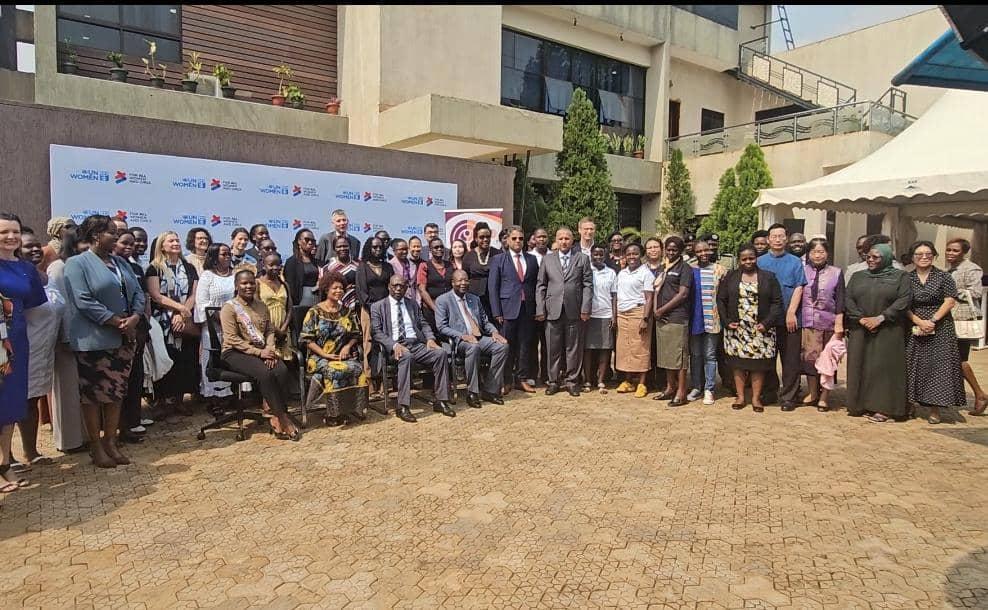
Africa-Press – Uganda. Uganda has reaffirmed its position as a regional and global champion on the Women, Peace and Security (WPS) agenda during the Women Uganda 2025+ Exhibition and Knowledge Fair, held to commemorate 25 years of United Nations Security Council Resolution 1325.
Organized by UN Women in partnership with the UN Resident Coordinator’s Office, the event forms part of the broader Women Uganda 2025+ Campaign, which promotes gender equality as a shared responsibility benefiting women, men, girls, and boys alike.
Speaking at the exhibition, Paulina Chiwangu, the UN Women Representative in Uganda, said the event was designed to recognize and celebrate the critical role women play in peacebuilding, while making their contributions visible and documented.
“This year marks the 25th anniversary of the landmark UN Security Council Resolution 1325 on Women, Peace and Security. For a quarter century, this resolution has helped shape peace outcomes globally, and Uganda has been a recognized champion of this agenda since 2008,” Chiwangu said.
She noted that Uganda’s success lies in its inclusive and participatory approach, supported by strong coordination structures led by the Ministry of Gender—a model studied and adopted by several countries in the region, including Ethiopia, Tanzania, and South Sudan. Uganda has also received international recognition for localizing the WPS agenda to community and district levels.
“The exhibition goes beyond celebration, serving as an act of recognition and restoration. Too often, the stories of women peacebuilders remain invisible and undocumented. Through photographs, videos, and dialogue, this exhibition brings to light the reality that women are not passive beneficiaries of peace—they are its architects, mediators, frontline defenders, and healers,” she added.
The United Nations Resident Coordinator in Uganda, Leonard Zulu, described Resolution 1325 as historic for redefining the global understanding of peace.
“Over the past 25 years, evidence has consistently shown that when women are included at all stages of peacebuilding—negotiation, mediation, and reintegration—peace agreements are more durable, communities safer, and recovery faster,” Zulu said, quoting the UN Secretary-General: “When women and girls rise, we all rise.”
Zulu also praised the Women Uganda 2025+ Campaign for bringing together women leaders and male champions to promote positive narratives around gender equality, emphasizing that gender equality is a societal imperative, not just a women’s issue.
Representing the Government of Uganda, State Minister for the Elderly, Mafabi Gidudu, commended UN Women and the UN Resident Coordinator’s Office for choosing Uganda to host the landmark event.
She highlighted Uganda’s progress, including 34 percent women representation in Parliament and 45 percent in Cabinet, ratification of international and regional instruments like the Beijing Platform for Action, and initiatives such as the Parish Development Model and GROW Project to improve women’s socio-economic wellbeing.
“Women are not merely victims of conflict. They are crucial agents of peace, recovery, and transformation—from national leadership to grassroots communities,” the Minister said.
The exhibition and knowledge fair highlighted women-led peacebuilding initiatives at the community level, showcasing evidence, best practices, and lessons from across the country.
While progress has been made, stakeholders acknowledged persistent challenges including gender-based violence, harmful cultural norms, unpaid care work, unemployment, and poverty, which continue to hinder women’s full participation in peace and development.
As Uganda marks 25 years of UNSCR 1325 and 30 years of the Beijing Platform for Action, speakers called for renewed commitment to inclusive leadership, documentation of grassroots innovations, and sustained investment in women’s leadership.
The exhibition concluded with a call to action for stakeholders to build on existing gains and ensure that the next chapter of the Women, Peace and Security agenda in Uganda remains inclusive, community-driven, and impactful.
For More News And Analysis About Uganda Follow Africa-Press