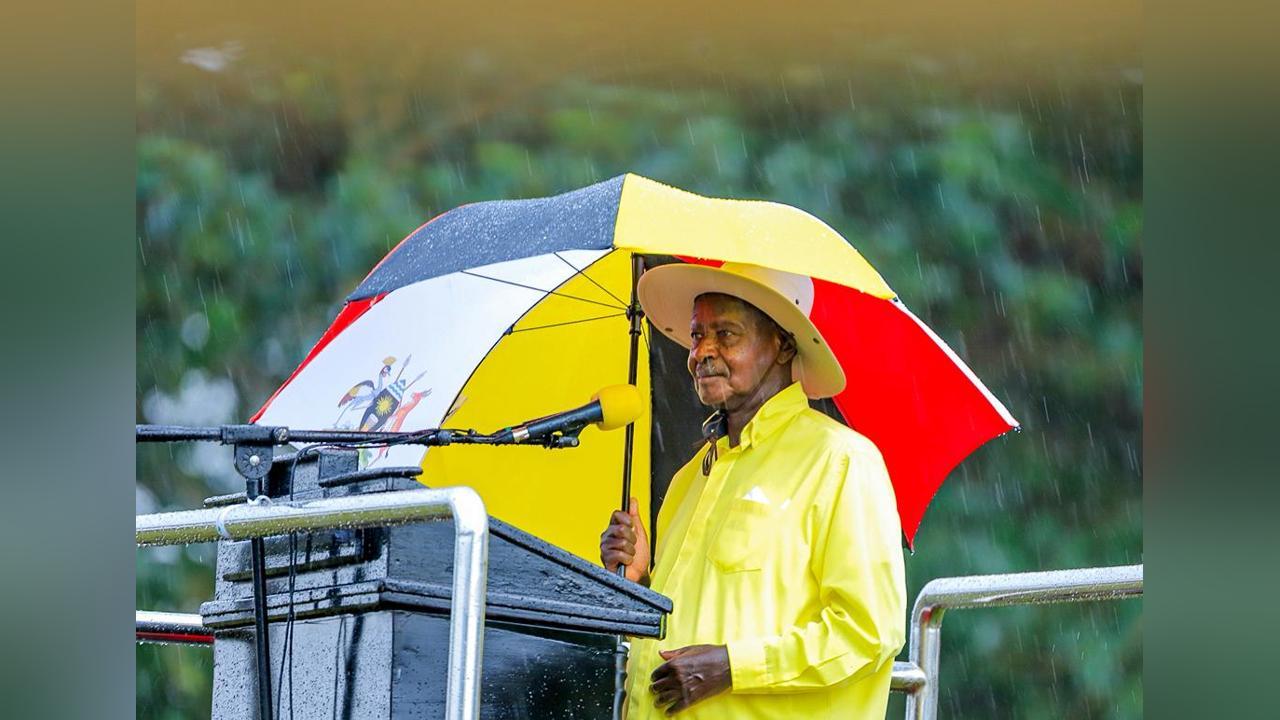
Africa-Press – Uganda. President Museveni has said the government is deliberately sequencing Uganda’s development, arguing that support for creatives and local innovation is part of a broader, long-term plan rather than an omission.
Museveni was responding to a question on why there appears to be no deliberate government efforts to support local innovation and creative skills, yet Ugandans continue to import skills and services that citizens are capable of providing themselves.
This was during a youth interaction with President Museveni dubbed ‘Jazz With Jajja’ at State Lodge in Nakasero on Sunday.
In his response, the President placed the debate in a long historical context, tracing Uganda’s economic and social evolution from pre-colonial times to the present.
“You must know where you are coming from,” Museveni said. “This land is populated by us — the Bantu of the lakes, the Nilotics, and other groups like the Lugbara from Central Africa, the Karimojong and the Ateso.”
He explained that these communities had endured centuries of instability. “These people had a lot of problems in the past,” he noted, pointing to the collapse of the Bachwezi period and the rise of new kingdoms such as Bunyoro, Buganda, Rwanda and Ankole.
“After the Bachwezi collapsed, new kingdoms came up and started causing wars, until the British came and captured them like grasshoppers.”
Museveni acknowledged that governance under the old kingdoms was weak but stressed that society itself was productive.
“Although governance of kings was poor, the population was very strong. People had what we called emyooga — skills.”
He emphasized that before colonialism, nearly everyone had a practical trade.
“Before Europeans came, everyone had a skill. There were cattle keepers, blacksmiths, carpenters, surgeons — people knew how to do things.”
According to the President, colonial rule disrupted this system.
“When the Europeans captured us, they killed all these skills and brought a very narrow money economy,” he said. “It was the economy of the three Cs — coffee, cotton and copper — and later the three Ts: tobacco, tea and tourism.”
He described this model as an “enclave economy,” explaining that it created “a small island of modernity surrounded by a big area of backwardness.”
“The original myooga were killed,” Museveni said. “Everything was being imported.”
He further argued that the post-independence turmoil worsened the situation. “When Idi Amin came, he killed it even more,” he said, before crediting the National Resistance Movement (NRM) government with reversing the trend. “When NRM came, it revived these efforts.”
Museveni outlined what he called Uganda’s phased economic strategy. “We started with minimum recovery,” he said. “Then we expanded it, diversified it, and brought in more products into the money economy.”
He explained that crops once regarded purely as food were deliberately commercialized. “Maize, milk, bananas — these were not cash products,” Museveni said. “We put products that were previously regarded as food crops into the money economy.”
According to the President, this was followed by value addition and has now reached a new stage. “The fourth phase is value addition,” he said. “The fifth phase is the knowledge economy. Now we have gone to phase five.”
Using sports infrastructure as an example, Museveni defended government priorities. “People ask, why have we only built Namboole, repaired Nakivubo and built Hoima?” he said. “It is not that we didn’t know football or sports were important.”
He added, “We knew there were other more important things that would help us do everything else — electricity, security, roads. You must have the basics first.”
Museveni argued that the emergence of creative and sporting talent in Uganda is already linked to broader stability.
“When you see these talents coming up, it is mainly because of peace and education,” he said. “They are not so much supported, but they come up because of progress in peace.”
He reiterated that government emphasis has been intentional. “Our emphasis has been on agriculture and manufacturing,” Museveni said. “We wanted to build the base first, then go to the others.”
The President insisted that creatives and innovators have not been forgotten. “We are aware,” he said. “We haven’t forgotten you, but it is coming.”
He contrasted Uganda with industrialized nations that rely heavily on imports. “Uganda is very rich, unlike other countries you admire,” Museveni said. “Japan does not have capacity for agriculture or raw materials for manufacturing. They depend on importation.”
“We are not like Germany, South Korea or Japan,” he added. “We have almost everything.”
However, Museveni pointed to what he believes is Uganda’s main weakness.
“The only thing we lack is understanding the importance of the market,” he said. “Once you understand the market and have the basics, everything else follows.”
As the economy expands, diversifies and transforms, Museveni said, more deliberate support for creatives and innovators will follow. “Time will come to pay more attention to you,” he said. “But you must first build the foundation.”
For More News And Analysis About Uganda Follow Africa-Press