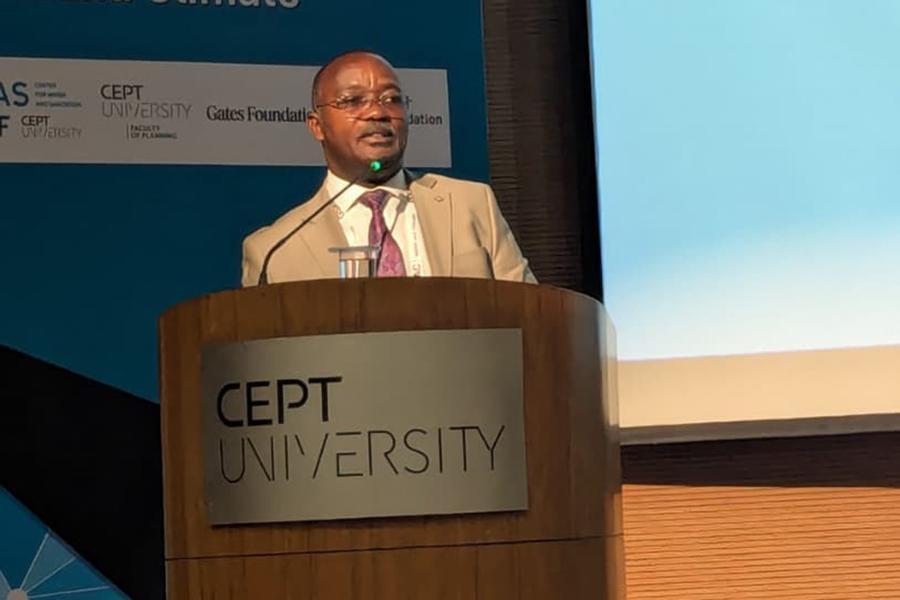
Africa-Press – Uganda. The Managing Director of the National Water and Sewerage Corporation (NWSC), Eng Dr Silver Mugisha, has outlined how public utilities can transform into high-performing, customer-focused organizations, emphasizing innovation, accountability, and climate resilience during his keynote address at the Global South Academic Conclave (GSAC) 2026 in India.
Dr Mugisha emphasized that in the “Global South reality,” utilities occupy a critical space at the intersection of climate resilience, governance, public finance, and social equity.
“Engineering builds systems; service delivery builds trust,” he said, outlining the Corporation’s transformation from a broken state before 1998 to today’s era of operational efficiency, service equity, and jurisdictional expansion.
NWSC now operates in over 287 towns, up from just 23 in 2013, managing over 1 million water connections and serving more than 22 million people.
Its annual turnover has grown from Shs170 billion to Shs622 billion over the past decade.
A cornerstone of this transformation, Dr Mugisha said, has been the use of incentive-based “New Performance Management” contracts, which set clear corporate, area, and individual performance indicators to ensure accountability.
“What gets measured gets managed,” he said, noting that these contracts have shifted staff toward financial self-reliance and a “utility as a business” mindset.
Digital innovation has also played a central role. By developing homegrown systems for real-time monitoring, NWSC has improved billing efficiency and reduced non-revenue water while avoiding the high cost of off-the-shelf software.
Despite progress, Dr Mugisha acknowledged persistent challenges, including climate variability, rapid urban growth, and the proliferation of informal settlements, which continue to strain infrastructure and service delivery.
One key concern remains the disparity between water and sanitation financing, with sewerage infrastructure lagging due to high costs and lower cost recovery.
NWSC has established a Strategic Research Committee to support evidence-based decisions, citing a recent study on meter accuracy involving 1,200 units as an example of applied research improving operations.
Dr Mugisha called for stronger academia-utility partnerships, urging researchers to focus on practical solutions and grassroots innovation that address Global South challenges.
“We need to invest in ecosystems bridging the classroom and the field. Engineering innovation must drive the water and sanitation transformation agenda,” he said.
The NWSC Corporate Plan 2024–2027 sets ambitious targets, aiming to expand services to 350 towns and 26 million people by 2030.
Priority areas include climate stewardship and equitable service provision for vulnerable populations in informal settlements.
NWSC staff also shared insights during the summit. Martin Kalibbala, Senior Manager for Performance Management & Staff Development, highlighted data-driven innovations in WASH and climate adaptation, while Penninah Nabireeba, Branch Manager at Industrial Area Branch (Kampala Water), presented success stories in urban water utility operations.
Dr Mugisha highlighted collaborations with institutions such as CEPT University, the Gates Foundation, CRDF, and the Viega Foundation, emphasizing that research partnerships are accelerating service delivery and operational excellence.
“Leadership and courage to implement reforms will decide the future of water and sanitation in the Global South. Technical challenges are vast, but human engagement and management are ultimately decisive,” Dr Mugisha said.
The Global South Academic Conclave is an international academic forum focused on issues related to water, sanitation and hygiene (WASH) and climate that brings together researchers, practitioners, policy‐makers and sector partners to share knowledge, lessons and innovations relevant to countries in the Global South.
It is organised by the Center for Water and Sanitation at CEPT University in Ahmedabad, India, in collaboration with academic partners and supported by foundations such as the Gates Foundation and the Viega Foundation.
The event serves as a cross‐learning platform to discuss governance, monitoring and financing of climate‐resilient WASH services and other development priorities.