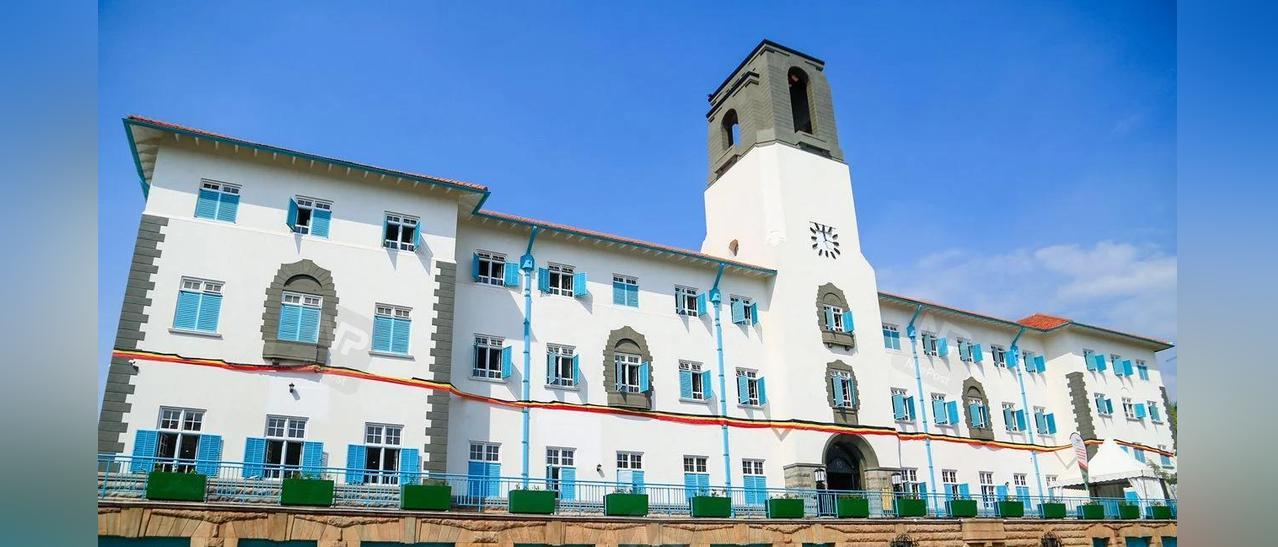
Africa-Press – Uganda. What began as a routine administrative query over staff attendance has grown into a defining debate about the soul of Makerere University, pitting managerial authority against academic autonomy and raising uncomfortable questions about how scholarly work should be measured in a modern public university.
The controversy crystallised in aJanuary 30, 2026 letter in which Makerere University asked a staff member seeking promotion to the rank of lecturer to explain a shortfall in their biometric attendance record.
Although the letter was addressed to an individual, it has since come to symbolise a much wider institutional fault line.
According to the letter from the Directorate of Human Resources, the Appointments Board, while reviewing the staff member’s promotion application to salary scale PU6.1, noted that their biometric attendance between July 1, 2025, and December 10, 2025, stood at 87.2 percent.
“The purpose of this letter is to require you to submit a written explanation on why your Biometric attendance for the period between 1st July 2025 and 10th December 2025 was at 87.2%,” the letter reads.
Signed by Chief Human Resources Officer Deus Tayari Mujuni, the communication required that the explanation be submitted by February 6, 2026.
However, while the letter did not specify the minimum attendance threshold required for promotion – which the Nile Post has established is 90% -, it nonetheless highlighted the growing weight biometric attendance records now carry in staff evaluation and promotion processes.
Although university management insists the system is merely a neutral administrative tool, critics argue that its application, particularly in promotion decisions, signals a deeper shift in how academic productivity is defined and enforced.
Makerere University officials maintain that the biometric system is being misunderstood. They argue that attendance has always been a requirement and that biometric technology is simply a more efficient way of enforcing existing rules.
Speaking to Nile Post, Mr Tayari said the system is neither new nor punitive, noting that it was approved and officially launched by the University Council on July 24, 2024, after following all required governance processes.
“This is not a system introduced to hurt anyone. It has been approved by Council, and we have been implementing it. Other universities and institutions also use biometric attendance systems,” Mr Tayari said.
He explained that the system had been in place for some time but had previously attracted little attention.
However, the HR manager emphasized that its implementation was guided by Council resolutions and aligned with practices in other public institutions.
Importantly, Tayari rejected claims that the system was intended to restrict lecturers from engaging in external academic or private work.
“The system allows staff to engage in teaching, research, and community service, including outside the university, as long as these activities are properly declared. It is about accountability, not limiting academic freedom,” he said.
Yet despite these assurances, opposition from academic staff has continued to intensify.
For the Makerere University Academic Staff Association (Muasa), the biometric system represents not just a technological change but a philosophical one.
The association argues that academic work cannot be governed using the same logic applied to administrative or corporate labour.
Speaking to Nile Post, Muasa General Secretary Associate Professor Jude Ssempebwa said the union’s rejection of biometric attendance has been consistent since the idea was first proposed.
“Our view is the same as it has always been. Academic staff are not shopkeepers whose productivity is measured by sitting behind a counter from eight to five,” he said.
“We are researchers. We go to the field. We engage communities. Tracking academics using a machine fundamentally changes everything we have always known the university to be,” Dr Ssempebwa added.
While management views attendance as a basic employment obligation, Muasa sees the elevation of attendance data—especially in promotion decisions—as a distortion of academic values.
“The idea that promotion is pegged to attendance is atrocious. Attendance is not one of the policy requirements for promotion. Makerere is a public institution and has an obligation to follow its policies as they are written,” Ssempebwa said.
Although the biometric system has existed for some time, the controversy escalated when staff began reporting that promotion applications were being queried or delayed due to attendance shortfalls, even where candidates had met academic benchmarks such as publications, supervision, and years of service.
This, Muasa argues, contradicts Makerere’s promotion framework, which prioritizes research output, teaching effectiveness, and scholarly contribution over physical presence.
While management has questioned why Muasa is raising objections now, Ssempebwa insists the resistance is neither sudden nor opportunistic.
According to Muasa, the issue is not merely the system’s existence but its consequences—what Ssempebwa describes as the “law of unintended effects.”
“It may not have been introduced as a witch-hunt. But whether intended or not, the effect is the same,” he said.
At the heart of the dispute is a fundamental disagreement over the nature of academic labour. Muasa argues that while attendance tracking may be suitable for administrative staff, it is ill-suited for academics whose work often occurs outside lecture rooms and offices.
“Much of academic work involves community engagement, research, supervision, examining, conferences and seminars,” Ssempebwa said.
“We even work at sister universities and are praised for it, not criticized.”
Although management has pointed out that the biometric system includes modules for declaring off-campus activities, Muasa says staff were never adequately trained to use these features.
“That was a failure on the part of the Directorate of ICT,” Ssempebwa said. “Staff were not properly sensitized on how to navigate the system.”
What is at stake?
Beyond principle, Muasa has raised serious governance concerns about the system itself. Staff reportedly do not know how attendance percentages are calculated, who controls the backend, or how errors and abuse can be detected and corrected.
“Staff are being asked about their attendance percentages but do not know how those figures are arrived at,” Ssempebwa said.
“Who audits the system? Who verifies it if someone deletes another person’s records?”
Without transparency, Muasa argues, the system risks becoming a tool of arbitrary control rather than accountability.
Makerere University Secretary Mr Yusuf Kirunda has defended the system, arguing that it enforces existing obligations rather than introducing new ones.
“The biometric system was introduced by Council as a tool for attendance management as part of the University’s digitalization programme,” Kirunda said.
He stressed that attendance requirements are already provided for in the Human Resource Manual, individual terms of employment, and applicable Public Service standards.
“Therefore, the question is about attendance, not the biometric system, which is merely a tool for managing attendance,” Kirunda said.
Kirunda also rejected claims that staff were not consulted, noting that Council engaged staff and staff association leaders during the development and approval of the biometric attendance guidelines.
Political analyst and researcher Yusuf Serunkuma argues that the debate reflects a deeper erosion of intellectual culture at Makerere.
“The system reduces intellectuals to factory workers,” Serunkuma said. “A scholar can work at home, respond to students, read, think, and write. Academic work is not confined to an office.”
He warned that rigid administrative controls risk transforming Makerere into what some critics now call a “glorified secondary school.”
According to Serunkuma, the university is shifting away from research-intensive scholarship toward mass undergraduate teaching, overcrowding, and managerial surveillance symbolized by biometric systems and physical barriers such as perimeter walls.
“A scholar’s mind works all the time. You cannot manage a university like a Sunday school,” he said.
For Muasa, the biometric system ultimately symbolizes misplaced priorities. While attendance is monitored electronically, many lecturers still lack basic tools such as laptops, reliable internet, and adequately equipped laboratories.
“How can you fail to give a lecturer a laptop,” Ssempebwa asked, “yet spend money on machines to ensure that lecturer is seated in an office?”