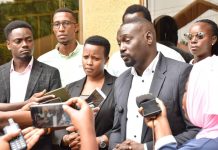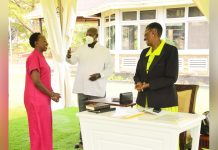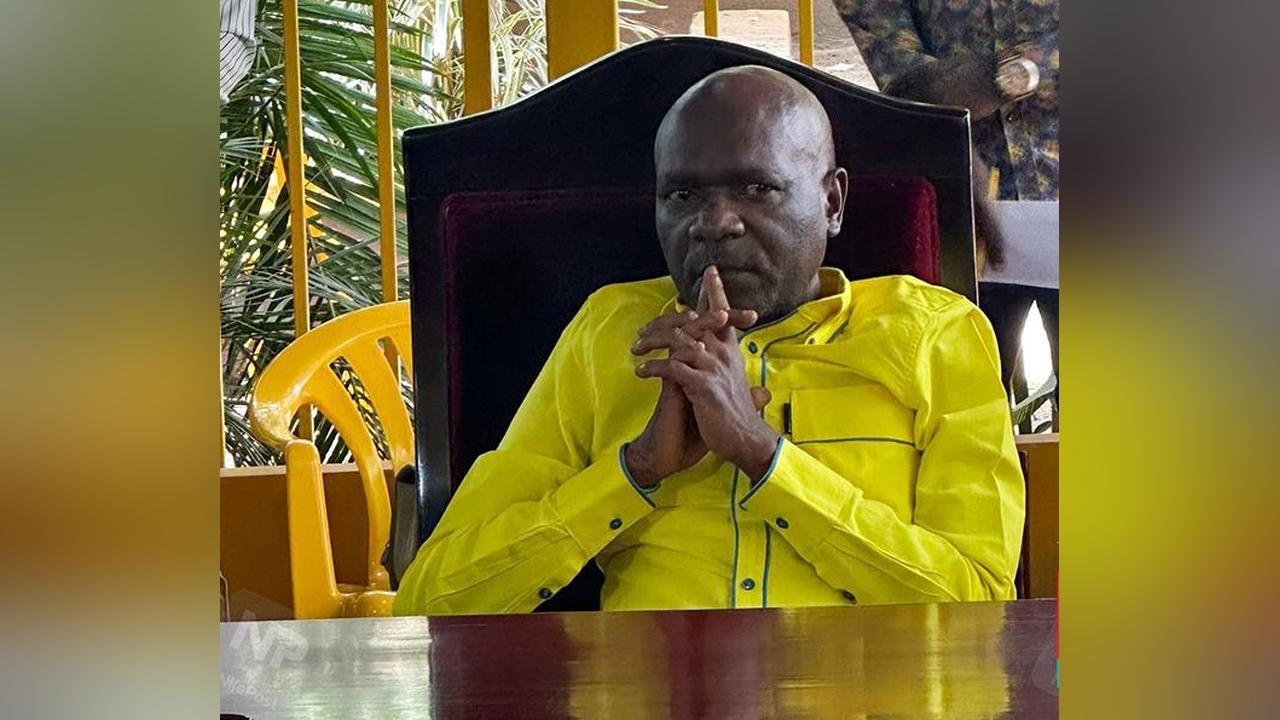
Africa-Press – Uganda. In Ugandan politics, defeat rarely signals retirement. More often, it marks the beginning of negotiations. For Yusuf Nsibambi, the outgoing Mawokota South legislator, the January 15 loss appears less like an ending and more like a transition into a different theatre of power.
Years ago, a group of Muslim leaders walked Nsibambi to President Museveni, presenting him as a pragmatic figure who could work with the establishment. He was subsequently appointed to the Kampala District Land Board, a strategic perch in a city where land is currency and influence.
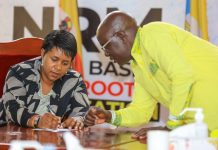
Now, after losing his parliamentary seat, Nsibambi has resurfaced in a more conspicuous embrace of the ruling National Resistance Movement (NRM). His formal unveiling at the party headquarters, led by Speaker Anita Among, was as symbolic as it was strategic.
“I am ready to join the struggle for peace. I am ready to be given any task to serve our people,” Nsibambi declared, clad in the NRM’s signature yellow.
The timing is instructive. A new Cabinet is expected in May, and the next 75 days are likely to see sustained lobbying by political heavyweights and hopefuls alike. Insiders suggest Nsibambi has dived in early—seeking not just relevance but reward.
His defeat in Mawokota South was dramatic. The former Forum for Democratic Change (FDC) parliamentary whip reportedly took it hard, at one point disconnecting electricity to a village after accusing residents of abandoning him despite his personal contribution toward purchasing a transformer. For a politician known for his vocal opposition credentials, the loss may have accelerated a recalibration.
Over the years, foreign service postings have become a soft landing for political casualties. Several former ministers and MPs have found refuge as ambassadors, enjoying prestige without the daily grind of constituency politics. Nsibambi, with a master’s degree in International Financial Crime from the University of Florida and legal experience dating back to Sebalu and Lule Advocates, would not look out of place in Ottawa or London.
But those close to the unfolding manoeuvres say he is unlikely to settle for diplomatic exile. Nsibambi does not project the temperament of a politician content with ceremonial ribbon-cutting abroad. He appears to be angling for a seat closer to the epicentre of power.
One potential landing spot is the Ministry of Lands, Housing and Urban Development, currently held by Judith Nabakooba. With his prior service on the Kampala Land Board, Nsibambi has familiarity with land governance—a sector fraught with disputes, patronage networks and political heat.
A reshuffle could see Nabakooba redeployed. The ICT and National Guidance docket, which she once held, is widely viewed as “vacant-in-waiting.” The incumbent, Dr Chris Baryomunsi, has faced public friction with the Patriotic League of Uganda, a pressure group aligned with First Son and Chief of Defence Forces General Muhoozi Kainerugaba.
Gen Muhoozi was categorical in his condemnation of Baryomunsi, declaring that the minister from Kanungu who insisted he was a Mukiga who cannot bend, would not return to Cabinet.
But there is another intriguing possibility: Justice and Constitutional Affairs. The ministry, currently headed by Norbert Mao, sits at the crossroads of legal reform and political contestation. Mao’s balancing act between Democratic Party roots and NRM alignment has often drawn scrutiny. Should he pursue ambitions such as the Speakership or fall out of favour, the docket could open.
Nsibambi, a trained lawyer who earned his Bachelor of Laws from Makerere University in 1989, would meet the professional threshold. More importantly, insiders argue he would bring a different political instinct. Unlike Mao, who has occasionally taken moderate or nuanced positions, Nsibambi is perceived as unlikely to hedge his bets. If appointed, he would be expected to toe the NRM line firmly.
His trajectory is notable. Born in 1965 in Kalagala village, Nkozi, Mpigi District, Nsibambi built a profile as a sharp opposition voice, blending legal practice with business ventures such as Jalia City in Mpigi. As FDC parliamentary whip, he was often combative. His pivot to the NRM, therefore, is less ideological evolution than strategic repositioning.
Last week’s meeting with Museveni was not a one-off. Nsibambi has acknowledged that he met the President multiple times last year, defending the engagements against claims that such visits guarantee immediate material rewards.
Yet in Uganda’s political ecosystem, proximity matters. The President’s “dining table” is both metaphor and mechanism—where appointments are whispered into being and loyalties rewarded.
Whether Nsibambi ultimately lands at Lands, Justice, ICT, or even in foreign service, his early plunge into the ruling party suggests a calculated bid to avoid political oblivion. For a man who once led opposition ranks in Buganda, the shift is dramatic but not unprecedented.
As May approaches and the Cabinet list takes shape, the question is no longer whether Nsibambi will eat. It is how big his portion will be—and at which table he will sit.