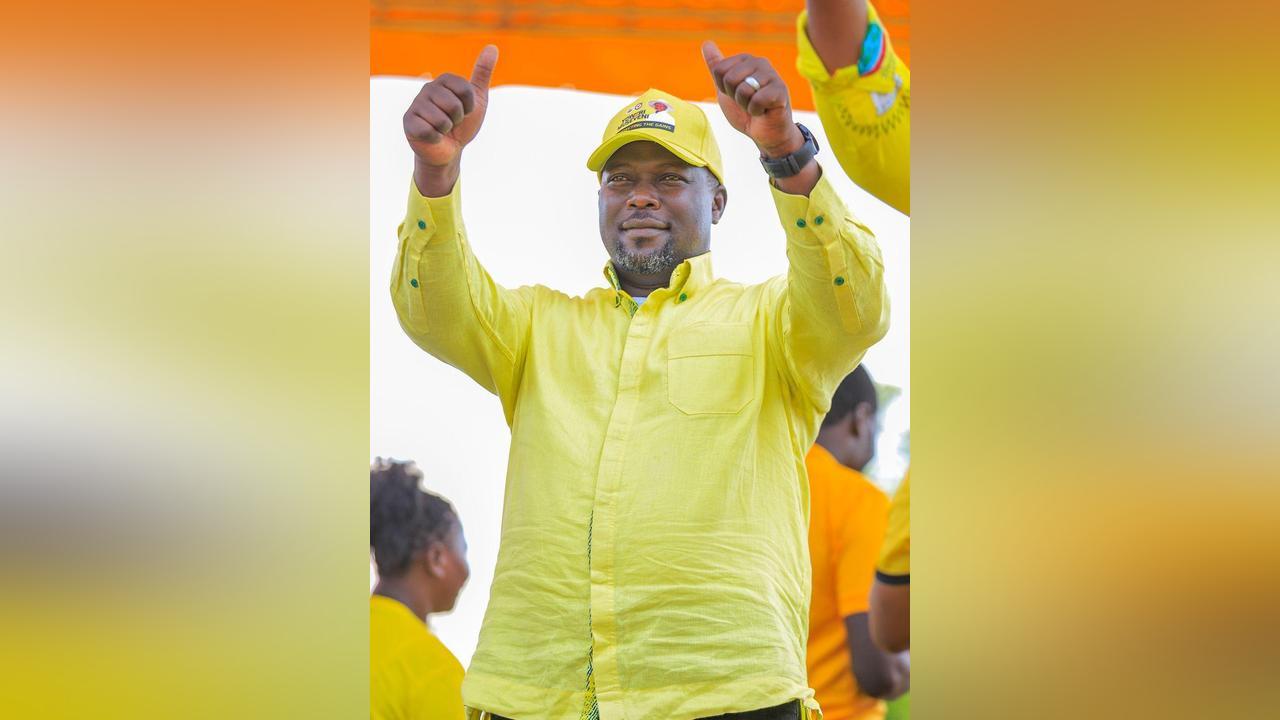
Africa-Press – Uganda. The political career of Richard Todwong reflects a gradual rise through party structures, shaped by grassroots mobilisation and long-term organisational involvement within the President Museveni-led National Resistance Movement (NRM).
In the 2026 general elections, the NRM secured 71.56 percent of the national vote — its strongest performance under a Secretary General. Party officials attribute part of that outcome to internal reforms and mobilisation efforts undertaken during Todwong’s tenure.
Early Political Engagement
Todwong’s political involvement dates back to his student years, when he emerged as an advocate for the NRM in Northern Uganda — a region that historically presented political challenges for the party. Associates from that period describe him as an organiser focused on recruitment and structure-building rather than personal visibility.
Over time, he became involved in broader party mobilisation efforts in the Acholi sub-region, contributing to the growth of NRM structures in Northern Uganda.
Parliamentary and Government Roles
Todwong later served as Member of Parliament for Nwoya County, where he gained legislative experience and constituency-level exposure. Prior to that, he held the position of Special Presidential Advisor for Northern Uganda, engaging in post-conflict political coordination and regional outreach.
He subsequently served as Minister in charge of Political Mobilisation, a role that linked government programmes with party structures. His responsibilities included coordinating outreach efforts and reinforcing alignment between state initiatives and party messaging.
His appointment as Deputy Secretary General of the NRM placed him within the party’s central administrative framework, where he was involved in managing internal processes and coordinating national activities.
Reforms at the Secretariat
Upon assuming office as Secretary General, Todwong inherited organisational and financial challenges, including historical debts and concerns about internal cohesion.
Under his leadership, the NRM Secretariat introduced a digitalised membership register, restructured financial management systems, and channelled funds directly to district accounts. Party officials say most historical debts were cleared, and district offices were revitalised, with new infrastructure projects launched in several areas.
Grassroots mobilisation was prioritised through the reactivation of village, parish and district committees, as well as youth and women leagues. Plans for expanded ideological training and cadre development have also been outlined as part of long-term institutional strengthening.
2026 Electoral Performance
In the run-up to the 2026 elections, the Secretariat coordinated nationwide mobilisation efforts, emphasising early preparation, message discipline and management of internal party processes. Party leaders also pointed to improved coordination between the Secretariat and the President’s campaign structures.
When results were declared, the NRM secured 71.56 percent of the vote, consolidating strongholds and improving performance in several competitive regions.
Institutional Impact
Supporters view the outcome as evidence of strengthened party structures and administrative reforms. Political observers note that Todwong’s leadership style has largely centred on organisational consolidation rather than high-profile public engagement.
His trajectory — from student activist to Secretary General — reflects a career built within party ranks over several decades. Whether the reforms introduced during his tenure will translate into sustained long-term institutional stability remains a subject for future political assessment.