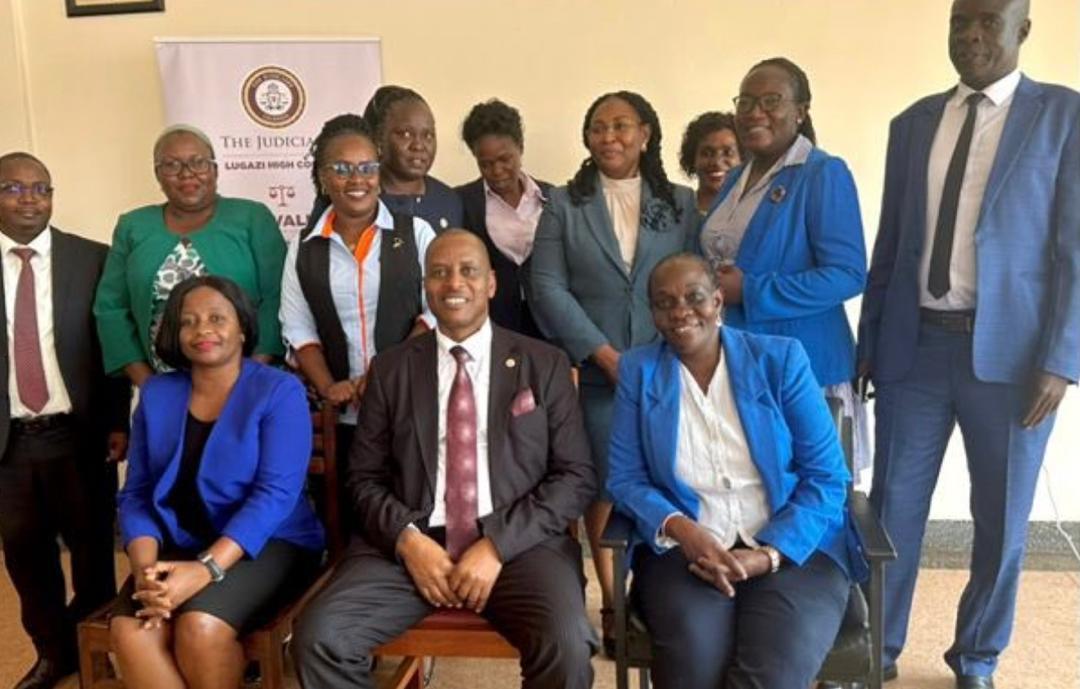
Africa-Press – Uganda. The Registry of Communications and Public Relations under the Judiciary of Uganda convened a strategic customer care engagement on February 23, 2026, bringing together Judicial Officers and support staff serving under the Lugazi High Court Circuit to reinforce service excellence as a cornerstone of justice delivery.
The engagement drew participants from Lugazi High Court, Lugazi Chief Magistrate’s Court, and the courts of Buikwe, Ngogwe, Nyenga and Njeru.
Organisers said the session was designed to reposition customer care as a core driver of judicial performance, stressing that attentive, empathetic and professional service is as vital to justice as court rulings themselves.
Opening the session, the Resident Judge of Lugazi High Court Circuit, Winfred Nabisinde, reminded participants that every staff member, judicial and non-judicial, represents the Judiciary at the frontline of public service.
“Every person who walks through our court doors must feel heard, respected, and guided. Justice is not only delivered through judgments; it is experienced through the way we treat people at every stage of the process. Professionalism, empathy, and integrity must define our daily conduct,” Justice Nabisinde said.
The key facilitator, Jamson Karemani Karemera, Resident Judge of Kiboga High Court Circuit, delivered a presentation under the theme “Making Our Judicial System More Approachable and User-Friendly.”
He referenced remarks by Chief Justice Flavian Zeija, delivered at the opening of the New Law Year 2026, where he reaffirmed that efficient and effective justice service delivery remains a top priority.
Justice Karemani outlined plans for an independent Court Users’ Survey to objectively assess the effectiveness and efficiency of court processes and measure user satisfaction.
He said strengthening customer care practices was central not only to improving service delivery but also to nurturing sustained public trust in the administration of justice.
Participants acknowledged progress made in expanding court infrastructure, recruiting additional Judicial Officers and improving staff welfare.
However, they also held candid discussions on persistent challenges affecting court users, including case backlogs, delays, negative staff interactions, corruption and limited procedural guidance.
Reference was made to Article 126 of the Constitution of the Republic of Uganda, which provides that judicial power is derived from the people and exercised by courts in their name.
Officers were reminded that every point of contact, from the court entrance to courtroom proceedings, directly shapes public confidence in the justice system.
Key operational risks identified during the engagement included heavy caseloads, supervision gaps, limited continuous professional training, weak complaint-handling frameworks and inadequate customer-support infrastructure.
Proposed interventions include strengthening internal accountability mechanisms, institutionalising structured public engagement forums and enhancing complaint management systems with timely feedback loops to ensure responsiveness and transparency.
In her closing remarks, the Chief Magistrate of Lugazi Chief Magistrate’s Court, Roselyn Nsenge, commended the initiative and pledged to operationalise the recommendations within the circuit to improve the court user experience.
The engagement was moderated by Senior Communications Officer Ruth Ashaba and concluded with a renewed commitment that effective customer care is foundational to institutional legitimacy.
Complaints from court users were reframed as performance-feedback mechanisms which, when addressed proactively, can drive continuous improvement in justice service delivery.
The session forms part of a series of sensitisation activities ahead of the official launch of the Lugazi High Court Circuit scheduled for March 2, 2026, to be officiated by the Chief Justice, Flavian Zeija.