Africa-Press – Uganda. On the morning of June 1, unknown assailants riding on two motorcycles attacked the former Chief of Defence Forces (CDF), Gen Edward Katumba Wamala, spraying his vehicle with bullets in what police said was a “targeted drive-by shooting”.
The General’s daughter, Brenda Nantogo, and his driver Haruna Kayondo, died in the shooting that followed a pattern that also saw the killing of Maj Muhammad Kiggundu in Masanafu, Kampala, on November 26, 2016 and that of former police spokesperson Andrew Felix Kaweesi, in Kulumbiro on March 17, 2017.
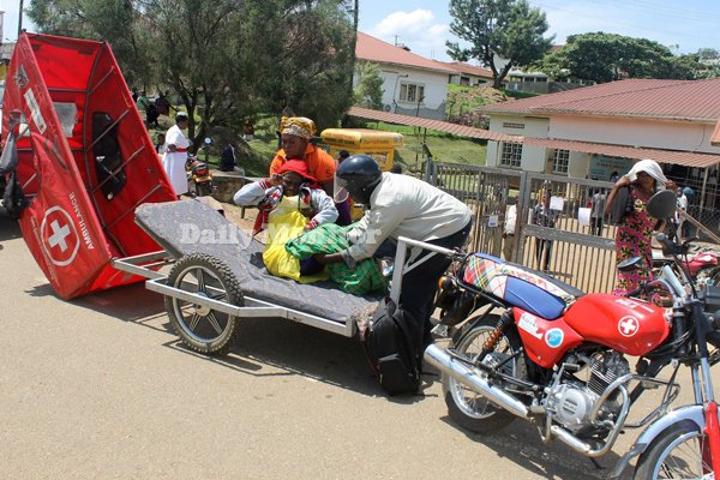
Images of the injured former CDF being evacuated from the scene of the attempted assassination on boda boda motorcycle have, however, generated a hot talking point over the last 12 days.
The shock that those images elicited were perhaps best captured by the comments of Dr Charles Mbalyohere, the former president of Busoga Yaiffe, a non-governmental organisantion.
“Lots of work to do around emergency responses. The man was losing blood profusely and the only way to transport him fast was on a boda boda, says everything about how far we still have to go to build a functioning system,” Dr Mbalyohere posted on his Facebook wall, a few hours after the General’s shooting.
Flawed EMRS system
It can only mean that the existing emergency medical response services (EMRS) system is flawed given that a boda boda was the only means by which a high profile person such as an outgoing minister and former CDF could access a medical facility.
A research paper: Preparedness for mass casualties of road traffic crashes in Uganda: Assessing the surge capacity of highway general hospitals, authored by Mr Nathan Onyachia, Everd Maniple and Stefano Santini, tells the sorry story of our emergency transport system.
“Uganda does not have a public ambulance system, and so the casualties are usually ferried by any means immediately available, such as at the back of police pick-up trucks and vehicles of other passersby. Police personnel and the public are not trained in first-aid and evacuation of casualties, and could aggravate the injuries sustained in an accident,” the report reads in part.
According to the trio, the crude methods of on-scene care have been responsible for either worsening injuries or even causing death.
“A common method they use to remove casualties from the wreckage of the vehicles is cutting it open with axes. It is a slow process and worsens many injuries. Deaths have been reported. Other injuries are worsened by the increasing negative practice whereby the population near the accident scene rummage through the pockets and bags of the injured… in search of personal valuables of the dead and injured…” the researchers say.
A functional EMRS system should be supported by radio communication and transport, but if what Dr John Baptist Wanaiye, the commissioner of Emergency Medical Services at the Ministry of Health says is anything to go by, it is either inadequate or simply lacking.
“We are required to have a universal access number that one has to call in order for the ambulance to come. We have worked on that with the Uganda Communications Commission (UCC), which has given us the number 911, but it is not yet functional. That is why most still call 999, but 999 is not effective because when you call, the immediate thinking of the people at the other end is that it is a security matter,” Dr Wanaiye says.
A functional EMRS system should also have capacity for rapid response, evacuation of patients in cases of accidents or shootings and be supported by trained paramedics and emergency workers to handle the injured or the acutely ill.
It is a highly organised ambulance service system, a well-oiled referral system with good hospitals and functional intensive care units. Has Uganda got such a system in place? Dr Wanaiye offers very little comfort in that regard.
A number of ambulances parked at the National Ambulance Emergency Coordination centre at Mulago hospital in Kampala which had been created to respond to emergencies in 2015. PHOTO | FILE
“We are in the process of developing the emergency medical response system. That is what we have been working on for the last three years,” Dr Wanaiye says.
Failed attempt
The Ministry of Health has in the past made attempts to move in that direction. Spurred by the outcome of research it conducted together with the University Hospitals of South Manchester, and Health Education North West, it unveiled Uganda National Ambulance Service Project in January 2014.
Under the project, which was meant to have been the first step towards the operationalisation of Uganda’s EMRS system, government was meant to have purchased 100 ambulances equipped with modern technology to allow for surgery.
The ambulances, which were meant to be accessed via a toll-free emergency telephone number with a response time of between 10 and 20 minutes, were meant to be linked to designated emergency units and ICUs in different parts of the country, but the project never got off the ground.
Dr George Ekwaro, the health minister in the ‘People’s Government’, a loose coalition of people who believe Dr Kizza Besigye won the 2016 General Election, argues that the problem has been around government’s reluctance to give due attention to the health sector.
“The biggest problem has been lack of funding to the health sector. The sector accounts for 35.8 per cent of the human capital development, but its allocation in this (2020/2021) financial year was less than 10 per cent of the national budget. That does not sound good. We need to see increased health sector budget above seven per cent of the Gross Domestic Product (GDP),” Dr Ekwaro says.
He argues that is the only way Uganda can develop a functional referral and EMRS system.
The outbreak of the Covid-19 pandemic has turned out to be a blessing in disguise. Prior to March 2020 when government imposed a lockdown as a containment measure, most of the public health facilities did not have ICUs.
George Otim, the acting commissioner in-charge of health infrastructure at the Ministry of Health, told Sunday Monitor in a previous interview that the installation of ICU beds and ventilators had been concluded at Mulago National Referral Hospital and other regional referral hospitals, including Jinja and Mbale.
“At least 145 ICU beds, including ventilators, patient monitors, X-rays, oxygen plants and high flow oxygen therapy apparatus have been procured. The 145 ICU beds have been distributed to 13 regional referral hospitals and four other selected hospitals,” he said.
New effort
Dr Wanaiye says the establishment of a national ambulance service that is regionally coordinated and provision of on-scene care for accident or shooting victims such as the assassination attempt on Gen Katumba are high on the agenda as the ministry moves to complete the development of the EMRS.
“We clearly reflect on the issue of on-scene care. Going forward, we are going to train boda boda operators, Local Council leaders, police officers and other members of the communities who might be the first people to arrive at the scene of an emergency so that they are equipped with first aid skills and kits,” he says.
The target, according to Dr Wanaiye, is to have at least two trained first aid responders in every cell or village across the country.
Besides the first aid responders, the EMRS will require highly trained personnel specialised in emergency care, 460 ambulances out of which 20 are life-support ambulances, 15 water boat ambulances, and helicopter ambulance coverage.
Government and development partners did purchase at least 116 ambulances to support the Covid-19 response, but resources are now required for the purchase of 354 more ambulances, boat ambulances and helicopter ambulance.
Even more resources will be required to meet the operations costs of those fleets. Money to fund the fleet of ambulances has in the past not been coming.
Will the assassination attempt on Gen Katumba serve to nudge government into realising the urgent need to fund the operationalisation of a functional EMRS? Or will it take another attempt on the life of a high profile person for it to be driven to do something in that direction?
Manpower shortages in ICUs
Whereas government allocated about Shs4 billion towards the recruitment of staff under its Covid-19 response, the recruitment seemed not to have catered for the specific needs of the intensive care units (ICUs).
Under ideal conditions, a nurse should not work for more than eight hours a day, but nurses in Uganda’s ICUs have been working longer hours than usual due to an acute shortage of nurses. Each patient is also meant to be attended to by at least two nurses, but that has turned out to be an unaffordable luxury in Uganda’s ICUs.
Mr Emmanuel Ainebyona, the Ministry of Health spokesperson, concedes that the ministry has challenges round intensive healthcare, but that it has since taken steps to address them.
“Although Uganda has not attained the number of the desired critical care workers, a number are currently being trained under fully paid scholarships by the Ministry of Health,” he says.
Limited number of anesthetists
Safety standards of anesthesia care prescribed by the World Federation of Societies of Anesthesiologists and the World Health Organisation require a permanent presence of an anesthetist and a system for transfer of care at the end of anesthesia, but that, again, is a luxury that Uganda, which has been suffering from an acute shortage of anesthetists for close to three decades, cannot afford.
Arthur Kwizera, the Association of Anesthesiologists of Uganda (AAU) spokesperson, told Sunday Monitor in an earlier interview that the area of anesthesia and intensive health care is under resourced.
“Under ideal conditions, every referral hospital is meant to have at least three anesthetists and a national referral hospital 55, but that is not the case. The only referrals that have the required three are Mbarara and Mbale. Kabale and Lacor hospitals have two anesthetists each, while Jinja and Masaka have one a piece. The others do not have,” Kwizera says.
That comes down to one anesthesiologist for every 100,000 people. Uganda is, therefore, way short of WHO’s target of having between five and 10 anesthesiologists for every 100,000 people by 2030.
Emmanuel Ainebyona, the spoekesperson of the Ministry of Health, says the ministry has, with the help of the World Bank, given out scholarships to people to study medical anesthesia and critical nursing, adding that more scholarships will be given out in the future.
“An additional 400 health workers are to be trained in critical care nursing with funding from the World Bank. Many of the health workers should have completed their studies but were unable because of the Covid-19 pandemic,” Ainebyona says.