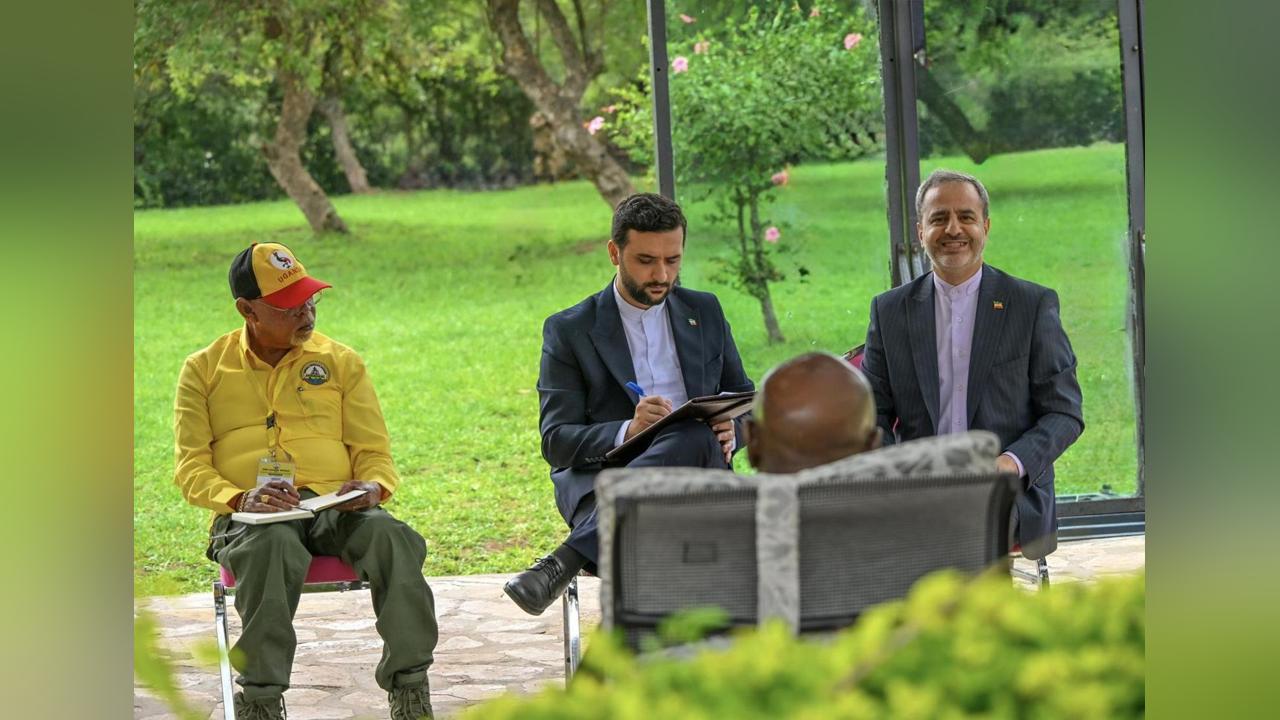
Africa-Press – Uganda. President Museveni on Sunday held a meeting with Iran’s Ambassador to Uganda, Majid Saffar, on the sidelines of the National Resistance Movement (NRM) retreat in Kyankwanzi, amid rising diplomatic tensions linked to outspoken remarks by the Chief of Defence Forces Gen Muhoozi Kainerugaba that have drawn Uganda into heightened Middle East sensitivities.
Museveni confirmed the engagement, saying: “I welcomed His Excellency Majid Saffar, the Iranian Ambassador to Uganda, who called on me this afternoon in Kyankwanzi. We discussed issues of mutual interest and cooperation between Uganda and Iran.”
The official details of the talks remain limited and Amb Saffar had not responded request for interview at the time of publishing this.
However, sources familiar with the discussions said the Iranian delegation sought clarity over Uganda’s position following a series of public statements by Gen Muhoozi expressing strong support for Israel, including controversial remarks suggesting Uganda’s readiness to deploy troops in defence of Israeli interests and his sharp criticism of Turkey and Iran-aligned positions.
The meeting was also attended by Foreign Affairs Minister Gen Jeje Odongo, underscoring the diplomatic weight attached to the discussions.
Ambassador Saffar has in recent months intensified engagements with Ugandan leadership, reaffirming Tehran’s interest in expanding cooperation across East Africa.
His outreach comes at a time of escalating global tensions involving Iran and Western allies, particularly the United States and Israel, with Tehran repeatedly insisting its posture is defensive and not directed at African states.
The Kyankwanzi engagement follows a wave of geopolitical messaging triggered by Gen Muhoozi, who, in a series of posts on X (formerly Twitter), declared Uganda’s alignment with Israel on religious and strategic grounds, invoking Christian solidarity and scriptural references.
His comments have raised questions over whether Uganda’s long-standing non-aligned foreign policy is being subtly reshaped by military and political elites.
The tensions have also extended to Turkey, where Muhoozi’s remarks demanding financial compensation and threatening diplomatic consequences prompted intervention from Uganda’s Permanent Secretary in the Ministry of Foreign Affairs, Amb Adonia Ayebare, who sought to downplay the fallout, saying Uganda values its partnerships and expects “good faith talks” to resolve concerns.
Diplomatic unease has been further amplified by the broader Israel–Iran confrontation, including recent military escalations in the Middle East that have placed global partners on alert.
Uganda’s strategic relevance has also resurfaced, with reports indicating that US personnel were temporarily relocated through East African facilities, including Entebbe, amid regional security concerns.
Uganda’s balancing act between Iran and Israel is rooted in a complex historical and geopolitical backdrop.
Relations with Iran date back decades, including presidential engagements in 1996 and 2010, and more recently the 2023 visit by Iranian President Ebrahim Raisi, which produced agreements in agriculture, visas, and political cooperation.
Iran has also engaged Uganda on broader development issues such as energy and technology transfer.
At the same time, Uganda maintains historical ties with Israel dating back to the 1976 Entebbe hijacking and subsequent Israeli rescue operation, an event that continues to shape political memory in both countries.
President Museveni, who currently chairs the Non-Aligned Movement, has in previous engagements emphasised Uganda’s commitment to diversified partnerships, including cooperation with Iran, while maintaining relations with Western and Middle Eastern powers.
Iran is a member of NAM with its delegation led by Foreign Affairs minister Abbas Araghchi attending the last meeting in Munyonyo, Kampala.
However, Gen Muhoozi’s increasingly direct interventions on global conflicts have introduced a new layer of complexity, with analysts warning that public military diplomacy could strain Uganda’s carefully managed foreign policy equilibrium.
As diplomatic consultations continue behind closed doors, the Kyankwanzi meeting signals Kampala’s effort to contain emerging tensions and reassure partners that Uganda’s official foreign policy remains anchored in non-alignment, even as internal voices project increasingly divergent geopolitical signals.
For More News And Analysis About Uganda Follow Africa-Press