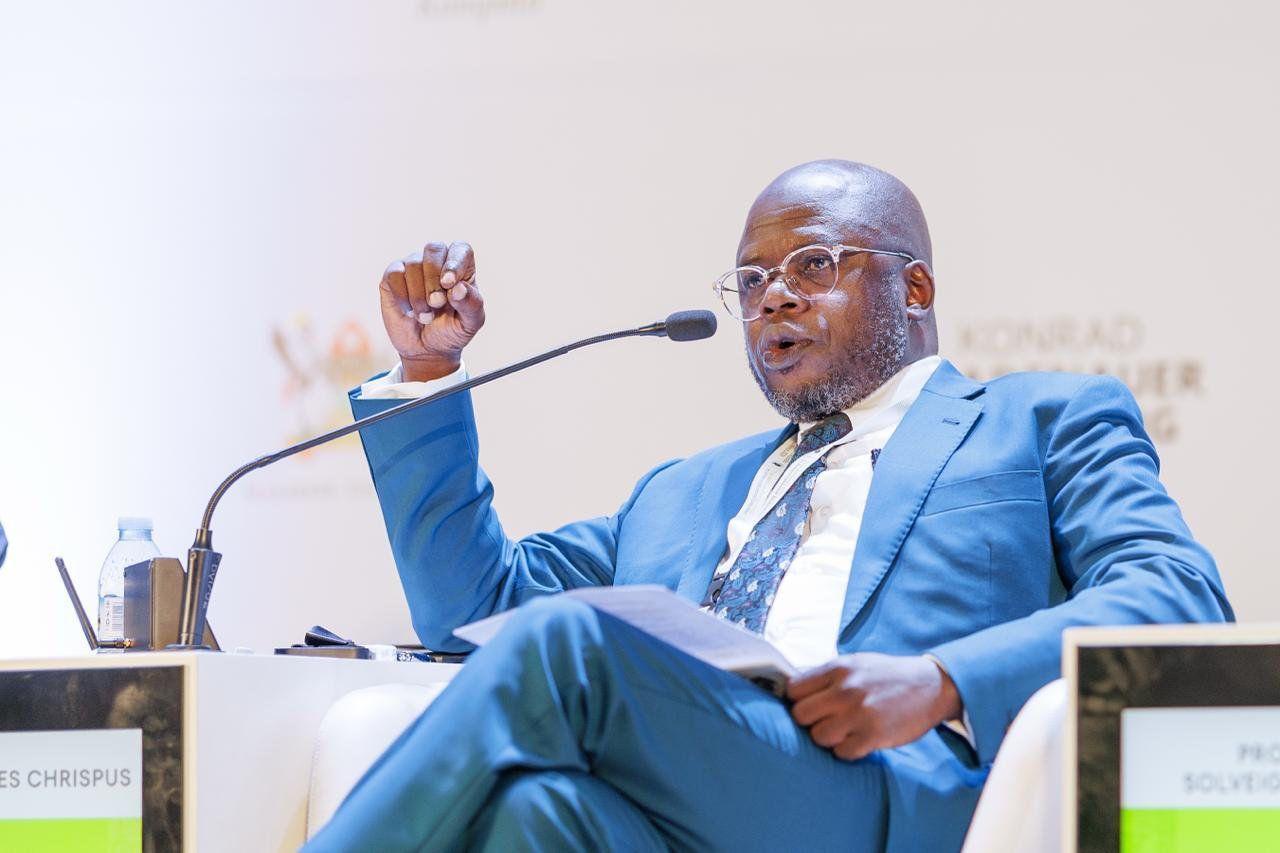
Africa-Press – Uganda. A growing consensus is emerging among policy experts and scholars that Africa is redefining how it engages with external powers, placing increasing emphasis on agency, strategic interests, and balanced partnerships.
During discussions on “Africa and External Powers: Shaping the Terms of Engagement,” panelists underscored the need to rethink global conversations through an African lens—one that reflects the continent’s priorities rather than inherited narratives.
Dr. David Ngendo-Tshimba, Head of the Centre for African Studies at Uganda Martyrs University, argued that reframing international discourse from an African vantage point fundamentally alters both the narrative and its outcomes. He noted that Africa is no longer in a position of passive alignment but is increasingly asserting its distinct needs in global engagements.
“Africa is now in a place where we can say we have very particular needs which differ from those of external actors,” he said, adding that this shift will inevitably redefine engagement frameworks.
Panelists noted that this repositioning reflects a broader movement toward self-determination and strategic negotiation.
Dr. Edith Namutebi, Head of Regional Peace and Security at Uganda’s Ministry of Foreign Affairs, highlighted that Africa’s historical marginalisation has driven a shift toward protecting its interests through more deliberate and coordinated approaches. She pointed to regionalism as an emerging platform for advancing African-led solutions and strengthening negotiation capacity.
“Regional frameworks are becoming critical spaces for articulating and defending African interests,” she said, noting that engagement is increasingly moving away from traditional hegemonic structures toward newer global players.
Namutebi also emphasized the continent’s adoption of multi-alignment—engaging with multiple global partners simultaneously—as a defining feature of its current geopolitical posture. This, she explained, is reinforced by the rise of economic blocs that enhance Africa’s leverage in a multipolar world.
Prof. Dr. Solveig Richter, Professor of International Relations and Transnational Politics at Leipzig University, observed that Africa is attracting heightened global attention amid shifting development financing models. With the gradual decline of Official Development Assistance (ODA), new forms of cooperation are emerging, each with their own conditions and expectations.
However, she cautioned that reduced involvement from Western actors could have implications for governance and civic space.
“Citizens continue to place value on human rights and democratic principles,” she said. “A decline in engagement from partners such as the United States and Europe could reduce support for civil society and human rights advocacy.”
Okello Moses Chrispus, Senior Analyst at the Institute for Security Studies, highlighted the role of technology in reshaping global power dynamics. He noted that while geography and natural resources remain important, real influence lies in how these assets are controlled and utilized.
“The strategic value derived from resources now outweighs mere possession,” he said, pointing to the growing importance of supply chains and technological leverage in determining global influence.
The discussion reflects an Africa that is recalibrating its position within the international system—moving toward more assertive, interest-driven engagement while navigating a rapidly evolving global order.
For More News And Analysis About Uganda Follow Africa-Press