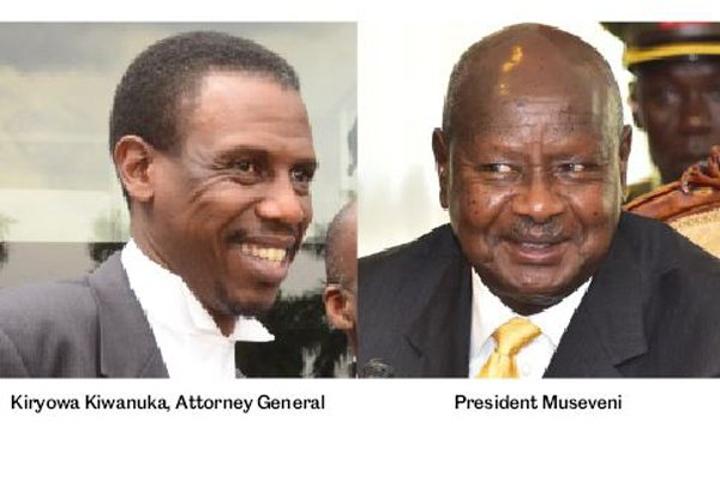
Africa-Press – Uganda. The Attorney General (AG) has blocked all ministers from entering into any agreement on behalf of the country with international bodies or nations without permission from President Museveni.
In a November 26 letter to the Prime Minister, AG Kiryowa Kiwanuka said only the Head of State is constitutionally empowered to enter into such agreements.
“I, therefore, wish to advise that ministers and public officers be guided that they cannot, and shall not, enter into agreements, regardless of appellation or subject matter, with foreign countries or international organisations or bodies without the authorisation of the President,” Mr Kiwanuka wrote.
He added: “In the same vein, they should be advised that henceforth, this office shall not advise on such agreements in accordance with article 119(5) of the Constitution unless it has been furnished with proof that the President has authorised the conclusion of the same.”
Article 123 of the Constitution provides that the President or a person authorised by them may make treaties, conventions, agreements or other arrangements between Uganda and any other country or international body, in respect of any matter.
The AG said even with delegated powers, any conclusion of any agreement must be approved by the President.
The directive, the AG said, draws from the recent debate on the suspension of the activities of the Democratic Governance Facility (DGF).
President Museveni in January suspended the activities of DGF, a multi-billion donor fund that supports numerous government entities and civil society groups.
Mr Museveni said he had not been consulted about the establishment of the Fund that he accused of facilitating entities and activities with an anti-government agenda. He accused technocrats at the Ministry of Finance for “irregularly and unilaterally” licensing DGF.
“How and why did the Minister of Finance unilaterally make such a major decision with far-reaching consequences, let alone one whose effect is to surrender the sovereignty of the people of Uganda to foreigners? Was this a reason of subversion, corruption, or criminal negligence, or all of these? Why wasn’t the Cabinet and I consulted?” Mr Museveni wrote in a January letter.
Legal experts say whereas seeking presidential authorisation is within the law, the directive will have consequences.
Constitutional lawyer Wandera Ogalo said the provision does not apply to private entities.
“If a non-government organisation is entering into an agreement with a [foreign] government to give it money that is not an agreement between Uganda and that international organisation. This should be matters of state; an NGO is a private entity,” he said.
Mr Peter Walubiri, also a constitutional lawyer, said the directive could slow government operations.
“I think the President now wants to personally be in charge because the same Article 123 envisages the President authorising any other person to negotiate agreements and treaties. The President is refusing to allow officials he has delegated work to work…I think that is unfortunate. The President wants to micro-manage the agreement-making process. The President should give general guidance to his ministers under the guidance of the AG. Look at an institution like Makerere University, it enters agreements with many organisations but that means the vice chancellor must first line up at the President’s Office to be authorised,” he said.
He added: “What good governments do; the President will authorise his ministers in charge of a sector to handle all agreements. Those agencies will negotiate and have clearance from the AG.”
The directive, he noted, will not affect existing agreements as long as they were cleared by the AG’s office.
[email protected]@ug.nationmedia.com
For More News And Analysis About Uganda Follow Africa-Press