Africa-Press – Uganda. The process of shifting Uganda’s education system from the much-maligned humanities and arts to STEM (Science, Technology, Engineering, and Maths) principals has been beset with financial bottlenecks that haven’t even spared President Museveni’s backyard in Nyabushozi County.
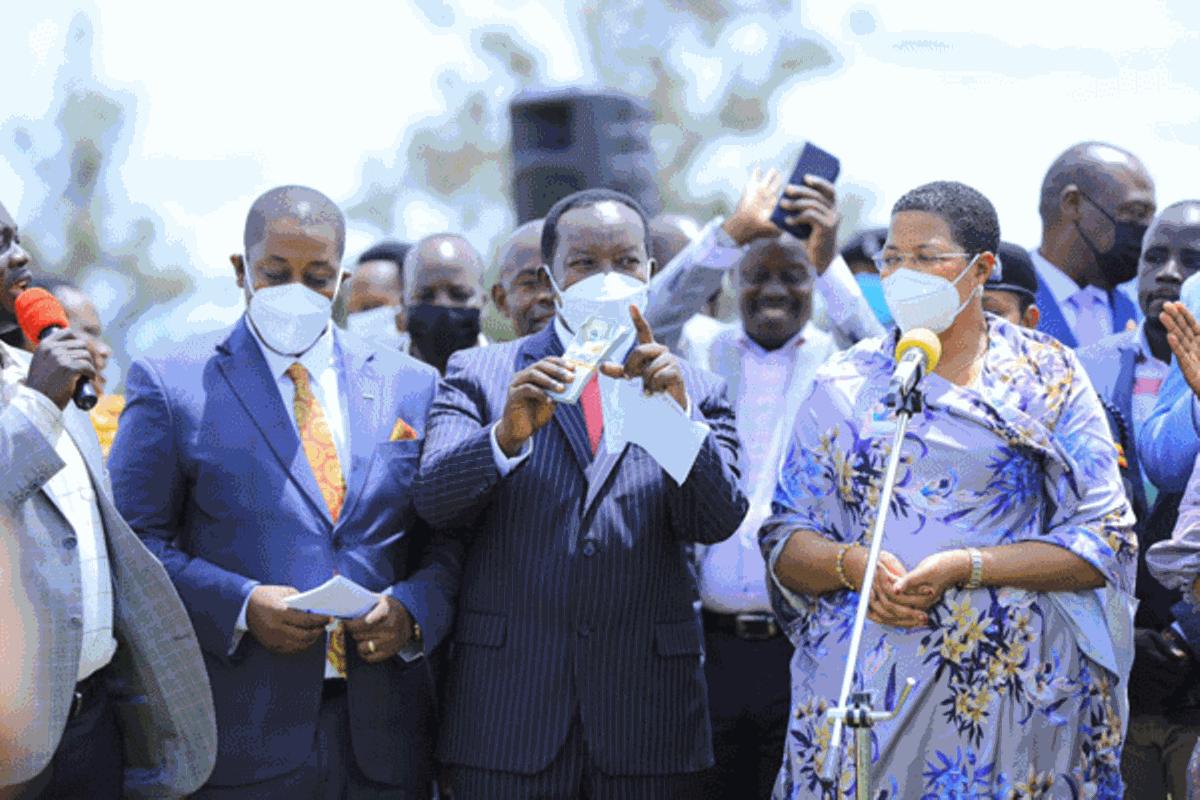
A number of luminaries recently gathered at Bishop Buningwire Guest House to try and address the bottlenecks. Among them was Ms Anita Among, the Speaker of Parliament, who offered Nyabushozi lawmaker, Mr Wilson Kajwengye a blank cheque.
“I told your MP to ask for any amount you want but he asked for $10,000 (Shs 36m) and that’s what I’m going to give you,” Ms Among said.
She wasn’t the only generous contributor in the township of Rushere that day. Mr Dan Kimosho, the opinionated legislator whose Kazo County neighbours Kiruhura District, chipped in with $5000 (Shs18m).
Senior army officers from Nyabushozi such as Lt Gen James Mugira, Maj Gen Samuel Kavuma, and Brig Charity Bainababo had joined efforts to contribute Shs15m. The funds will be used to equip secondary schools in Nyabushozi with basic laboratory apparatuses, chemicals, and science teaching materials.
Mr Kajwengye, who ousted Col Fred Mwesigye—the National Resistance Army (NRA) historical—from the House during the 2021 polls, laid out how precarious the situation is.
“It is a common occurrence to see students from Nyabushozi travel to do science practicals from faraway places. This must stop,” he said, adding, “You will agree with me that no country has sustainably transformed without focusing on science, technology, engineering, and innovation.”
Huge deficits
Seventeen years ago, the government came up with a policy that made the study of science subjects—physics, chemistry, biology, and mathematics—compulsory at the Ordinary Level of secondary school. The government reasoned that it was intent on creating a critical mass of scientists and engineers to spur growth and development in the country.
“You ask these art students what they can solve and they tell you, ‘for us we only think.’ Think about what?” Mr Museveni once asked, adding, “It is unfortunate that many universities continue teaching very useless courses at degree level, rendering their graduates jobless after graduation. You find many of these people putting on big academic gowns but have no solutions to many of the country’s challenges.”
Despite putting STEM principals on the pedestal, the government has neither equipped laboratories nor facilitated science teachers.
A 2012 study conducted by the Uganda National Council of Science and Technology’s (UNCST) linked the poor performance of science subjects to ill-equipped laboratories, poor teaching, and assessment methods.
In 2009, a National Universal Secondary School Education headcount report showed that the majority of private secondary schools have no designated laboratory rooms. These are deemed too expensive to construct. This consequently forces science teachers to exclude practical teaching. The same report also showed that 406 of the 1,067 government-aided secondary schools have science laboratories, inferring that science practical lessons are conducted in areas that are not gazetted. Such rooms often lack attendants, facilities like water and heating sources.
The report further noted that whilst the option of using mobile laboratories has been incorporated by many schools, the teaching of practical sciences is further constrained by the nature of furniture used in schools. Flat surfaces are basically few and few between.
Kaaro High School is the oldest secondary school in Nyabushozi, having been established 40 years ago. Teaching sciences at the school is a persistent struggle.
“We have just one room where we keep apparatus,” Mr Patrick Kashaija, the school head, says, adding, “We also have a computer laboratory with 20 computers yet we have 400 students. That’s not enough.”
Dearth of equipment
A 2022 report authored by the Kiruhura District education department notes that while Kaaro High School has high enrolment; its laboratory is poorly equipped.
It adds: “There is a need for a set of physics equipment/ apparatus for electricity, mechanics, and light. The absence of any of these items renders the department redundant. Additionally, many chemical reagents are missing, as well as glassware and plastics.”
“The laboratory building is well built, but the gas system and water systems are not operational. There is a lack of consumables like papers and litmus paper,” it further reads in part.
Mr Kashaija says the school “needs separate laboratories for physics, biology, chemistry, and computer.”
The situation is worse at Kashwa Secondary School in Kiruhura Township. The district report points out—instead of a laboratory—the school has a “multipurpose room.” Such are the improvisations that “the main source of heat is a mobile stove and gas cylinder.” Most of the laboratory reagents and chemicals for both biology and chemistry departments are also conspicuously absent as is the laboratory technician.
Mr Charles Tumushabe, the headteacher at Kashwa Secondary, believes last weekend’s fundraising will turn the tide.
“I hope this is going to help us change the mindset about sciences. We also hope we are going to get laboratories because at the moment we have nothing,” Mr Tumushabe—whose school has 330 students and 22 teachers—said.
Schools such as Emmanuel Secondary School, which—according to the district education report—“use plant thorns other than optical pins” during practicals are optimistic. Despite running into strong headwinds, Emmanuel Secondary School produced one of the best science students in the district.
Divine intervention
Education in Nyabushozi like in many parts of Uganda traces its roots to the advent of Christianity. A team, which included religious leaders, was recently dispatched to all secondary schools in Nyabushozi. Its assignment was unambiguous: to assess the status of their science laboratories. The findings were ominous. It discovered that apart from the newly-built seed secondary school in Nyakashashara Sub-county, all the other secondary schools—be they private, communal or government—were lacking either apparatuses, chemicals or science teaching materials.
“We first did what you could call a baseline study and we came to know that we have a very big problem,” Father Zeddy Byabashaija, a member of the committee, who doubles as the school head of the Catholic Church-founded Sedes Sapientie Academiare, said, adding, “That’s why together with our MP (Mr Kajwengye) we came up with this fundraiser and we think the money we shall get will be used to equip schools with apparatus, chemicals, and other items needed when doing sciences.”
The Church has vowed to be central to surmounting problems besetting schools keen on popularising STEM principals.
“There was a time when the church had abandoned its role,” explained Ankole North Bishop Stephen Namanya, adding, “But I can tell you, we are back and our focus is on the girl child. We want the girl child to succeed in science.”
Speaker Among promised more support on account of wanting “to make this Parliament a people-centred Parliament.”
She concluded: “We need to solve people’s problems.”
For More News And Analysis About Uganda Follow Africa-Press