Faridah N Kulumba
Africa-Press – Uganda. The United Kingdom’s (UK) government at the beginning of this month issued a travel advisory warning on its website noting that terrorists are very likely to try to carry out attacks on Uganda.
The attacks could be indiscriminate or against or against foreign nationals or it could happen in places frequented by foreign nationals.
The UK and United States governments have previously issued similar terror alerts and in a number of cases, these have been followed by actual attacks.
For example, last month, there was a terror alert and this was followed by the attack on Rubhiriha Secondary School by suspected Allied Democratic Forces ( ADF) rebels where more than 40 people lost their lives and some survived with serious injuries.
The unfortunate incident followed the ADF rebels linked to ISIS killing 41 people, including 37 students who were burned, shot, or hacked to death with machetes in a sickening attack on Mpondwe-Lhubiriha School in Kasese District, about 1.2 miles from the Democratic Republic of the Congo (DRC) border.
Uganda’s response
The joint security agencies said Uganda is safe despite the terror alert and travel advisory issued by the UK, they remain committed to foiling any attacks on the country. They noted that the manner in which the alert was issued makes it difficult to know the exact target and identity of the said attacks.
The joint security spokesperson explained that the way the advisory was released makes it difficult for security agencies to determine the specifics because it comes in the form of general information and doesn’t mention the targets.
However, the authorities acknowledged the concern and use the general information shared to determine which protective measures to be put in place by the joint security agencies.
The Uganda Police Force Spokesperson Fred Enanga leisure Ugandans by saying that the country’s biggest threat remains the ADF rebel group but noted the group has suffered a bloody nose in recent years since the attack on Kampala in November 2021.
After the June 2023 terrorist attack, the President of Uganda H.E Yoweri Kaguta Museveni said that the ADF is one of the fiercest rebels that have become desperate and cowardly to pressure exerted by both the UPDF and DR Congo national army following a joint operation launched in November 2021.
The ADF has long opposed the rule of Ugandan President Yoweri Museveni, a US security ally who has been in power since 1986.
In 2021, Uganda and DR Congo launched a joint operation against the ADF, an armed group allied with Islamic State. The joint forces conducted search operations in the air and artillery strikes against suspected ADF bases in the forests of eastern Congo.
Tightening security
Although the recent UK-issued terror attack was said to be vague without specifics, Uganda’s Security Task Forces cautioned that nothing should be taken for granted. Security says that they are now more than ever ready and committed to addressing all threats.
By taking the British government’s warning seriously all Ugandans were advised to be watchful and report strangers and anything unusual.
Security has been beefed up in Kampala city center, especially along the Kikuubo Business Centre. Kampala Metropolitan Police spokesperson Patrick Onyango says the security deployment is not about to end especially around the Kikuubo area until they feel the security threat has gone down.
Some previous terror attacks
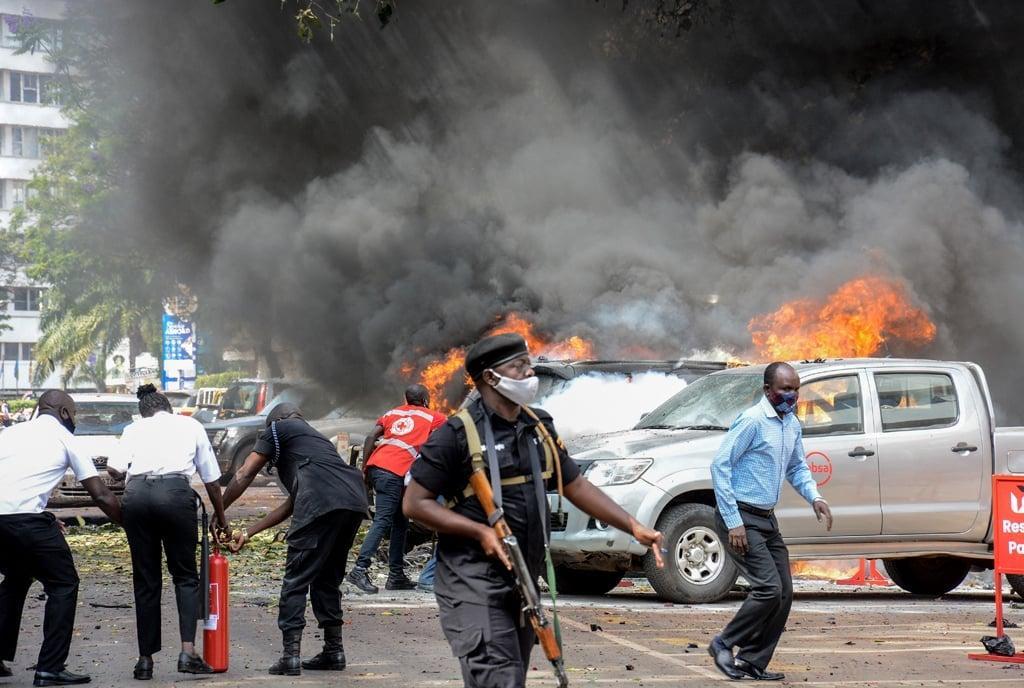
On November 16th, 2021, ISIL (ISIS) claimed responsibility for the attack, which killed seven people, including the three bombers, and injured dozens. One police officer was among the four others killed and 27 of the 37 wounded were also police officers.
Ugandan police reported that seven suspects were killed and 106 people detained during operations by the security services linked to three suicide bombings in the Ugandan capital, Kampala.
In 2022, Uganda faced several serious security challenges. Some of the serious
issues were the return of rebel activities, the criminal elements from the Allied Democratic Forces (ADF), and the Uganda Coalition for Change (UCFC) which is a self-styled attack rebel group that carried out senseless attacks on police units and personnel in which some police officers lost their lives while others were seriously injured.
The ADF and the UCFC carried out attacks on police units in which assault rifles were seized and in several instances, police officers were killed, and many were injured, the act that forced the government to close thousands of provincial police posts across the country.
These attacks which started in mid-2022 forced the parliamentary Leader of the Opposition Mathias Mpuuga to wonder whether the country was under attack and demand a comprehensive report from the government on the killing of police officers.
For More News And Analysis About Uganda Follow Africa-Press