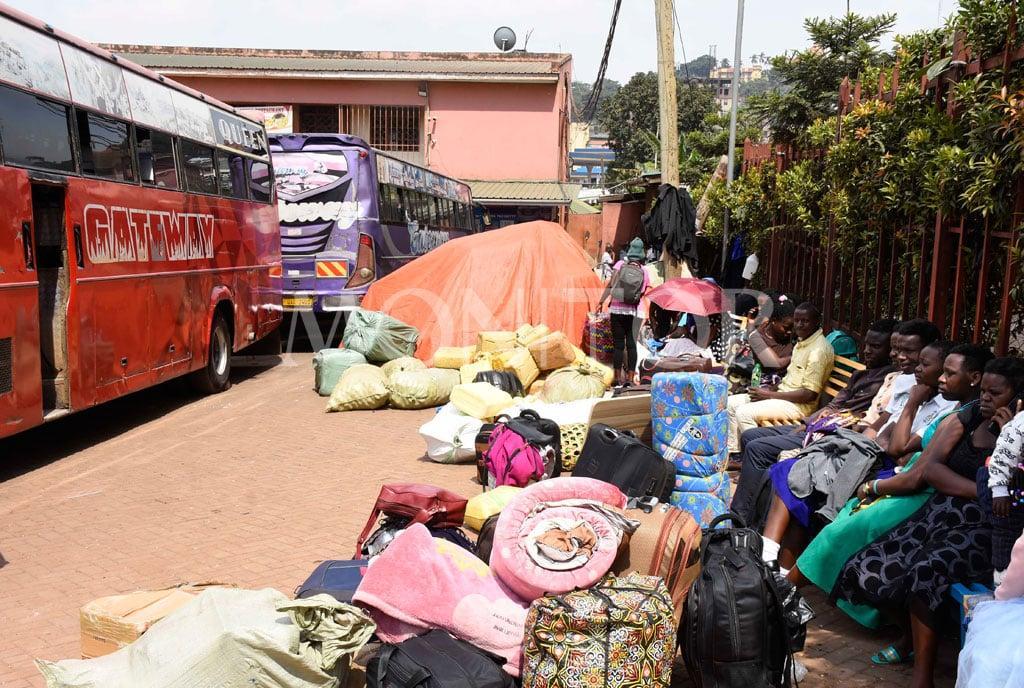
Africa-Press – Uganda. Scores of commuters were left stranded in Kampala as an unannounced strike by bus operators entered its third day on Thursday.
The impact of the strike has been immediate. Thousands have been grounded and businesses, which either rely on or are associated with bus transport, are losing money.
At the other end, the country’s urgent need for a proper and regulated mass transit system has again been highlighted by the strike, albeit at the considerable expense of the travelling public.
At all the six city bus terminals of Global, Kisenyi, Namayiba, Link, Tausi and Kalita, many travellers could be seen with their luggage, wondering what to do next. For some, the option of boarding either one of the few available 14-seater taxis or 30-seat coasters was a possible option but this would come at a cost.
Taxi operators have quickly taken advantage of the unfolding transport emergency to double, and in some cases, triple their fares, leaving those who cannot afford the new rates stuck.
A very frustrated Rebecca Nabwe, whom we found at Kisenyi Bus Terminal, had planned to travel to Mbarara yesterday morning for a family visit. However, her journey was halted by the bus strike. She couldn’t travel because of the inflated transport fares being charged by taxis.
“We are suffering. A Coaster [omnibus] to Mbarara now costs Shs70,000 and a taxi costs Shs90,000, from Shs30,000 using a bus. I can’t travel to see my parents, I will travel when the situation normalises because I can’t afford the fares,” Ms Nabwe said.
Another affected traveller, Mr Brian Ogwok, who was travelling to Lira District, decried the sudden spike in transport fares and asked government to intervene.
“The taxi operators have now taken advantage of the fact that bus operators are on strike and they are exploiting travellers who are desperate to travel. Something should be done by the authorities,” Mr Ogwok said.
But in Uganda’s very liberalised economic environment where the forces of demand and supply determine prices, Mr Ogwok’s hope of an intervention is slim. The situation is one where so many intending commuters are chasing after fewer taxis, despite the overpriced fares.
Mr Samuel Wamala, a taxi operator, said so many travellers were queuing up for taxis, the very reason they increased prices.
“Now that bus operators are on strike, we the taxi operators are the ones who are supposed to transport these travellers. The transport fares have increased because of high demand,” Mr Wamala said.
Similarly, Mr Michael Mwesigwa, who runs an omnibus service, noted that although their fares have slightly gone up slightly, the cause is down to increased demand, which offers an opportunity to rake in higher profits.
“The transport fares have increased slightly because we are receiving more people who were using buses and they have now opted for Coasters. So, you know when there is high demand, prices always increase,” Mr Mwesigwa said.
Mr Rashid Ssekindi, the chairperson of Uganda Taxi Operators Federation (UTOF), added that with scarcity, demand is always high and hence determines the prices.
“What causes the hike in transport fares is the many people seeking these services. Each time people are many, the vehicles in the parks will not be enough. So, the remaining few operators may hike fares because of monopoly,” Mr Ssekindi said.
The federation, he said, has tried to advise its members to be considerate to little avail.
“We had warned our taxi operators and cautioned them against taking advantage of the bus strike by increasing the prices,” he said.
Mr Ssekindi proposed that “the passengers should resist paying hefty transport fares”, something that is practically impossible.
As the strike enters its third day today, bus operators maintain that something must be done about the operations costs. They point to what they say is a lot of money paid in fees to Kampala Capital City Authority (KCCA), Uganda Revenue Authority (URA), and the owners of the bus terminals, which are privately owned.
The decision to suspend services by the Uganda Bus Owners Association (Uboa) was taken shortly after KCCA enforcement teams locked YY Bus Terminal, accusing the company of defaulting on parking fees.
Under a new law, KCCA levies an annual charge of Shs2.4 million per bus. Operators are also required to pay the central government Shs2.84 million per bus, Shs1.5 million of which goes towards the Passenger Service Vehicle licence and Shs1.34 million as Advance Income Tax to URA.
On top of that, bus operators said they pay at least Shs50,000 to the bus terminal owners each time they exit.
In a letter dated February 23 to Speaker of Parliament Anita Among, bus operators requested government to abolish the annual Park User Fees of Shs2.4 million per bus, and to also set up bus terminals to be managed by Uboa.
“Streamline the fees and taxes charged on buses with a view of enabling the industry to provide affordable services to the people. The current charges are many and high. They should be consolidated into one affordable fee,” the letter read.
The proposal Uboa suggested was for “all the taxies/levies for acquiring a licence [to] be combined into a [single] fee of Shs1,840,000 per bus, to apply as a total and final annual [payment] to government”.
Other proposals were for the government to streamline routing to protect operators on long routes. Uboa also wants touts, who demand a separate commission for loading, banned from the parks. As commuters suffer under the weight of out-of-control fares being charged by taxi operators. By last evening, no immediate solution was in sight.
Mr Simon Kasyate, the KCCA public relations officer, waved the law when reached for comment, pointing out that KCCA is only enforcing what the law says.
“It is not KCCA that made that law. That law has an author and that is the Ministry of Local Government. KCCA is only enforcing the payment of that tax as prescribed in that law,” he said, adding: “Statutory Instrument No. 73, 2020 of the local government law (amendment of the fifth schedule) under Section 175(2), Cap 243, states that a person operating a medium omnibus shall pay Shs2.4 million”.
Mr Ben Kumumanya, permanent secretary at the Local Government ministry, yesterday told Monitor he has scheduled a meeting with bus owners today.
“We have the meeting tomorrow (today) because I just got the information. I am not worried about those small issues because the matter has not been on for a long time. So, you will call after the meeting and I give you feedback,” Mr Kumumanya said.
About the rationale for the Park User Fees, Mr Kumumanya said: “It was a calculation we agreed on with them but I think at some point, they were saying that because of Covid-19, the economy was bad. Otherwise, we had agreed with them and with their association.”
Transport fares to different routes as of August 23, 2023
Route Bus, taxi and omnibus fare
Mbarara Shs30,000 Shs90,000 Shs70,000
Gulu Shs35,000 Shs50,000 Shs40,000
Lira Shs35,000 Shs50,000 Shs40,000
Arua Shs50,000 Shs70,000 Shs50,000
Amuru Shs50,000 Shs60,000 Shs60,000
Nebbi Shs40,000 Shs40,000 Shs40,000
Yumbe Shs65,000 Shs70,000 Shs65,000
Kitgum Shs40,000 Shs40,000 Shs40,000
Soroti Shs35,000 Shs40,000 Shs40,000
Kabale Shs40,000 Shs45,000 Shs45,000
Rukungiri Shs40,000 Shs45,000 Shs40,000
Ibanda Shs35,000 Shs35,000 Shs35,000
Kagadi Shs30,000 Shs50,000 Shs40,000
Masindi Shs20,000 Shs30,000 Shs25,000
Hoima Shs25,000 Shs30,000 Shs25,000
Bushenyi Shs40,000 Shs50,000 Shs45,000
Fort Portal Shs40,000 Shs45,000 Shs40,000
Kasese Shs50,000 Shs50,000 Shs50,000
Kyegewa Shs25,000 Shs30,000 Shs30,000
Ntungamo Shs35,000 Shs40,000 Shs35,000
Kamwenge Shs45,000 Shs50,000 Shs50,000
Bushenyi Shs40,000 Shs60,000 Shs50,000
Kyegewa Shs25,000 Shs35,000 Shs30,000
Kagadi Shs30,000 Shs30,000 Shs30,000
For More News And Analysis About Uganda Follow Africa-Press