By Franklin Draku
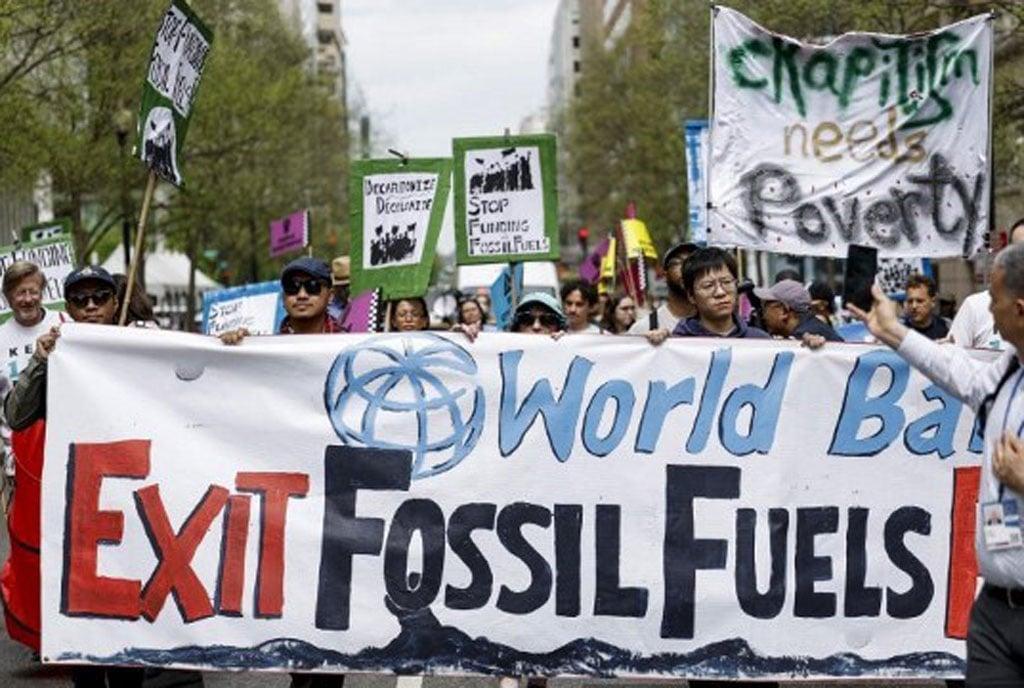
Africa-Press – Uganda. A new study has raised a red flag by blaming the financial sector for fuelling climate change through financing fossil fuels.
The report authored by Actionaid International tracks financial flows from banks to fossil fuels and industrial agriculture in 134 countries of the Global South.
Global South is a term that broadly refers to the regions of Latin America, Asia, Africa, and Oceania.
The report says as climate change escalates, fossil fuels and industrial agriculture continue to expand and thrive, while the solutions needed to address the crisis remain underfunded.
Ms Vanessa Nakate a Ugandan climate activist, said this year has seen climate disasters hit countries on a scale that has not been witnessed before, while world leaders look on without providing solutions.
“The country I live in, Uganda, has one of the fastest changing climates in the world. I’ve seen first-hand the devastation extreme weather can inflict on the lives of people who did very little to cause it. What angers me the most is the lack of action that world leaders and huge polluters are taking to halt this crisis,’ Ms Nakate, who is founder of Rise Up Movement, Youth for Future Africa and the Green Schools Project, said.
The report says while the impact of burning fossil fuels is well known, the role of industrialised agriculture in the climate crisis is less widely publicised yet agriculture is the second-largest contributor to climate change.
“These industrialised agriculture approaches drive deforestation, aggressively market agrochemicals that lead to large amounts of greenhouse gas emissions and expand factory farming. They also undermine billions of smallholder farmers and their agro ecological farming systems which could otherwise feed the world while cooling the planet,” the report says.
The report states that countries in the Global South are hosting an increasing number of fossil fuel and industrial agriculture developments such as coal mines, gas wells, oil pipelines, coal-fired power plants and monoculture plantations full of chemicals such as fossil fertilisers and pesticides.
“These lead to conflicts over land and water, cause premature deaths, destroy ecosystems, poison rivers and lakes, and drive up the climate change impacts already devastating their communities,” the report says.
The report warns that financing fossil fuels and industrial agriculture also risks locking Global South countries into building expensive and debt-dependent infrastructure that will quickly become outdated, rather than investing in renewable energy and agroecology.
Despite global banks’ public declarations to addressing climate change, the report says the scale of their continued fossil fuel and industrial agriculture financing is staggering.
It says banks have provided an annual average of 20 times more financing to fossil fuels and agriculture activities in the Global South than Global North governments have provided as climate finance to countries on the front lines of the climate crisis.
The figures
The report says since the Paris Agreement, there has been $3.23 trillion in bank financing to fossil fuel operations in the Global South. This includes close to $870 billion in loans and $2.4 billion in underwriting.
The report says these averages around $460 billion annually, meaning banks have provided 18 times more financing to fossil fuel activities in the Global South, than in the Global North.
It lists the top banks funding fossil fuels in the Global South as Industrial and Commercial Bank of China has which provided $146 billion since 2016, China CITIC Bank ($124 billion), Bank of China ($116 billion), Citigroup ($90.6 billion) and China Construction Bank ($87 billion).
JPMorgan Chase, which provided $61.2 billion, and Bank of America, which had $54.2 billion, according to the report, follow Citi as the largest banks from the Americas financing fossil fuels in the Global South.
HSBC ($63.6 billion), BNP Paribas ($36.5 billion) and Société Générale ($36.3 billion) according to the report head the list of European financiers of fossil fuels in the Global South.
The report says the largest recipients of fossil fuel financing in the Global South include the State Power Investment Corporation ($203.9 billion since 2016) and several Chinese power companies and producers that heavily invested in coal. Others are the commodities trader Trafigura, and major oil and gas companies including Saudi Aramco, Petrobras, Eni, Exxon Mobil, BP and Shell.
The report reveals that in the seven years since the Paris Agreement, the world’s leading financial institutions have provided $369.2 billion in bank financing (loans and underwriting) to big industrial agribusiness corporations operating in the Global South, averaging out at about $53 billion per year, although the annual figures fluctuate.
Industrial agriculture
“In comparison, the real value of financial support for all climate action provided from countries in the Global North to the Global South has been estimated to be around $21 to $24.5 billion in 2020.
This means that since the Paris Agreement was signed, banks have provided twice as much financing to industrial agriculture corporations operating in the Global South, than Global North governments have provided as climate finance to countries on the front lines of the climate crisis,” the report says.
According to the report, the major banks financing agribusiness in the Global South are headquartered in the United States, Europe, China and Japan. HSBC is the largest agribusiness bank, providing $17.2 billion in financing between 2016 and 2022, followed by JPMorgan Chase ($14.2 billion), Bank of America ($14 billion), Citigroup ($13.9 billion) and Mitsubishi UFJ ($13.2 billion).
The report says the largest recipient of industrial agriculture financing in the Global South is Bayer, the German multinational firm, which bought agrochemical and biotechnology company Monsanto in 2018, and has received an estimated $20.6 billion in financing for its agribusiness operations in the Global South since 2016.
The report names the other major industrial agriculture recipients of bank financing in the Global South as ChemChina (Syngenta), COFCO Group, Archer-Daniels-Midland (ADM) and Olam Group, which are all involved in either the sale of climate-warming agrochemicals or deforestation-driving animal feed and biofuels. It says financing provided for fossil fuels and industrial agriculture in the Global South is likely to dwarf the financing provided by banks for renewable energy and agroecology over the same period.
The report says recent research has shown that only seven percent of the financing provided by the major international banks featured in the report has gone to renewable energy in the seven years since the Paris Agreement.
The report says while many banks have committed to reach ‘net zero’ emissions in their financing portfolio by 2050, none have adequate policies in place to genuinely decarbonise their portfolio. It also says several banks, including Barclays, BNP Paribas, HSBC and Citigroup, now have long-term targets to phase out coal lending, but continue to finance some of the largest coal power producers and mining companies in the interim.
“Major banks are funding corporations responsible for controversial projects, which are devastating local communities and ecosystems. None of the major banks has a policy to fully phase out oil and gas financing, even though this is required if their financing is to be consistent with a 1.5°C climate goal. Instead, the main recipients of bank financing are the largest oil and gas companies,” the report states.
The report says while financing has the capacity to contribute greatly to solutions to the climate change crisis, it remains a big part of the problem and that governments continue to channel public funds to fossil fuels and industrial agriculture through a web of public subsidies, state-owned enterprises, state-owned banks, national wealth and pension funds, and official development assistance.
Available data shows that renewable energy has the potential to far exceed projected global energy demand by 2050, and renewables are already more affordable than fossil fuels in most cases. The report, however, says, appropriate financing is still lacking, including scaled up climate finance to help reach the goal of achieving universal energy access.
For More News And Analysis About Uganda Follow Africa-Press