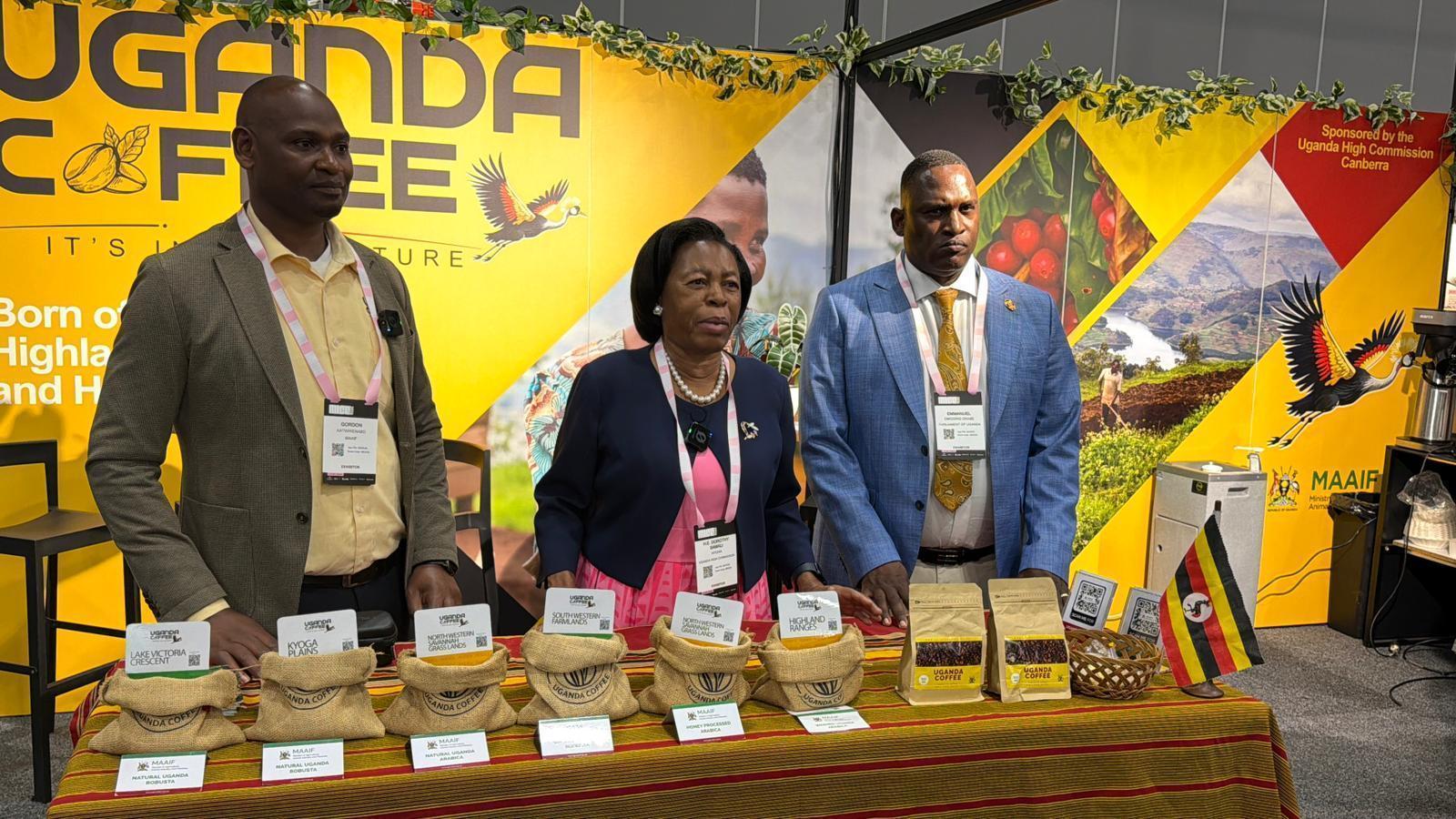
Africa-Press – Uganda. At the bustling Melbourne International Coffee Expo, the Southern Hemisphere’s largest dedicated coffee showcase, Uganda’s presence stood out—not just for the quality of its coffee, but for the powerful human story behind every bean.
In Uganda, coffee is more than a commodity. It is a livelihood.
In the highlands of Bugisu, farmers begin their day before sunrise, handpicking ripe coffee cherries. These beans then embark on a journey spanning thousands of kilometres—through exporters, roasters, and distributors—before finally reaching cups in cities like Melbourne, London, and Tokyo. Behind this journey lies survival, resilience, and hope.
More than 1.7 million Ugandan families rely on coffee, making it one of the country’s most vital economic lifelines. Smallholder farmers form the backbone of the sector, cultivating beans across diverse regions and helping Uganda maintain its position as one of the world’s leading coffee producers.
For years, Ugandan coffee has quietly powered global blends, particularly in markets like Australia, where its Robusta beans are prized for their strong body, crema, and consistency. Today, Uganda is stepping forward as a recognized origin, no longer content being hidden in the blend.
Global consumers increasingly seek traceability, authenticity, and ethical sourcing. Ugandan coffee delivers on all three, offering not just a rich, cocoa-toned cup profile, but a direct connection to the families and communities behind it.
At the expo, Dorothy Hyuha Samali, the head of mission in Australia emphasized that engaging with Ugandan coffee means engaging with the communities whose livelihoods depend on it. Uganda positions itself uniquely in the global coffee landscape, combining strong production capacity with high traceability and untapped value-chain opportunities—creating space for innovation and deeper partnerships.
Gordon Katwirenabo, Assistant Commissioner for Coffee Quality Assurance and Value Addition, highlighted ongoing investments in improved farming practices, better post-harvest handling, and consistent quality standards. These efforts aim to increase incomes for farmers while enhancing Uganda’s competitiveness on the global stage.
Historically, Uganda has exported primarily raw green coffee beans, leaving much of the value in roasting, branding, and retail to international markets. Today, the country is promoting origin-based roasting, branded coffee products, and direct trade partnerships—opening new pathways for growth in a still-expanding value chain.
Uganda’s participation at MICE 2026 signals more than trade-show presence; it represents a redefinition of value. Coffee here is not just an export; it is a source of income, a pillar of community, and a symbol of national identity. Increasingly, it also serves as a bridge connecting local livelihoods to global markets.
In an industry dominated by giants like Brazil and Vietnam, Uganda offers a rare combination: scale, story, and sustainability in a single ecosystem. For investors and buyers, the timing is critical—engaging now means entering a market before its full potential is realized.
Uganda has long been part of the global coffee story. Now, it is inviting the world to engage more directly, consciously, and meaningfully. Because every cup of Ugandan coffee is not just consumed—it is experienced.