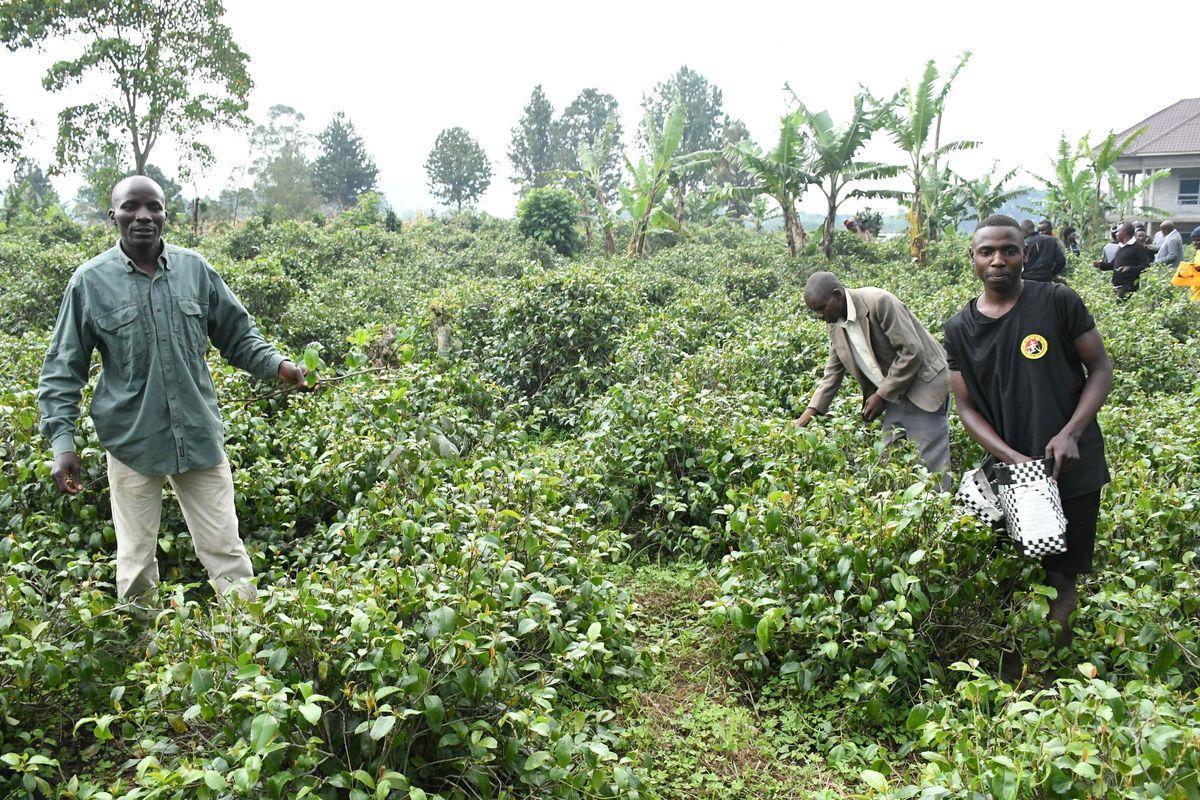
Africa-Press – Uganda. Mr Geoffrey Twesigomwe, a 57-year-old resident of Kibasi Village in Kibasi Town Council, Kabarole District, has spent the last 27 years cultivating khat (mairungi).
This enterprise, he proudly asserts, has not only proven profitable but has also significantly transformed his life and the well-being of his community.
The farmer has eight siblings but only one went to school due to the family’s financial constraints. He says financial constraints persisted into his adulthood.
In 1997, he ventured into tea cultivation and planted the crop on one acre of land. However, he was earning only Shs40,000 a month from the venture.
Mr Twesigomwe adds that he decided to start cultivating khat after seeing many families who were engaged in the activity thriving.
The farmer says he began by buying khat seedlings at Shs1.5m which he planted on a half-acre piece of land. He adds that at the time, the demand for khat was low.
“We used to sell a bundle (less than a quarter kilogramme) of khat leaves at Shs500. We measured it by hand and wrapped then in banana leaves. While the demand was low, it still outperformed the returns from tea cultivation,” he says.
Mr Twesigomwe says when he had just begun the venture, he would harvest 60 to 70 bundles of khat daily, which earned him Shs35,000 a day.
He then decided to intercrop tea and khat in a bid to make more money. However, in just one year, he fully transitioned from tea to khat cultivation. He says this was because in the early 2000s, customers from other parts of the country such as Mbarara, Kasese, Bundibugyo and even Kampala were flocking to the area looking for khat.
He adds that this motivated more people to embrace khat farming.
“There is no other crop that can match the profitability of khat. Consider this, a bundle of khat, weighing not even half a kilogramme, sells for Shs2,000. However, during the dry season, the price increases to Shs7,000. This increase is due to the fact that many gardens are facing drying conditions and overall production is reduced,” he says.
Mr Twesigomwe now grows khat on a four-acre piece of land and says he harvests between 400 and 500 bundles of fresh khat leaves daily.
He employs around 30 workers daily.
“Every worker receives a payment of Shs1,000 for each bundle they harvest daily. However, for those who gather khat with smaller green leaves, we provide a rate of Shs1,500 per bundle. As a result, I am able to generate a net income of Shs300,000 to Shs500,000 per day,” he says.
He adds: “We refrain from employing individuals under the age of 18 for this line of work as it is better suited for older individuals. By 11am, all tasks, including sales are wrapped up, allowing workers to return home and tend to their domestic responsibilities.”
The farmer also supplies khat seedlings to new farmers. The cost of khat seedlings for a one-acre garden is to Shs15 million. The seedlings are essentially khat stems, which are directly transplanted from one garden to another without nursery cultivation.
Mr Twesigomwe says khat cultivation doesn’t require one to use fertilisers. However, towards the dry season, it becomes essential to apply mulches and spray with chemicals. This precaution is due to the vulnerability of khat leaves to insect infestations during this period.
“When we apply these chemicals, we allow a span of three weeks without harvesting in the specific garden. This timeframe ensures that the chemicals sprayed on the khat leaves dissipate, either through rain or morning dew. Consequently, when harvesting resumes, all leaves are clean,” he says.
Benefits
Mr Twesigomwe says he is able to fend for his family which consists of nine children, some of whom are adopted. He says some of the children completed nursing school, three are in Senior Six, and others are progressing in their studies.
He adds that he has purchased multiple acres of land and constructed a residential building worth Shs200 million.
The farmer, however, says the Narcotic Drugs and Psychotropic Substances Control Bill 2023, poses a huge threat to the business.
“If enacted, this Bill could jeopardise our livelihoods. Our appeal to President Museveni is not to classify it as illegal,” he says.
Mr Twesigomwe hopes that khat can be recognised as a major cash crop.
Leaders speak out
Mr Fred Gaaki Rwitanga, the chairman of the Hakibaale Sub-county in Kabarole District, says khat has improved the livelihoods of his people, adding that if it is criminalised, it will leave many people poor.
He says he earns about Shs4 million in three months from khat.
“As local leaders, we strongly oppose any efforts to halt Khat cultivation by the government,” he says.
He says 90 percent of people in his sub-county have khat gardens.
The Kabarole District speaker, Mr Timothy Ruwheza, says a law banning the crop would be unfair to those who depend on it as a source of livelihood.
Mr Steven Kagwera, the Burahya County Member of Parliament, says President Museveni should critically study the Bill before making any decision.
“Our concern is if you stop people from cultivating khat, where will they go? Some people have relied entirely on growing khat for their livelihoods,” he says.
For More News And Analysis About Uganda Follow Africa-Press