Africa-Press – Uganda. President Museveni and his young brother, Gen Caleb Akandwanaho, aka Salim Saleh, who commanded the 1985 Katonga battle, have hailed the bravery of fallen and living heroes of the Bush War that brought the then National Resistance Army (NRA) guerillas into power 37 years ago.
The NRA has since transformed into the present-day Uganda Peoples Defence Forces (UPDF) with Gen Museveni as the Commander-in-Chief.
The Katonga battle, which took place at Katonga Bridge in the present-day Mpigi District, was the last stroke that broke the late President Tito Okello Lutwa’s government (1981 to 1985) as Mr Museveni’s guerrillas fought to capture power. The five-year NRA Bush War struggle ended after the rebels crossed River Katonga.
By doing this, NRA, according to its then commander Gen Museveni, intended to deny the logistics supplies and personnel reinforcement to then government forces in Masaka and western Uganda.
This particular battle, which several officers who participated in it since compared it to different bloody battles like the one of Waterloo against the famous Napoleon in 1814 in Europe, Kandahar in Afghanistan and Misrata in Libya, cemented President Museveni’s capture of power.
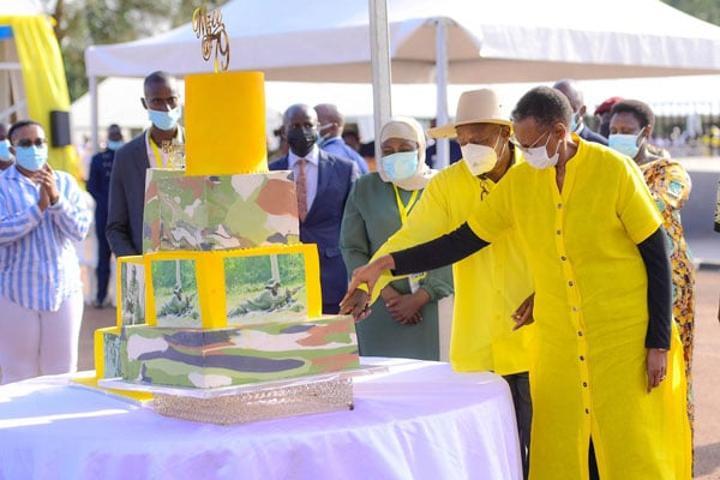
In remembrance of the fearless fighters who sacrificed their lives during this battle, the Office of the National Chairman (ONC) last Friday held a pre-birthday fete for President Museveni, who will clock 79 years tomorrow.
NRA kicks out Gen Okello’s government
“Today, we gather here to express our heartfelt gratitude and profound admiration for the brave men and women who served our nation with utmost valour. They sacrificed their comfort to protect the freedoms we hold here,” Ms Hadija Namyalo, the coordinator of ONC, said.
According to media reports, 17 government soldiers were killed and an additional 82 were captured in clashes.
Gen Saleh praises fearless heroes
Gen Saleh, who commanded the Katonga battle, in a speech read by Ms Desire Muhooza from Operation Wealth Creation (OWC) who also doubles as the national youth coordinator, asked the youth to emulate the braveness that was exhibited by the soldiers in 1985, to be resilient and productive.
“My dream is to see that all the Bazzukulu [grandchildren] have what they are engaged in and not be diverted by politics but first fight poverty because the President is leading us to fight it. We believe that if all of you embrace the message of wealth creation before we go into 2026 elections, the percentage will go below as far as 30 percent,” he said.
Gen Saleh is remembered for his fearless tactics and the braveness he showed while commanding the rebel army, which later led to the success of the battle.
Speaking at the fete, Mr Museveni recalled what he described as two very important events that occurred in the struggle; one in September 1972, and that of September 1985 at Katonga.
“I had turned 28 years of age when we attacked Mbarara from Tanzania in September 1972. Due to poor planning of the attack, many of the soldiers died, therefore, it was a bad September in our history and the situation was terrible. It was bloody and I will show Ugandans proof by sharing some of the pictures on social media that were taken during that gun war,” recalled the four-star General last Friday.
“I am glad that you agreed to unite my 79 years of life with ..the struggle of Katonga. I want to thank all those who fought in the Katonga battles and those who fought the battles before,” he added.
Mr Museveni, however, said the majority of the past wars could have been avoided.
“Ugandans should know that those wars were totally unnecessary. Since 1962, we could have had peaceful politics but some people didn’t want to. They decided to go for violence and sectarianism. They never wanted the elections to decide. We would have used peaceful means to solve our problems,” he said.
A series of wars started after the then Prime Minister Apollo Milton Obote overthrew the first president, Sir Edward Muteesa II in 1966 and declared himself president.
Five years later, Obote was also overthrown by his army commander Idi Amin, who was also overthrown in 1979.
Uganda later witnessed a number of presidents before Mr Museveni and his colleagues went to the bush and later captured power in 1986.
READ: War against Museveni: UNLA soldiers kill each other
Harmony
Mr Museveni used last Friday’s function to inform the country about the current stability of the country.
“Everybody should join the money economy by engaging in commercial agriculture, services, industries and ICT. That is the war we are on, to fight poverty from homesteads and the entire country. Those who have land, use it for farming, rearing animals and fishing. Venture in both small and big factories. Some of you are already in that sector of offering services such as, boda bodas, hotels, hospitality, musicians, and we shall give you more support.”
Mr Museveni added:“I was talking with Gen Saleh and he was telling me how they are engaged in maize growing but we are still importing animal feeds from outside, we have got enough maize here, so people should be involved in making animal feed here for chicken, pigs and cows, and fish.”
He said his government plans to transform Uganda into a modern society, which will only be achieved after every Ugandan joins the money economy and every young person should get the necessary education.
“There are two ways of creating a new society. One is by offering free education and the second way is to stop working only for the stomach. We want everybody to work for the stomach and also for the pocket. This is how we shall get a modern society. We don’t want a peasant to produce another peasant. That is very bad. Therefore, all of you who are here, you should know that this is our plan for the future,” he said.
Mr Museveni also hailed Ms Namyalo who also doubles as his senior advisor on political affairs and his team leader at ONC, for organising the function, which linked his 79 years of life with the Katonga struggle.
For More News And Analysis About Uganda Follow Africa-Press