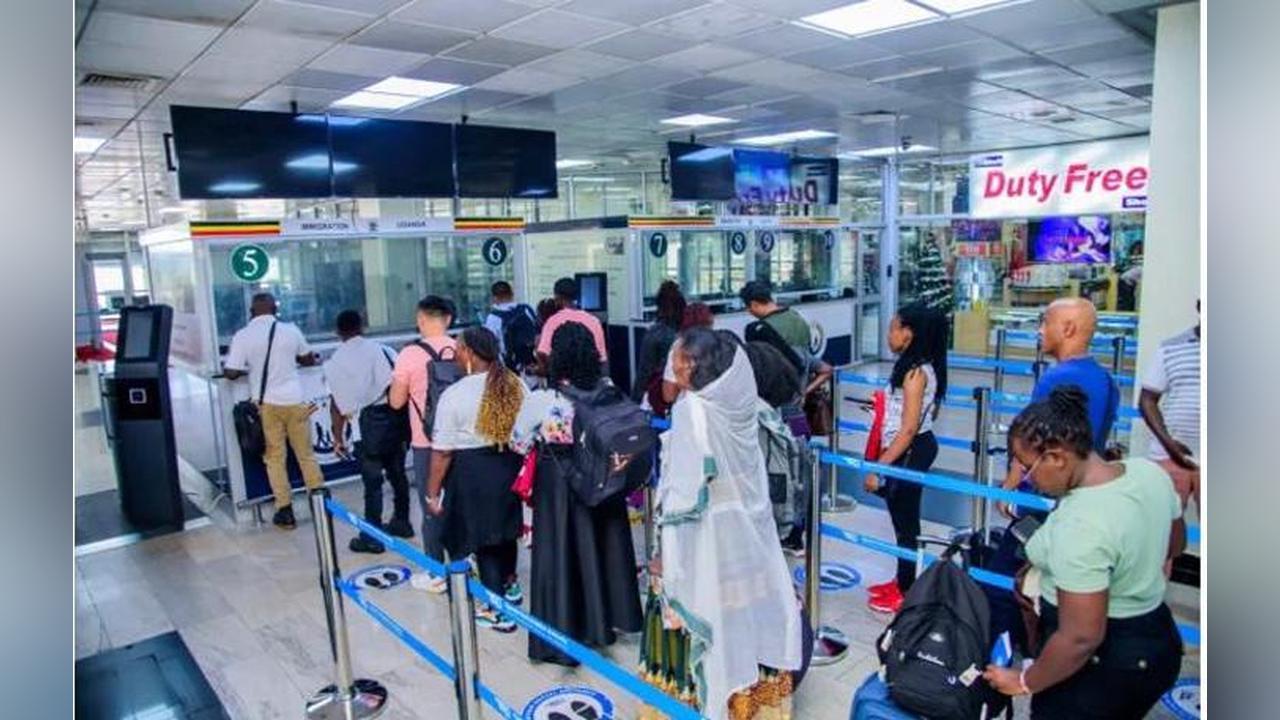
Africa-Press – Uganda. Passenger traffic at Entebbe International Airport posted a significant increase in February 2026, reflecting renewed momentum in Uganda’s aviation sector and strengthening economic activity.
According to data from the Uganda Civil Aviation Authority (UCAA), the airport handled 189,575 international passengers during the month, comprising 90,007 arrivals and 99,568 departures. This translates into an average daily movement of approximately 6,770 passengers, highlighting robust travel demand across key routes.
The February performance represents a sharp increase of 39,387 passengers compared to 150,188 recorded in January 2026, signaling strong month-on-month growth. On a year-on-year basis, traffic expanded by 30,072 passengers from the 159,503 recorded in February 2025, when arrivals stood at 73,524 and departures at 85,979.
The sustained growth trajectory underscores rising confidence in Uganda’s air transport sector, supported by increased tourism arrivals, business travel, and improved regional connectivity. Entebbe continues to play a strategic role as Uganda’s primary international gateway, facilitating trade, investment, and cross-border mobility.
On the cargo front, the airport also recorded notable growth, further reinforcing the positive outlook for aviation-linked trade. Total cargo volumes in February 2026 reached 4,498 metric tonnes, up from 3,982 metric tonnes in January 2026. Exports accounted for 2,955 metric tonnes, while imports totaled 1,543 metric tonnes.
This performance also reflects an improvement compared to February 2025, when total cargo volumes stood at 4,546 metric tonnes, comprising 3,157 metric tonnes of exports and 1,389 metric tonnes of imports. The sustained export volumes highlight the resilience of Uganda’s export sectors, particularly high-value perishables such as fresh produce and horticultural products that rely on air freight.
Industry analysts note that the combined growth in passenger and cargo traffic signals a broader recovery in economic activity, with aviation acting as a key enabler of trade and tourism.
However, short-term risks remain. The partial closure of sections of Middle Eastern airspace from February 28, 2026 has disrupted flight operations for several carriers serving Entebbe. With only a phased reopening underway, airlines are expected to adjust schedules and capacity, which could weigh on traffic volumes in March 2026.
Despite these challenges, the medium-term outlook remains positive, supported by growing demand for air travel, expanding export markets, and continued investments in airport infrastructure aimed at enhancing capacity and efficiency.